Chapter 15 / 19
For Women: 'Awrah, Permission to Travel and Menstruation
Covering the 'awrah in ihram, in tawaf and in sa'i; the husband's permission, travelling with a mahram or trustworthy women, and the woman in iddah; then the rulings on menstruation that matter most in Hajj, what you may do during your period, what to do if it comes before Tawaf al-Ifadah, and the use of pills to delay it.
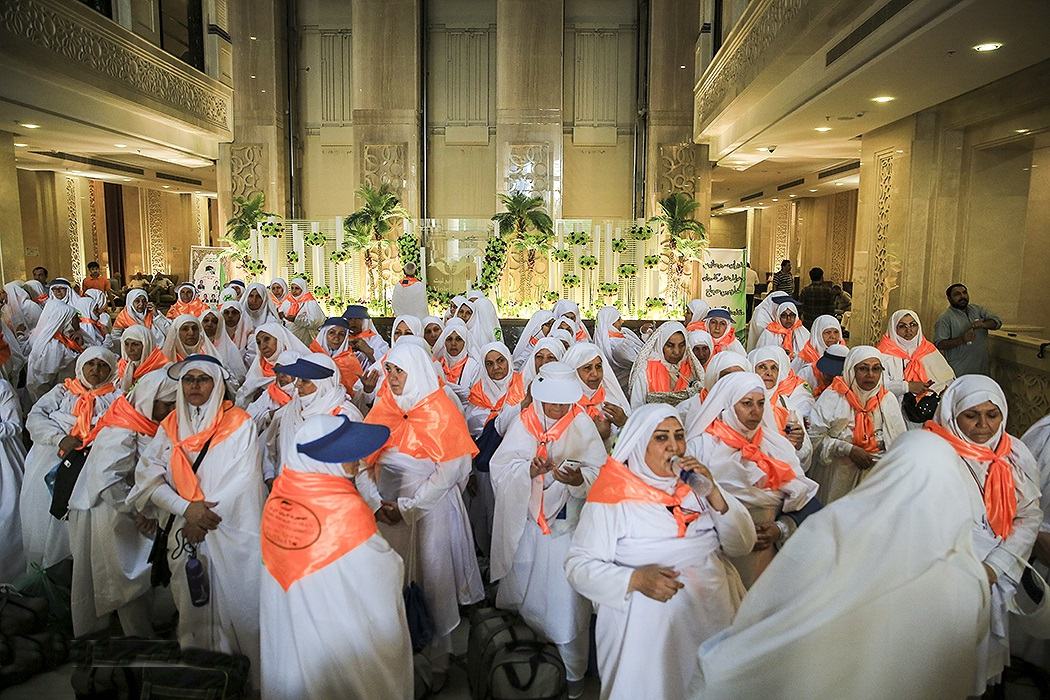
The 'awrah of a woman
In the Shafi'i school, a woman's 'awrah in prayer is her whole body except her face and her hands (front and back). The covering must be thick enough to hide the colour of the skin.
The course describes complete covering as:
- a headscarf that is long, not see-through, and covers the chest;
- a long, loose top;
- sleeves down to the wrists;
- a skirt or trousers down to the ankles;
- socks that do not show the skin or nails;
- if wearing heeled shoes, ones that do not make a noise.
In tawaf
Covering the 'awrah is a condition of tawaf. If it is uncovered deliberately, the round is void. Before tawaf, check:
- under the chin;
- the wrists, especially when raising the hand to the Black Stone;
- hair at the forehead, and around the ears, take care if you wear glasses;
- socks: thick ones.
When gesturing to the Black Stone, keep your hand inside your telekung, or wear gloves outside ihram. (In ihram gloves are not allowed, keep the hand inside the cloth.)
In sa'i
Covering the 'awrah is not a condition of sa'i, but exposing it in front of men who are not mahram is still sinful. Watch out for:
- the hair being cut at Marwah in a public place;
- thin socks.
Among other women, in the tents and in hotel rooms
The normal rules apply. In hotel rooms, bathrooms and the tents of Arafah and Mina, among women only, the usual 'awrah between women applies. With your husband or mahram in ihram, the usual rules apply too, but remember the prohibitions of ihram concerning intimacy.
A note for men
A man's 'awrah in prayer is from the navel to the knee. In ihram, when you visit a women's hotel room you must be fully covered with your ihram cloths. Do not enter rooms of the opposite sex, even to meet your own spouse; meet outside the room.
Permission and travelling companions
The husband's permission
A wife must obtain her husband's permission before performing Hajj, whether it is the obligatory Hajj, a vowed Hajj or a voluntary one. The course stresses:
- permission is the husband's right;
- it is needed even if the husband is a sinful man (fasiq);
- a woman in the iddah of a revocable divorce (talaq raj'i), three cycles, still needs her (former) husband's permission;
- if a wife enters ihram without her husband's knowledge, he has the right to tell her to come out of ihram (by the tahallul of ihsar, at her own expense).
An unmarried woman needs the permission of her guardian (wali).
If a husband permits his wife to go without him, the course lists these conditions: she has a mahram with her (or trustworthy women, see below); she is confident the journey is safe; her expenses are her own, not taken from her husband's money; and her husband does not need her while she is away.
A mahram or trustworthy women
- A woman should travel with her husband or a mahram.
- For the obligatory Hajj and Umrah, the Shafi'i school, along with the Maliki school and many early scholars, permits her to go with one or more trustworthy women (thiqah). Imam al-Nawawi wrote that a woman performing the obligatory Hajj must be with her husband, a mahram, or a group of trustworthy women.
- A weaker view in the Shafi'i school allows travel without them, on condition that there is no fear of fitnah, her safety is assured, she is with trustworthy women, and it is not for a self-imposed vow.
A woman whose husband dies
- A widow's iddah is four months and ten days. A woman whose husband died before she left, even if he had given permission, may not set out for Hajj during her iddah.
- If her husband dies while she is already in the Holy Land, she may continue her Hajj and Umrah. She should observe the mourning (ihdad) as far as possible: avoid going out of the hotel except for need, complete her rites, pray in the Haram or follow the programmes arranged for pilgrims, and stay with trustworthy women. During ihdad she avoids bright, decorative clothing, gold and jewellery, perfume, kohl (except for need), eye-catching make-up, henna and hair oil for adornment.
Menstruation and other bleeding
The kinds of blood
| Kind | What it is |
|---|---|
| Haid (menstruation) | Natural blood from the womb of a healthy, mature woman at regular times |
| Istihadah | Bleeding outside the possible pattern of haid, less than 24 hours, beyond the maximum of haid or nifas, or within 15 days of the end of a previous haid |
| Nifas | Post-natal bleeding after childbirth |
| Wiladah | Blood accompanying the birth itself |
| Fasad | Blood that is neither haid nor nifas, for example, in some views, during pregnancy |
Basic facts about haid (Shafi'i school)
- Earliest age: nine lunar (qamariyah) years, about 8 years, 8 months and 21 days in the Gregorian calendar. Blood before that age is istihadah or illness.
- Minimum: one day and night (24 hours). Maximum: fifteen days and nights. Usual: three, four, five, six or seven days and nights.
- Minimum purity between two periods: fifteen days.
- Colours that count as haid within its time: black-red, deep red, brown, yellow, and turbid (cloudy, like muddy water).
Interrupted bleeding (fatrah al-naqa')
Sometimes bleeding stops for a day or two and then returns within the fifteen days. In the stronger Shafi'i view, the clean days in between are also counted as haid. A second view (talfiq) counts the bleeding days as haid and the clean days as purity, on conditions.
Bleeding beyond fifteen days
If bleeding continues past the maximum, the extra is istihadah: a woman counts her haid according to her usual pattern, or by the colour of the blood if she can tell it apart. A woman with istihadah prays, fasts and may perform tawaf, with special care over cleanliness (below). Consult your religious guide for your particular case.
After menopause
In the Shafi'i school menopause follows the woman's family pattern (often cited as around 62 years), and blood after it may still be counted as haid. The course notes that if a woman who had stopped menstruating for six months or more bleeds and cannot otherwise complete Tawaf al-Ifadah before her return home or to Madinah, she may follow the Maliki, Hanafi and Hanbali view and treat it as istihadah.
Wind, discharge and moisture
- Wind from the front passage breaks wudu (Shafi'i). If it happens constantly, she is treated as someone with continuous impurity (da'im al-hadas). Air that stays inside, or sounds from muscle movement, do not break wudu.
- White discharge (keputihan) is impure and breaks wudu. Clean it before wudu. If it is continuous, the rules of continuous impurity apply.
- Ordinary internal moisture of the vagina is not impure and does not break wudu.
Continuous impurity: istihadah, constant discharge, incontinence
- Clean the private parts of impurity.
- Use a sanitary pad at the opening.
- Take wudu after the prayer time has begun.
- One wudu is for one obligatory prayer or one obligatory tawaf, plus any number of voluntary prayers and voluntary tawaf.
This follows the Prophet's ﷺ instruction to Fatimah bint Abi Hubaysh. (The Hanbali school also allows such a woman to combine prayers; the Shafi'i school does not.) Tampons are not recommended, as they can be harmful.
What you may and may not do during your period
The Prophet ﷺ told 'A'ishah when her period came in Hajj: "Do everything the pilgrim does, except tawaf around the House." (Reported by al-Bukhari and Muslim.)
| You may | You may not |
|---|---|
| Make the intention of ihram | Perform tawaf of any kind, pillar, farewell or voluntary |
| Take the ritual bath for ihram | Pray, obligatory, voluntary or make-up (no make-up is owed afterwards) |
| Say the talbiah, tasbih, tahmid, takbir, and adhkar | Fast (Ramadan fasts are made up later) |
| Perform sa'i, when it follows a valid tawaf | Stay or sit in the mosque (passing through is allowed) |
| Perform wuquf, the nights at Muzdalifah and Mina | Touch or carry the mushaf, though books of fiqh, tafsir and translations are fine, and a mushaf inside a bag of other items may be carried |
| Stone all three Jamarat | Recite the Qur'an as recitation (in the Shafi'i, Hanbali and Hanafi schools), though verses used as dhikr, such as Ayat al-Kursi and the last three surahs, may be said |
| Make du'a and dhikr anywhere | Have intercourse, or intimacy between the navel and the knee |
If your period comes before Tawaf al-Ifadah
This is the situation women fear most. The course sets out three options:
- Ask Tabung Haji to postpone your flight home, so that you can wait until you are clean and perform the tawaf.
- Go home without completing Hajj, and perform the tahallul of ihsar to come out of ihram. Your Hajj is not complete: you must return in a future year to complete it.
- Follow the Hanafi school, which allows a menstruating woman to perform Tawaf al-Ifadah when she has no other option. Her Hajj is complete, but she must pay a dam of one camel and ask Allah's forgiveness for entering the mosque in a state of major impurity.
Discuss these with your religious guide and the TH officers as soon as your period begins, do not wait until the last day.
A Tamattu' pilgrim whose period stops her Umrah
If your period comes before the tawaf of your Umrah and you fear missing Hajj:
- First consider whether fatrah al-naqa' or yellowish discharge after your usual days might apply (only if you must leave soon).
- If not, you may change your intention from Tamattu' to Qiran before leaving for Arafah, as explained in Chapter 5. A Qiran dam is then due. If you have already paid the Tamattu' dam, tell the TH officer that you have changed to Qiran.
Tawaf al-Wada'
A woman whose period has not ended by the time she leaves Makkah is excused from Tawaf al-Wada': there is no dam and no sin.
Pills to delay your period
The course's advice:
- Not encouraged for most women, every rite of Hajj except tawaf can be performed during menstruation.
- Permitted if needed, on conditions: seek advice from a trustworthy specialist; the medicine must not harm you; and start getting used to it at least three months before you travel.
From experience, the pills sometimes work, sometimes cause heavier bleeding, and sometimes cause irregular spotting. Practical advice:
- If you have no problems with your periods, do not take any pills.
- If you do have problems, raise them at your health screening.
- See a doctor at least three months before departure.
- Some women need treatment, hormonal pills or injections, or minor or major surgery, before going.
- Follow the instructions for your medicine exactly. Pills that stop bleeding and pills that regulate the cycle work differently.
- Do not copy your friends, every body is different.
- If there is no alternative, hormonal pills may be used for a limited time after medical advice, but have a back-up plan in case they do not work.
- See a doctor about excessive discharge or discomfort, and have prolapse or incontinence treated before you travel.