Chapter 1
Hajj and Umrah: Meaning, Obligation and Reward
What Hajj and Umrah are, who must perform them, how Hajj came to us from Prophet Ibrahim (peace be upon him) and the Farewell Pilgrimage, and what a mabrur, an accepted, Hajj looks like.
What Hajj and Umrah are
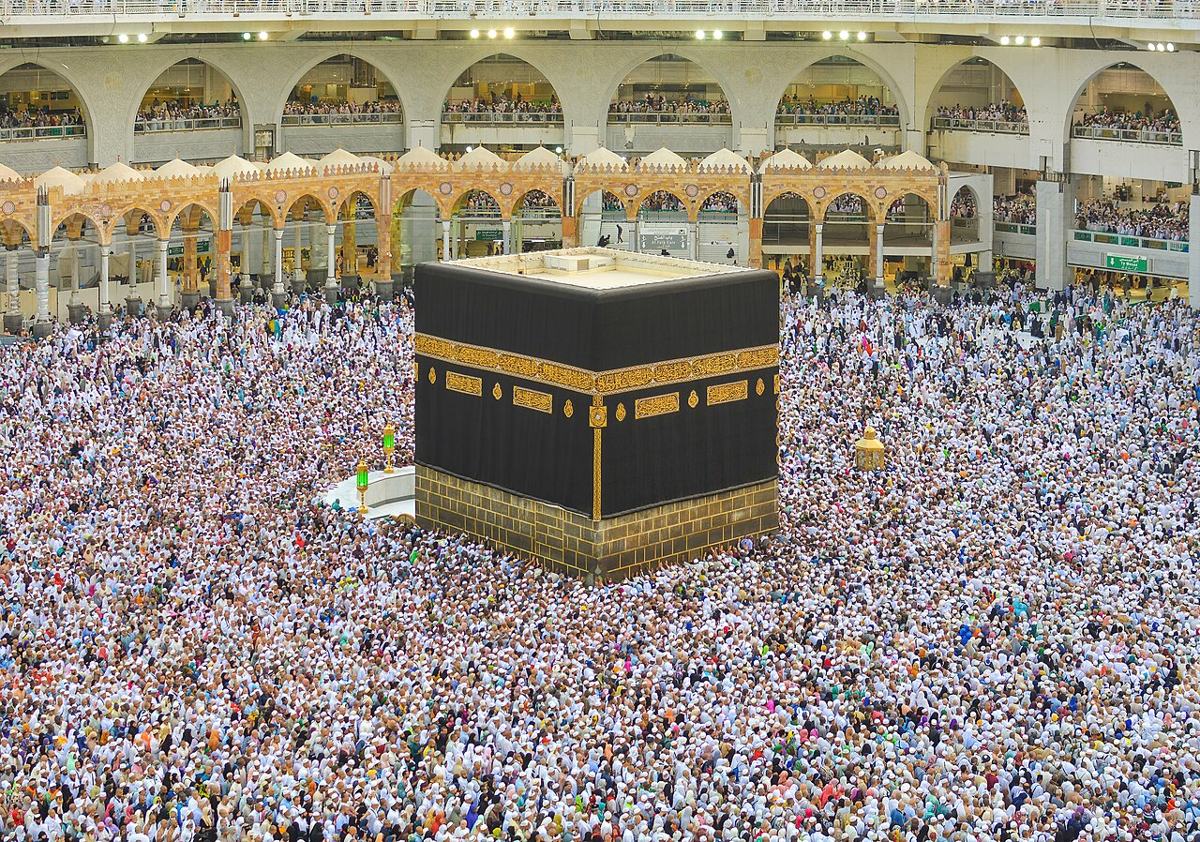
Hajj is travelling to the Ka'bah (the House of Allah, Baitullah) in Makkah during the months of Hajj to perform a set of acts of worship in a particular way and at particular times. Its central day is the 9th of Dhul Hijjah, the Day of Arafah, and it is the fifth pillar of Islam.
Umrah is visiting the Ka'bah to perform a smaller set of acts, ihram, tawaf, sa'i and cutting the hair, and, unlike Hajj, it can be performed at any time of the year. It is sometimes called the "lesser pilgrimage".
In the Shafi'i school followed in Malaysia, both are obligatory once in a lifetime for every Muslim who is able. Anything more than the first Hajj or first Umrah is a voluntary (sunat) act of worship.
وَلِلَّهِ عَلَى النَّاسِ حِجُّ الْبَيْتِ مَنِ اسْتَطَاعَ إِلَيْهِ سَبِيلًا ۚ وَمَن كَفَرَ فَإِنَّ اللَّهَ غَنِيٌّ عَنِ الْعَالَمِينَ
Reading Wa lillāhi ʿalan-nāsi ḥijjul-baiti manistaṭāʿa ilaihi sabīlā, wa man kafara fa innallāha ghaniyyun ʿanil-ʿālamīn.
Meaning Pilgrimage to the House is a duty owed to Allah by people who are able to make their way there. And whoever disbelieves, Allah has no need of anyone in all the worlds.
Surah Ali 'Imran 3:97
وَأَتِمُّوا الْحَجَّ وَالْعُمْرَةَ لِلَّهِ
Reading Wa atimmul-ḥajja wal-ʿumrata lillāh.
Meaning And complete the Hajj and the Umrah for Allah.
Surah al-Baqarah 2:196
The call of Ibrahim and the talbiah
When Prophet Ibrahim (peace be upon him) and his son Ismail had raised the foundations of the Ka'bah, Allah commanded Ibrahim to call mankind to pilgrimage (Surah al-Hajj 22:27). Every pilgrim who says the talbiah is answering that call: "Here I am, O Allah, here I am."
The course teaches the talbiah as a conversation. Allah calls people to His House; the pilgrim answers. Scholars mention that a pilgrim whose intention is sincere and whose provisions and money are halal is answered with welcome and good news, while one whose money is haram is told that his call is not accepted. The lesson is simple and serious: purify your intention and your money before you leave home.
لَبَّيْكَ اللّٰهُمَّ لَبَّيْكَ، لَبَّيْكَ لَا شَرِيكَ لَكَ لَبَّيْكَ، إِنَّ الْحَمْدَ وَالنِّعْمَةَ لَكَ وَالْمُلْكَ، لَا شَرِيكَ لَكَ
Reading Labbaik Allāhumma labbaik, labbaika lā sharīka laka labbaik, innal-ḥamda wan-niʿmata laka wal-mulk, lā sharīka lak.
Meaning Here I am, O Allah, here I am. Here I am, You have no partner, here I am. All praise, all blessings and all sovereignty belong to You. You have no partner.
A short history of Hajj in Islam
- Hajj was made obligatory in the 5th year after the Hijrah, as the course teaches.
- In 6 AH the Prophet ﷺ set out for Umrah with about 1,500 Companions but was stopped at Hudaybiyah, where the famous treaty was signed.
- In 7 AH they returned and performed the make-up Umrah ('Umrat al-Qada').
- In 8 AH, in Ramadan, Makkah was opened to the Muslims and the idols around the Ka'bah were removed.
- In 10 AH the Prophet ﷺ announced that he would perform Hajj. He left Madinah on the 25th of Dhul Qa'dah 10 AH with his wives, followed by 120,000 Companions. This Hajj is known as Hajj al-Islam, Hajj al-Akbar and the Farewell Pilgrimage (Hajj al-Wada'). It is the model every pilgrim follows, and its sermon at Arafah is one of the most important speeches in Islamic history.
Who must perform Hajj: the conditions of obligation
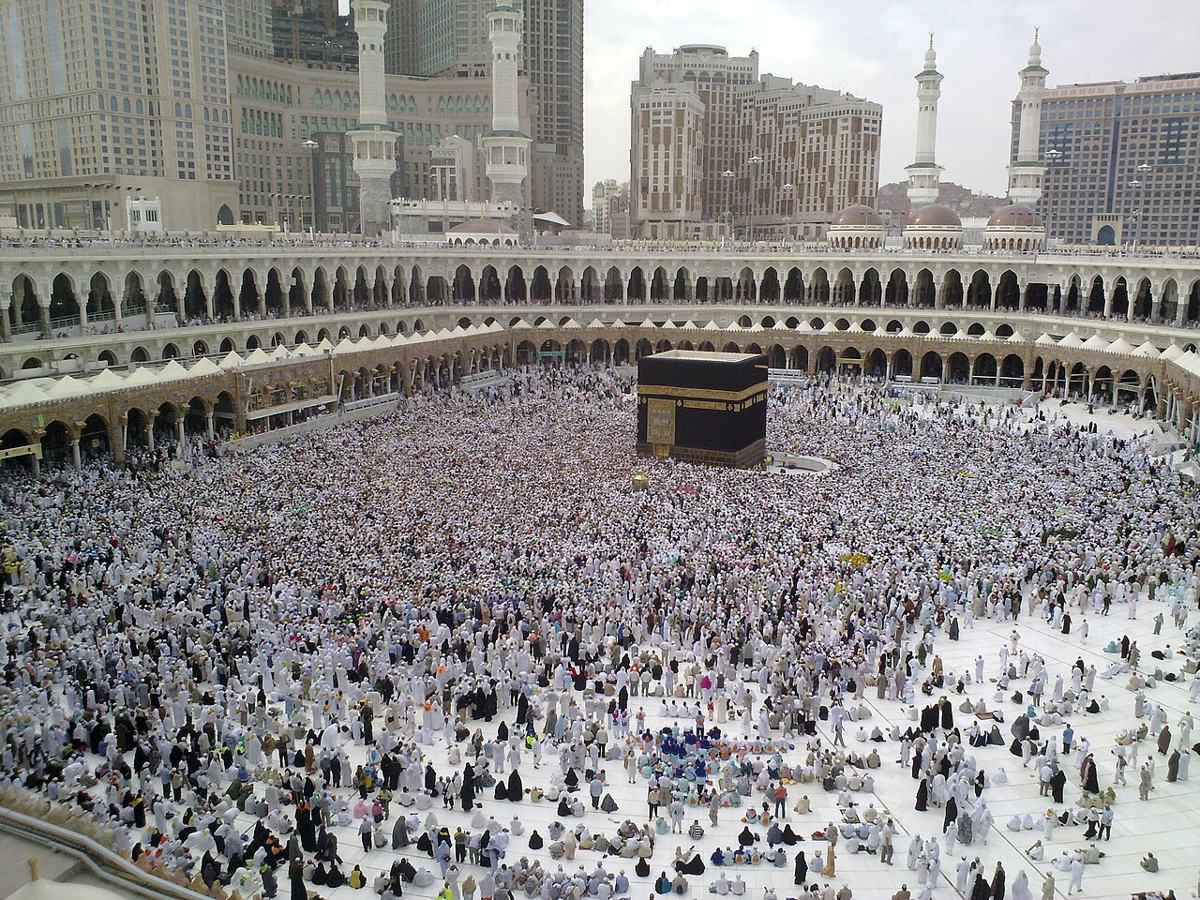
Hajj and Umrah become obligatory on a person who meets all of these conditions:
| Condition | What it means |
|---|---|
| Islam | It is not required of a non-Muslim. |
| Maturity (baligh) | It is not obligatory on a child. A child's Hajj is valid and rewarded, but he or she must perform Hajj again after reaching maturity. |
| Sound mind | It is not obligatory on someone who is not of sound mind. |
| Freedom | Historically, it was not obligatory on a slave. |
| Ability (istita'ah) | Having the means and the capacity to get there and back. |
Ability has two forms.
1. Able in person: the pilgrim can go themselves. This requires:
- The fare for the journey there and back.
- Provisions and expenses for the journey, and enough left for the family they support at home while they are away.
- Transport there and back.
- A journey that is reasonably safe, there and back.
- Physical health that allows the journey.
- Enough time to get there and complete the rites.
2. Able through someone else (badal haji), a person who has the money but can never go in person, because of an illness with no hope of recovery or great old age, must arrange for someone to perform Hajj on their behalf. The same applies to a person who died after Hajj had become obligatory on them: it is paid for from their estate. The person performing badal haji must already have performed their own obligatory Hajj.
Extra conditions for women. A woman needs her husband's permission (or her guardian's, if unmarried), and she must travel with her husband, a mahram, or, for the obligatory Hajj, according to the Shafi'i school, a group of trustworthy women. See Chapter 15 for the details.
The reward of Hajj
The course lists the virtues of Hajj:
- You gain the status of "guest of Allah" (dhuyuf al-Rahman).
- You gain a great reward.
- You are saved from dying as a Jew or a Christian, the warning given to one who was able to perform Hajj and did not.
- You receive the intercession of the Prophet's ﷺ prayer for forgiveness for pilgrims.
- You become clean like a newborn baby.
- It is among the best forms of jihad.
- An accepted Hajj has no reward except Paradise.
الْحَجُّ الْمَبْرُورُ لَيْسَ لَهُ جَزَاءٌ إِلَّا الْجَنَّةُ
Reading Al-ḥajjul-mabrūru laisa lahu jazā'un illal-jannah.
Meaning An accepted (mabrur) Hajj has no reward other than Paradise.
Hadith reported by al-Bukhari and Muslim
مَنْ حَجَّ لِلّٰهِ فَلَمْ يَرْفُثْ وَلَمْ يَفْسُقْ رَجَعَ كَيَوْمِ وَلَدَتْهُ أُمُّهُ
Reading Man ḥajja lillāhi fa lam yarfuth wa lam yafsuq rajaʿa ka yawmi waladat-hu ummuh.
Meaning Whoever performs Hajj for Allah, avoiding indecency and wrongdoing, returns like the day his mother gave birth to him.
Hadith reported by al-Bukhari and Muslim
Benefits in this world
- Muslims from all over the world meet one another.
- Trade and the economy benefit.
- It shows the equality of all Muslims.
Benefits for the Hereafter
- Training in devoting yourself to worship.
- Training in building a Muslim personality.
- Training to be ready to leave this world.
- The reward for looking at the Ka'bah.
- Training yourself to do every deed sincerely for Allah alone.
- Being praised by Allah before the angels.
- Attaining a mabrur Hajj.
What makes a Hajj mabrur
The course grades Hajj into three levels:
| Level | Description |
|---|---|
| Haji mabrur | The highest and most excellent Hajj: all its sins are forgiven, the pilgrim keeps up worship until the end of life, and Paradise is promised. |
| Haji diterima (maqbul) | A valid Hajj, with the pilgrim's sins forgiven. |
| Haji mardud | A Hajj that is not accepted, because of shortcomings in its conditions and pillars, or for other reasons. |
How do you aim for a mabrur Hajj? The course divides it into before, during and after.
Before you go
- Make your intention purely for Allah, not for a title, photographs or praise.
- Learn the rites properly (ilmu manasik) and bring enough money, from halal sources, after paying any zakat you owe.
- Make sure you are already performing the other pillars of Islam well, especially the five daily prayers.
During Hajj
- Perform every pillar (rukun) and obligation (wajib) correctly.
- Respect the prohibitions of ihram, and pay any dam (penalty) you incur.
- Avoid rafath (indecent talk), fusuq (sin) and jidal (arguing), Surah al-Baqarah 2:197.
After you return
- Stay away from sin and wrongdoing.
- Do more good deeds, so that your faith keeps growing.
- Keep improving your character and behaviour, steadily, for life.
اللّٰهُمَّ اجْعَلْهُ حَجًّا مَبْرُورًا، وَسَعْيًا مَشْكُورًا، وَذَنْبًا مَغْفُورًا، وَعَمَلًا صَالِحًا مَقْبُولًا، وَتِجَارَةً لَنْ تَبُورَ
Reading Allāhummajʿalhu ḥajjan mabrūrā, wa saʿyan mashkūrā, wa dhanban maghfūrā, wa ʿamalan ṣāliḥan maqbūlā, wa tijāratan lan tabūr.
Meaning O Allah, make it an accepted Hajj, an effort that is appreciated, sins that are forgiven, righteous deeds that are accepted, and a trade that never fails.
How this guide is organised
The chapters follow the order in which you will need them:
- 1 · Meaning, obligation and reward, this chapter.
- 2 · Hajj at a glance, the whole journey in one picture.
- 3 · Preparing your heart and your affairs.
- 4 · The Holy Land, Makkah, the Ka'bah and the sites of Hajj.
- 5 · Pillars, obligations and the three ways of performing Hajj.
- 6–10 · The rites themselves: ihram, its prohibitions and dam, tawaf, sa'i and cutting the hair and tahallul.
- 11–13 · The days of Hajj: Arafah, Muzdalifah and Mina and the Jamarat.
- 14 · Umrah step by step.
- 15–17 · Rulings for women, purification and prayer, and health and safety.
- 18 · The farewell tawaf and visiting Madinah.
- 19 · Planning and practicalities.
Chapter 2
Hajj at a Glance: The Whole Journey, Day by Day
Before learning each rite in detail, see the whole journey in one place: where you go, on which day, and what you do there, from leaving home to returning as a haji.
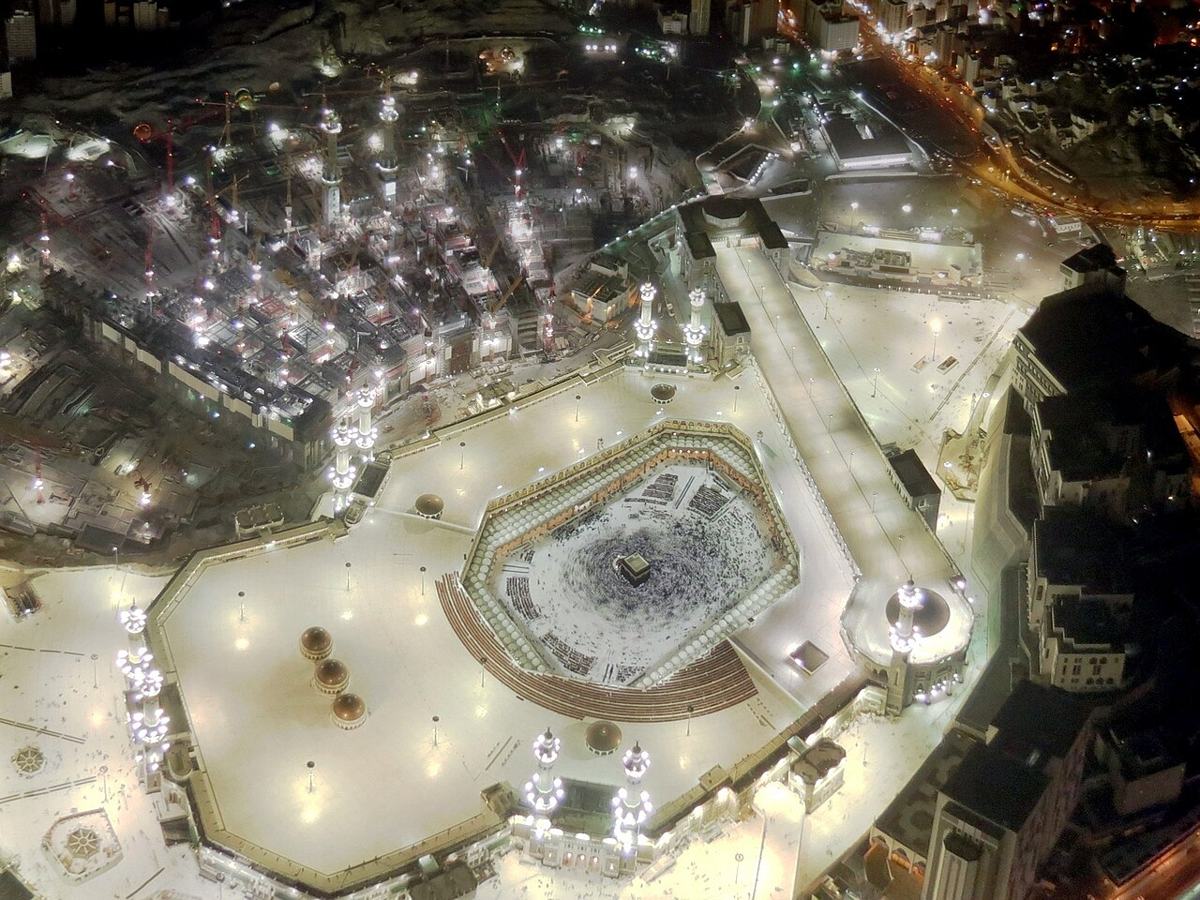
The journey in one picture
Hajj takes place over five or six days, from the 8th to the 12th or 13th of Dhul Hijjah, the twelfth month of the Islamic calendar. Most pilgrims, however, spend between four and seven weeks away from home, because flights arrive in Saudi Arabia over several weeks before Hajj and leave over several weeks after it.
A Malaysian pilgrim's journey usually follows one of two routes:
- Makkah first: fly to Jeddah, put on ihram on the plane before passing the miqat of Qarn al-Manazil, go straight to Makkah and perform Umrah. Spend the weeks before Hajj in Makkah, perform Hajj, then go to Madinah for around eight days before flying home from Madinah.
- Madinah first: fly to Madinah and spend about eight days there, then put on ihram at the miqat of Dhul Hulayfah (Bir Ali) on the way to Makkah. After Hajj, fly home from Jeddah.

The days of Hajj
Before the 8th: Umrah and waiting in Makkah
Most Malaysian pilgrims perform Haji Tamattu' (see Chapter 5): they arrive in ihram for Umrah, complete it, and come out of ihram. Then they live normally in Makkah, praying in Masjid al-Haram, performing voluntary tawaf, reading the Qur'an, and resting, until the days of Hajj. Use this time well, but save your strength: the hardest days are still ahead.
8th Dhul Hijjah, Yawm al-Tarwiyah
- Bathe, put on ihram clothing and make the intention (niyyah) for Hajj at your building in Makkah (pilgrims doing Ifrad or Qiran are already in ihram).
- Begin the talbiah and keep repeating it.
- Travel out of Makkah. The Sunnah is to go to Mina and spend the night there, then go to Arafah on the morning of the 9th. Many national Hajj missions, including Tabung Haji, take pilgrims directly to Arafah on the 8th to avoid the crush of millions of people moving on one morning. Both are valid; follow your group.
9th Dhul Hijjah, the Day of Arafah
- From midday (when the sun passes its zenith, zawal), you are performing wuquf, being present in Arafah. This is the most important pillar of Hajj: "Hajj is Arafah".
- Pray Zuhr and Asr together at Zuhr time (jamak taqdim), in full, four rak'ahs each, not shortened, as the course teaches for Arafah and Mina.
- Spend the afternoon in du'a, dhikr, istighfar, Qur'an and talbiah until sunset.
- After sunset, leave Arafah for Muzdalifah.
Night of the 10th, Muzdalifah
- Arrive in Muzdalifah. Pray Maghrib and Isha together, as your group's religious guide leads.
- Be present in Muzdalifah for at least a moment after midnight, this is the obligatory mabit.
- Collect pebbles for the stoning.
- Move on to Mina, before or after Fajr according to your group's schedule.
10th Dhul Hijjah, the Day of Sacrifice (Eid al-Adha)
This is the busiest day. Four acts can be done today, and the order below is the Sunnah order:
- Stone Jamrah al-'Aqabah (the large Jamrah) with seven pebbles.
- Slaughter the sacrificial animal (hadyu or dam), if you owe one, your Hajj body usually arranges this for you.
- Shave or cut your hair.
- Tawaf al-Ifadah (the pillar tawaf of Hajj) in Makkah, followed by sa'i if you have not already done it.
After any two of stoning, cutting the hair and tawaf (with its sa'i), you reach the first tahallul and may change into normal clothes. After all three, you reach the second tahallul and are completely out of ihram. See Chapter 10.
11th, 12th and 13th, the Days of Tashriq in Mina
- Spend the nights in Mina, more than half of each night, according to the view followed by Tabung Haji.
- Each day stone all three Jamarat in order, the small (Sughra), the middle (Wusta) and the large (Kubra or 'Aqabah), seven pebbles at each. The best time is after midday (zawal); follow the time assigned to your group.
- You may leave Mina on the 12th, before sunset, after stoning (Nafar Awwal), or stay the night of the 13th and stone on the 13th too (Nafar Thani).
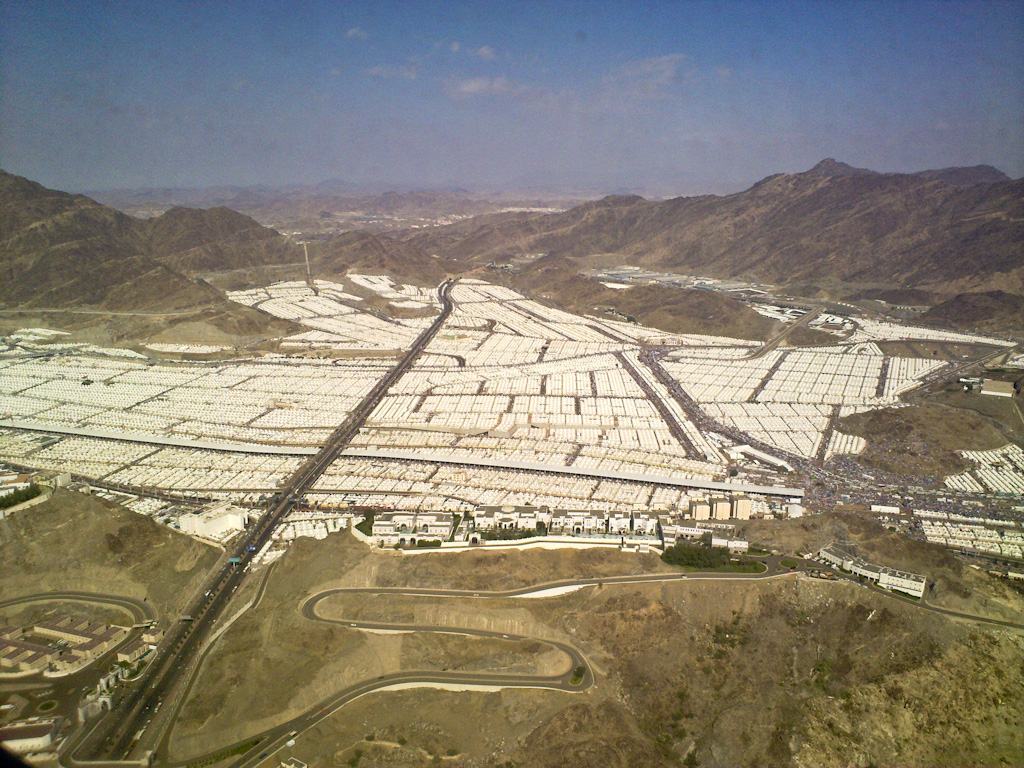
After Hajj
- If you have not yet performed Tawaf al-Ifadah and sa'i, do so as soon as you can.
- Rest, pray in Masjid al-Haram, and perform voluntary Umrah or tawaf if you are able.
- Before leaving Makkah for the last time, perform Tawaf al-Wada', the farewell tawaf.
- Visit Madinah, pray in the Prophet's Mosque and send salam to the Prophet ﷺ.
The difference between a pillar, an obligation and a sunnah
You will see these three words in every chapter. They decide what happens if something is missed:
| Type | If you miss it… |
|---|---|
| Rukun (pillar) | Your Hajj is not complete and you remain in ihram until it is done. Nothing can replace it, not even a dam. Missing the wuquf at Arafah means you have missed Hajj that year. |
| Wajib (obligation) | Your Hajj is still valid, but you must pay a dam (penalty), and you are sinful if you left it deliberately without a valid excuse. |
| Sunat (sunnah) | No penalty, but you lose its reward. |
Six things to remember
- Hajj is Arafah. Whatever happens, be inside the boundaries of Arafah at some point between midday on the 9th and dawn on the 10th.
- Keep your ihram clean. From the moment you make your intention, the prohibitions apply. Learn them before you travel (Chapter 7).
- Count with certainty. Tawaf is seven rounds and sa'i seven laps. If you are unsure, take the lower number and add a round.
- Mind the clock. The days of Hajj run from sunset to sunset. The best time to stone on the Days of Tashriq is after midday; follow your group's assigned time.
- Stay with your group. Know your maktab (office) number, tent number and the name of your building. Carry your ID card and wristband at all times.
- Be patient. You will meet heat, crowds, queues and fatigue. Patience is part of the worship.
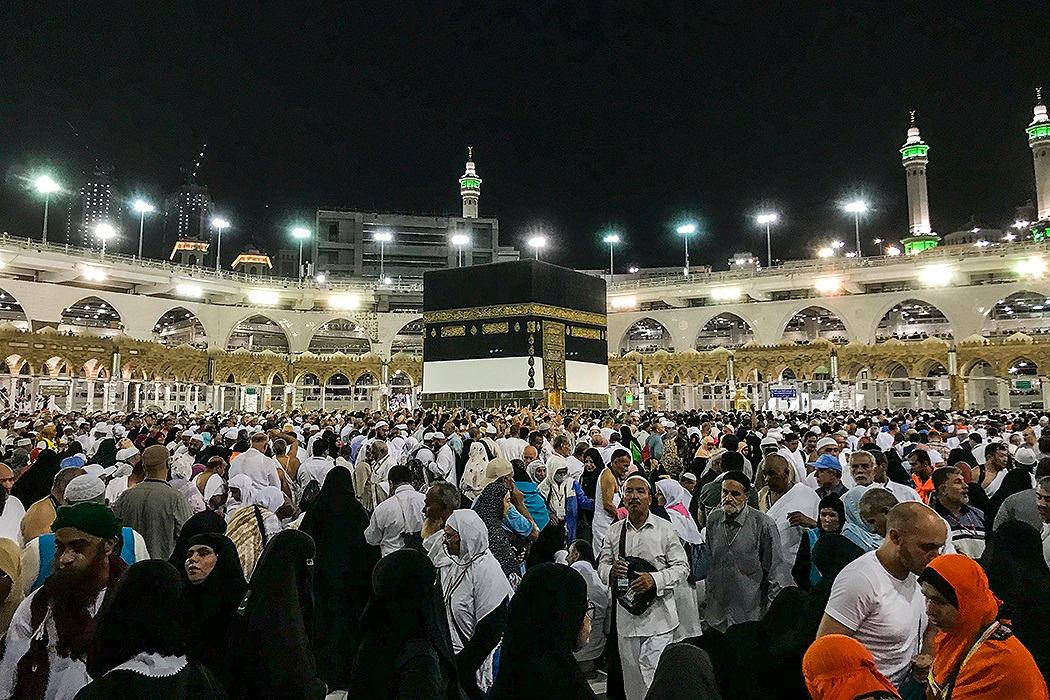
Chapter 3
Preparing Your Heart and Your Affairs
Hajj begins long before the airport. The course spends its first week on the inner journey: sincere intention, repentance, settling your affairs, purifying your character, and recognising the superstitions that can quietly spoil a pilgrimage.
Ten courtesies before you set out
The course lists ten adab, courtesies, for anyone preparing for Hajj or Umrah:
- A sincere intention, seeking only the pleasure of Allah.
- Sincere repentance (taubat nasuha): stop the sin, regret it, resolve never to return to it, and, where it concerns other people, return their rights.
- Spend only halal money on your Hajj.
- Take enough provisions and money for the journey, and leave enough for the people you support.
- Choose companions who will remind you, help you and keep you on track.
- Make du'a and dhikr a part of your daily life now, not only in Makkah.
- Write your will (wasiat).
- Ask for and give forgiveness, and leave with a clear heart towards everyone.
- Purify your heart: build praiseworthy qualities (mahmudah) and drive out blameworthy ones (mazmumah).
- Be steadfast (istiqamah) and serious about learning how to perform Hajj and Umrah.
Purifying the soul (tazkiyah al-nafs)
The pilgrim's real preparation is a heart that is ready to meet its Lord. The course recommends:
- Correct belief (aqidah) and correct practice of the shariah.
- Knowledge and understanding of Islam.
- The five daily prayers, on time, a pilgrim who neglects prayer at home will struggle to guard it in the crowds of Makkah.
- Voluntary worship:
- night prayer (qiyamullail) and the prayer of repentance;
- charity, of money, effort or kind words;
- abundant du'a and dhikr;
- reading the Qur'an;
- acts of kindness of every kind.
- Avoiding excessive joking and idle talk (lagha).
Qualities to build and qualities to leave behind
Hajj puts you in crowds, heat and queues with people from every nation. Your character will be tested, often several times a day. Work on it now.
| Praiseworthy (mahmudah) | Blameworthy (mazmumah) |
|---|---|
| Repentance; remembering Allah | Forgetting Allah and His Messenger ﷺ |
| Trustworthiness (amanah) | Excessive love of the world |
| Patience (sabar) and gratitude (syukur) | Selfishness |
| Sincerity (ikhlas) and contentment (reda) | Anger |
| Hard work and generosity | Arrogance (takbur) and showing off (riyak, ujub) |
| Being thrifty and considerate | Wastefulness |
| Compassion and forgiveness | Lying and cheating |
| Helping one another | Quarrelling and cursing |
| Keeping promises and keeping time | Backbiting (mengumpat) |
| Responsibility and self-reliance | Stinginess |
| Steadfastness (istiqamah) | Envy (hasad) and holding grudges |
| Always speaking the truth | Betrayal |
| Keeping clean | Being dirty and careless |
| Gentleness | Idle words and deeds; suspicion of others |
Courtesy in the Holy Land
Once you arrive, remember that you are a guest in Allah's House. The course's courtesies for the Haram:
- Depend on Allah, not on people.
- Remember that you are a guest of Allah.
- Show the best of character.
- Remember that the whole journey is worship, not a holiday.
- Be grateful and content with what you are given: the room, the food, the bus.
- Keep away from foul words and deeds.
- Avoid arrogance.
- Do not argue with or hurt other pilgrims, they are guests of Allah too.
- Do not spread gossip or unverified stories.
- Fill your time with worship: tawaf, Qur'an, i'tikaf, du'a, repentance and istighfar.
- Help and cooperate with others.
Superstitions to avoid (khurafat)
Over the years, practices with no basis in Islam have attached themselves to Hajj. Some only waste money; some touch on shirk, associating partners with Allah, and can damage a person's faith. The course names these specifically so that pilgrims recognise them:
| Practice | The false belief behind it |
|---|---|
| Taking pieces of the Ka'bah's cloth (kiswah) | That it brings blessing or makes a business prosper |
| Taking a white cloth used as a prayer mat home to be your burial shroud | That it lightens the punishment of the grave |
| Taking home rice crusts from Mina, or rice dried in the sun at Arafah | That it makes trade prosper or brings luck |
| Hugging pillars in Masjid al-Haram | That it lengthens life or brings wealth |
| Clinging to the Ka'bah's cloth to ask for your needs | Asking the Ka'bah instead of asking Allah |
| Leaving money under the kiswah during tawaf, then taking it back | That the money becomes "seed money" for business |
| Leaving a paper with the shahadah at home before travelling | That it prevents you dying in the Holy Land |
| Wearing amulets and charms (tangkal, azimat) | That they protect you |
| Calling a bomoh (shaman) to "protect" your house before you leave | That it wards off disaster |
| Carrying water from seven wells during tawaf to make medicine | That it heals |
| Buying a certificate from a "sheikh" in Makkah confirming your Hajj and giving you a new name | That it validates your Hajj |
| Taking twigs from brooms in Masjid al-Haram | That they bring blessing |
| Rubbing and stroking the doors of the two Holy Mosques | That it brings blessing |
| Taking Zamzam, raisins, dates or money into tawaf so they become "medicine" or "seed money" | That tawaf turns them into charms |
| Burying seven stones at Arafah | That they will close the seven gates of Hell |
| Secretly cutting ropes at Arafah | That it stops children crying or brings customers |
| Taking sand from Arafah for a child's first steps | That the child will become famous, healthy or brave |
Things that cancel the shahadah
Because some superstitions slide into shirk, the course also lists the things that cancel the testimony of faith (syahadah):
- Associating partners with Allah SWT in worship.
- Taking something as an intermediary between oneself and Allah.
- Not regarding the idolaters (musyrikin) as disbelievers.
- Believing that another religion's teaching is equal to, or more perfect than, Islam.
- Hating something the Messenger ﷺ established as his shariah.
- Mocking Allah SWT, His Book, or anything that is part of His religion.
- Believing in and practising sorcery, or befriending jinn.
- Helping the idolaters to fight the Muslims.
- Believing that some people are permitted not to follow the shariah of Prophet Muhammad ﷺ.
- Turning away from the religion of Allah SWT, or from what is an absolute condition of being a Muslim.
Keep your Tawhid pure: it is the foundation on which the whole of Hajj stands.
Settling your worldly affairs
- Debts: pay what is due, or get your creditor's agreement and write the details in your will.
- Will (wasiat) and estate: tell your family where your documents are. Name someone to manage your affairs while you are away.
- Family: arrange care for children and elderly parents, and leave enough maintenance (nafkah) for the whole period.
- Work: arrange your leave well in advance, you may be away for six or seven weeks.
- Health: complete your medical screening early and treat any problems before you travel (see Chapter 17).
- Knowledge: attend every session of your Hajj course and the practical rehearsal (amali). Ask questions now, it is much harder to ask in a crowd of two million.
سُبْحَانَ الَّذِي سَخَّرَ لَنَا هَٰذَا وَمَا كُنَّا لَهُ مُقْرِنِينَ، وَإِنَّا إِلَىٰ رَبِّنَا لَمُنْقَلِبُونَ
Reading Subḥānal-ladhī sakh-khara lanā hādhā wa mā kunnā lahu muqrinīn, wa innā ilā rabbinā lamunqalibūn.
Meaning Glory be to the One who has placed this at our service, for we could never have done it ourselves; and to our Lord we shall surely return.
Surah az-Zukhruf 43:13–14
Chapter 4
The Holy Land: Makkah, the Ka'bah and the Sites of Hajj
The story of Makkah from Adam and Ibrahim to the Prophet ﷺ, the parts of the Ka'bah you will see during tawaf, the virtues of the Haram, the places where du'a is answered, the well of Zamzam, and the geography of Arafah, Muzdalifah and Mina.
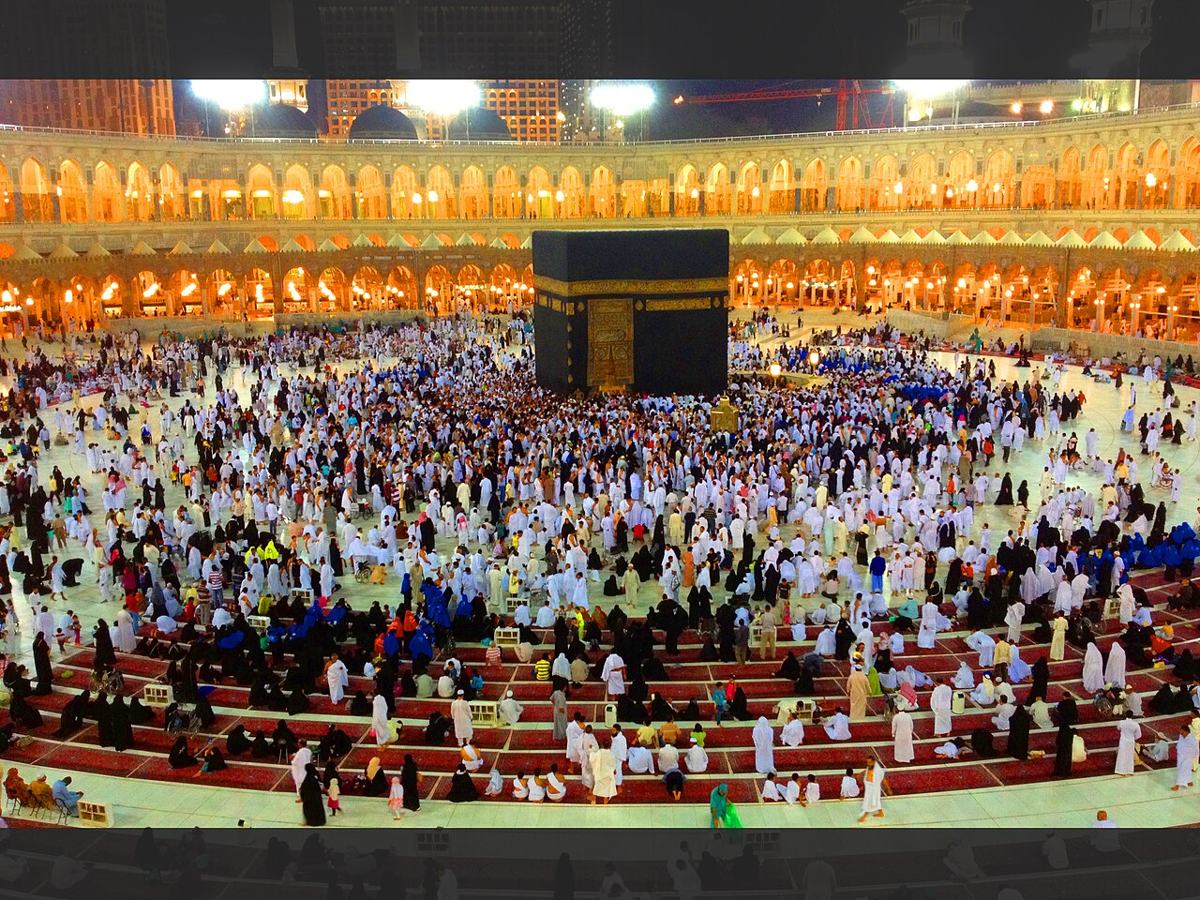
Adam and Hawa: the first meeting
The course begins the history of the Holy Land with Adam and Hawa (Eve). Tradition connects their meeting after leaving Paradise with the plain of Arafah, and scholars draw two lessons from it. First, repentance: two people who knew they had sinned turned back to Allah and were forgiven, exactly what the pilgrim seeks at Arafah. Second, the enemy: the whisperings of Iblis can reach a person anywhere, even in the holiest places.
The story of their sons, Qabil and Habil, who each offered a sacrifice, one of grain, one of a ram, is told in Surah al-Ma'idah (5:27–31). It is remembered as the first sacrifice, the root of the qurban that pilgrims and Muslims everywhere offer on Eid al-Adha.
Ibrahim, Hajar and Ismail
Makkah as we know it begins with a family. Prophet Ibrahim (peace be upon him), by Allah's command, left his wife Hajar and their baby son Ismail in a barren valley with no crops and no water, beside the place of Allah's Sacred House. He prayed:
رَبَّنَا إِنِّي أَسْكَنتُ مِن ذُرِّيَّتِي بِوَادٍ غَيْرِ ذِي زَرْعٍ عِندَ بَيْتِكَ الْمُحَرَّمِ رَبَّنَا لِيُقِيمُوا الصَّلَاةَ فَاجْعَلْ أَفْئِدَةً مِّنَ النَّاسِ تَهْوِي إِلَيْهِمْ وَارْزُقْهُم مِّنَ الثَّمَرَاتِ لَعَلَّهُمْ يَشْكُرُونَ
Reading Rabbanā innī askantu min dhurriyyatī bi wādin ghairi dhī zarʿin ʿinda baitikal-muḥarram, rabbanā liyuqīmuṣ-ṣalāta fajʿal af'idatan minan-nāsi tahwī ilaihim warzuqhum minath-thamarāti laʿallahum yashkurūn.
Meaning Our Lord, I have settled some of my offspring in a valley without crops, beside Your Sacred House, our Lord, so that they may establish prayer. So make the hearts of people incline towards them, and provide them with fruits, so that they may be grateful.
Surah Ibrahim 14:37
Every pilgrim is the answer to that prayer: hearts from every corner of the earth still incline towards this valley.
The story continues in the rites of Hajj:
- Sa'i: when the water ran out and Ismail cried with thirst, Hajar ran seven times between the hills of Safa and Marwah, searching and praying. Pilgrims walk the same path today (Chapter 9).
- Zamzam: after the seventh run, water burst from the sand where Ismail kicked it. Hajar built an enclosure around it (tazamzama) so that it would not overflow, hence the name Zamzam, and the well has flowed ever since.
- The sacrifice: when Ismail was 13 years old, Ibrahim came to Makkah and was commanded in a dream to sacrifice him. Father and son both submitted, and Allah ransomed Ismail with a great sacrifice (Surah as-Saffat 37:102–111).
- The stoning: Iblis tried to disturb Ibrahim and turn him away from obeying Allah, and Ibrahim drove him off with stones at the places where the Jamarat now stand (Chapter 13).
- The Ka'bah: Ibrahim and Ismail later raised the foundations of the House together (Surah al-Baqarah 2:127).
From the Jurhum to the Quraysh
- The valley lay on the caravan routes, and the tribe of Jurhum, seeing birds circling over water, asked Hajar's permission to settle. Ismail grew up among them and married into the tribe.
- The Jurhum controlled Makkah for around two centuries before they were defeated by the Khuza'ah from Yemen.
- Qusay ibn Kilab later united the Arab clans into the tribe of Quraysh, who became custodians of the Ka'bah.
- The Prophet Muhammad ﷺ was born in Makkah during the leadership of his grandfather 'Abd al-Muttalib.
- In Ramadan of 8 AH, the Prophet ﷺ entered Makkah, ended the rule of the idolaters over the Sacred House and cleansed it of idols.
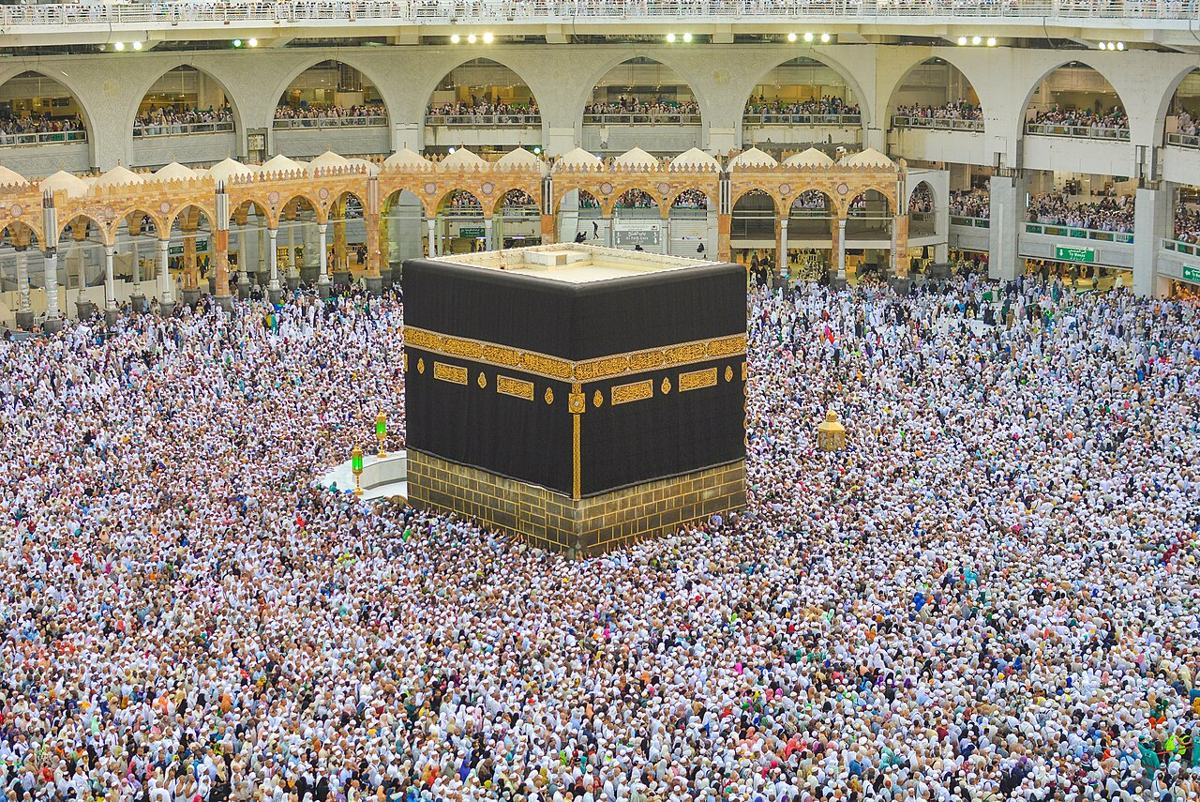
The Ka'bah
The course summarises the history of the House:
- It is the first house of worship established on earth (Surah Ali 'Imran 3:96).
- Its building stone is described as coming from five mountains: Jabal Lubnan, Tur Zita, Tur Sina, Jabal Judi and Jabal Hira'.
- Reports also describe earlier buildings before Ibrahim's, by angels, by Adam and by Seth.
- Ibrahim's building is reported to have measured roughly 14 m high, 12 m long and 11 m wide.
- The Quraysh rebuilt it when the Prophet ﷺ was 35 years old; he himself placed the Black Stone in its corner and settled the dispute between the clans.
- The course shows its successive buildings, by Qusay ibn Kilab, by the Quraysh, by 'Abdullah ibn al-Zubayr and by al-Hajjaj, and notes that renewal and conservation have continued from the reign of King Fahd until today.
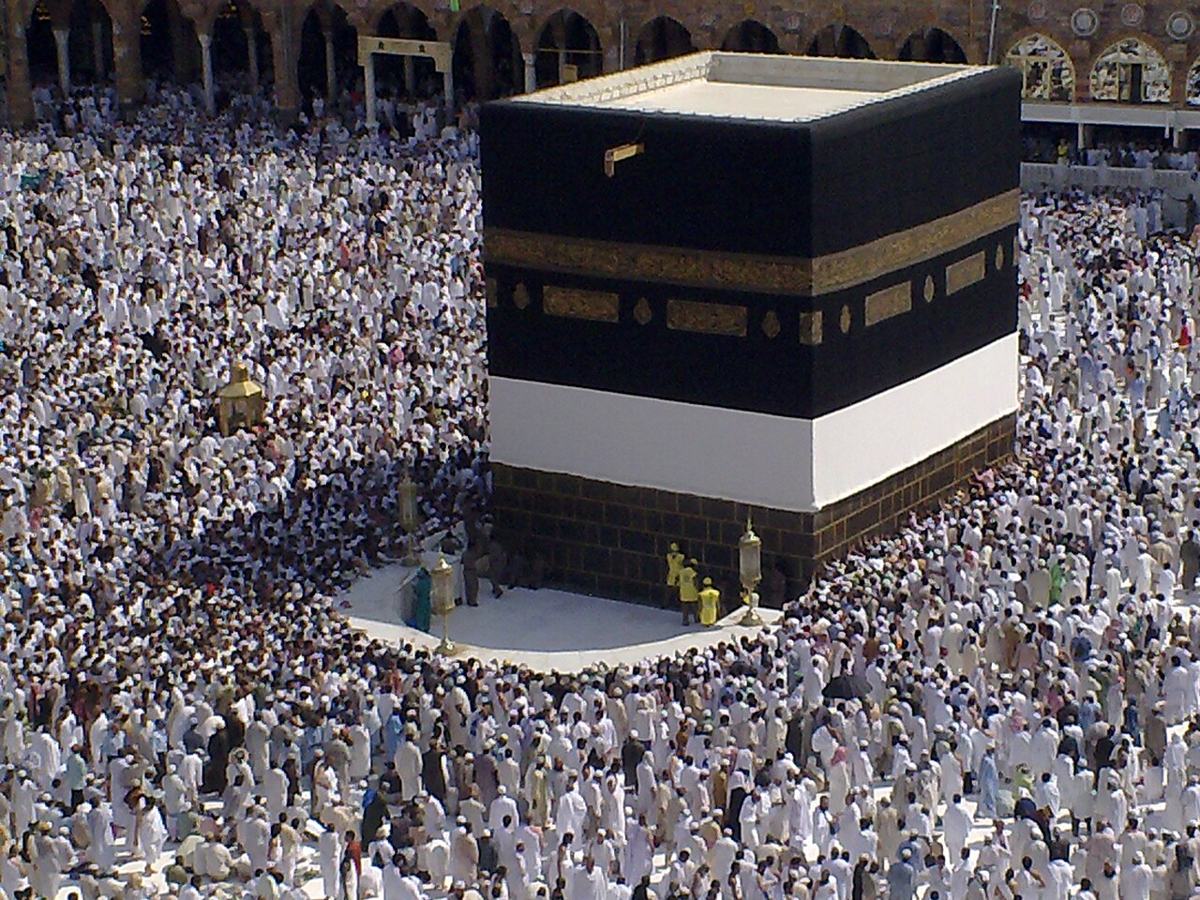
The parts of the Ka'bah
| Part | What it is |
|---|---|
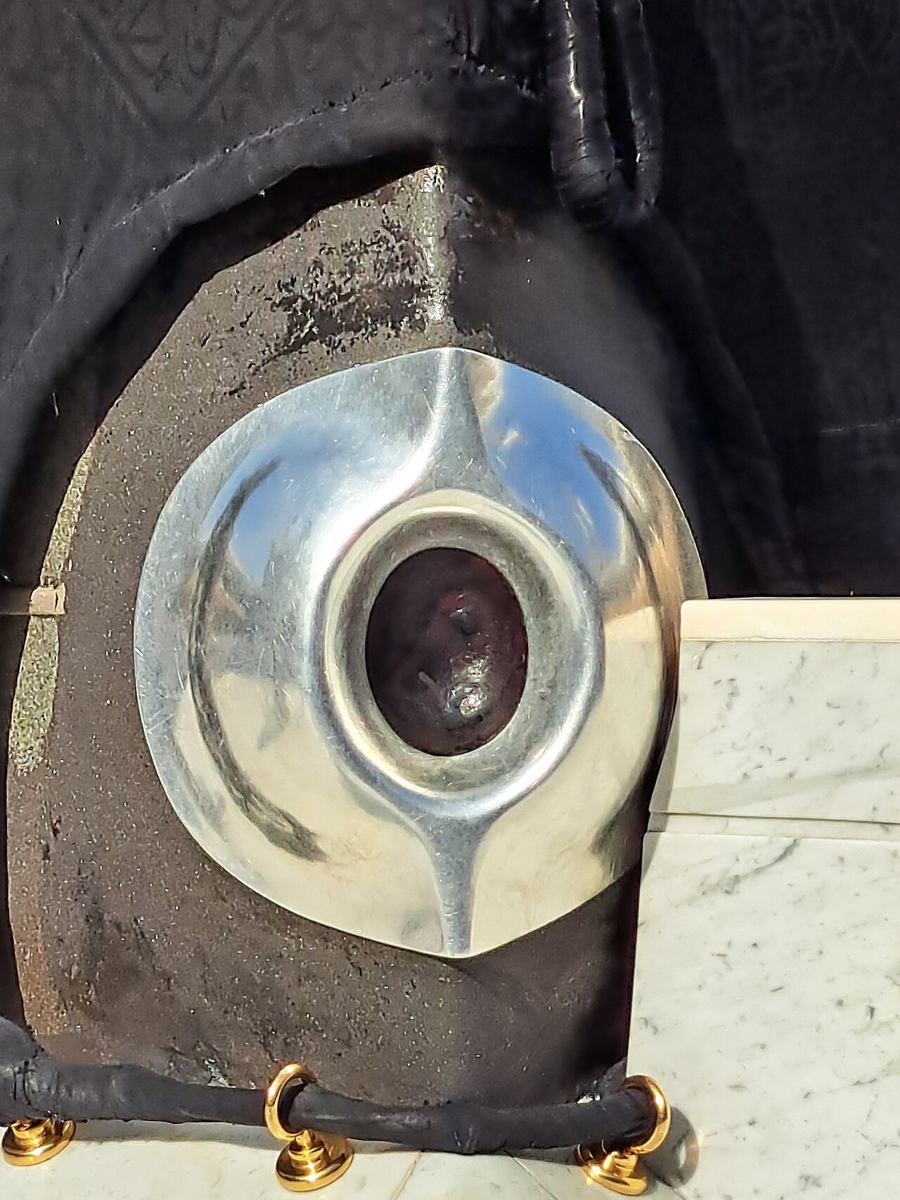
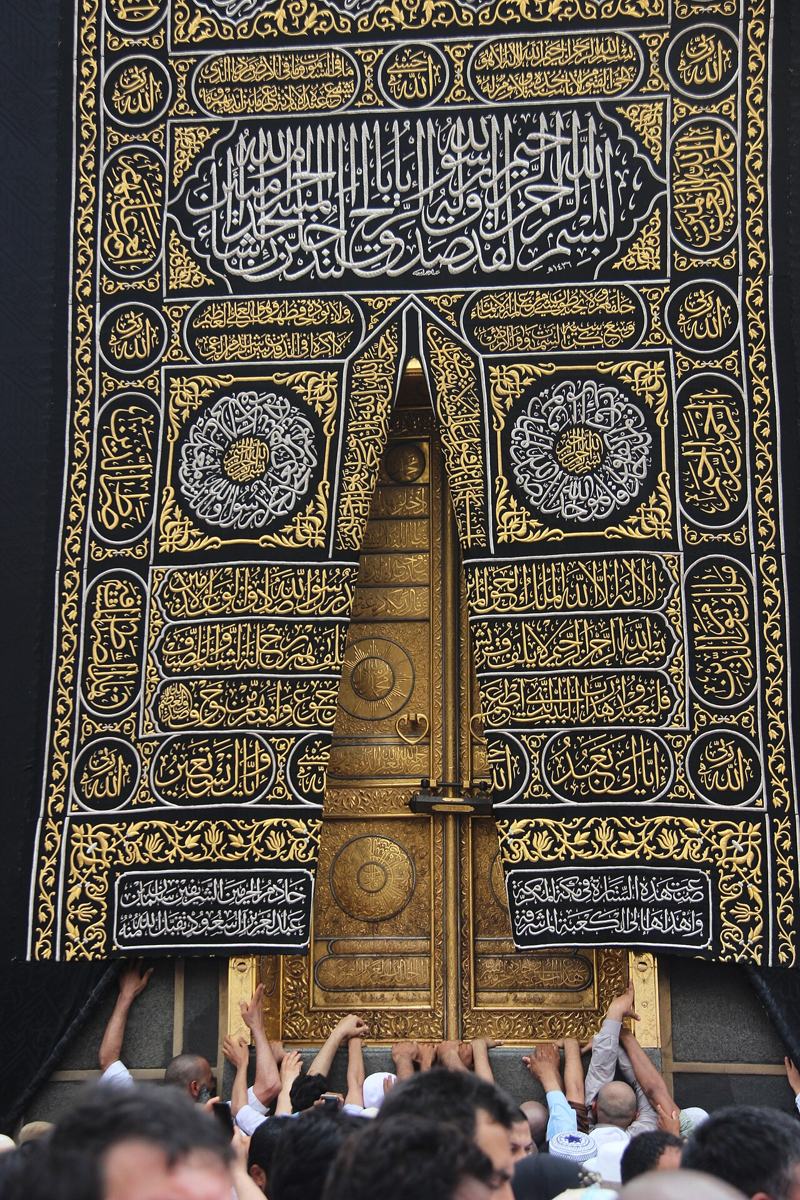
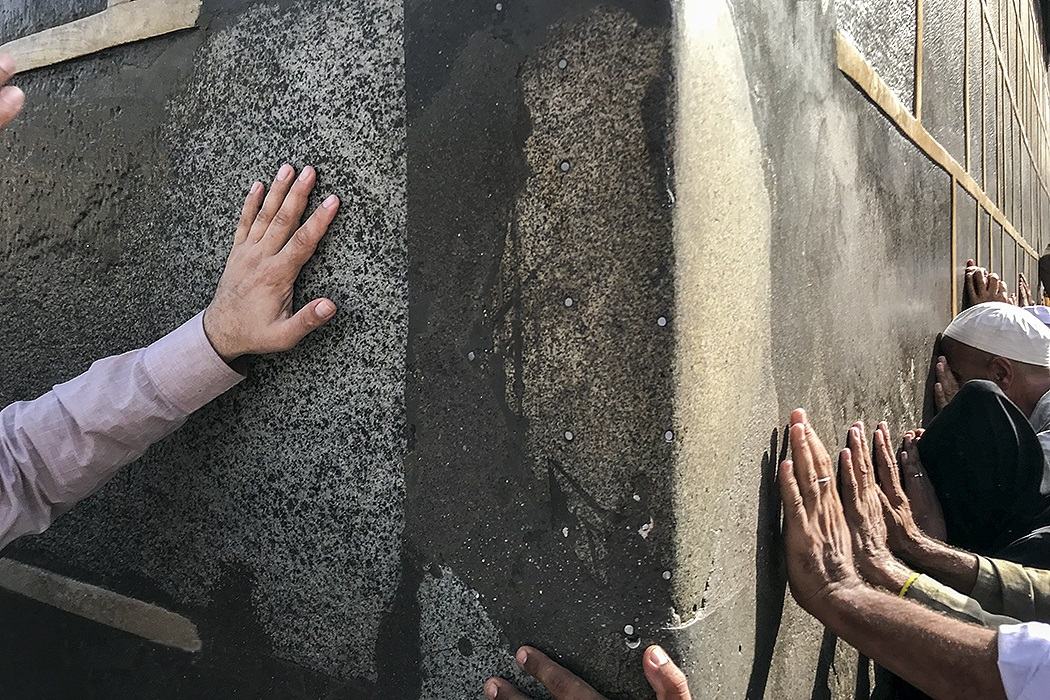
| Hajar al-Aswad (the Black Stone) | Set in a silver frame in the eastern corner. Tawaf starts and ends in line with it. |
| Rukn Iraqi | The northern corner, facing Iraq. |
| Rukn Shami | The western corner, facing Syria (al-Sham). |
| Rukn Yamani | The southern corner, facing Yemen. It is sunnah to touch it with the hand during tawaf, if you can do so without pushing. |
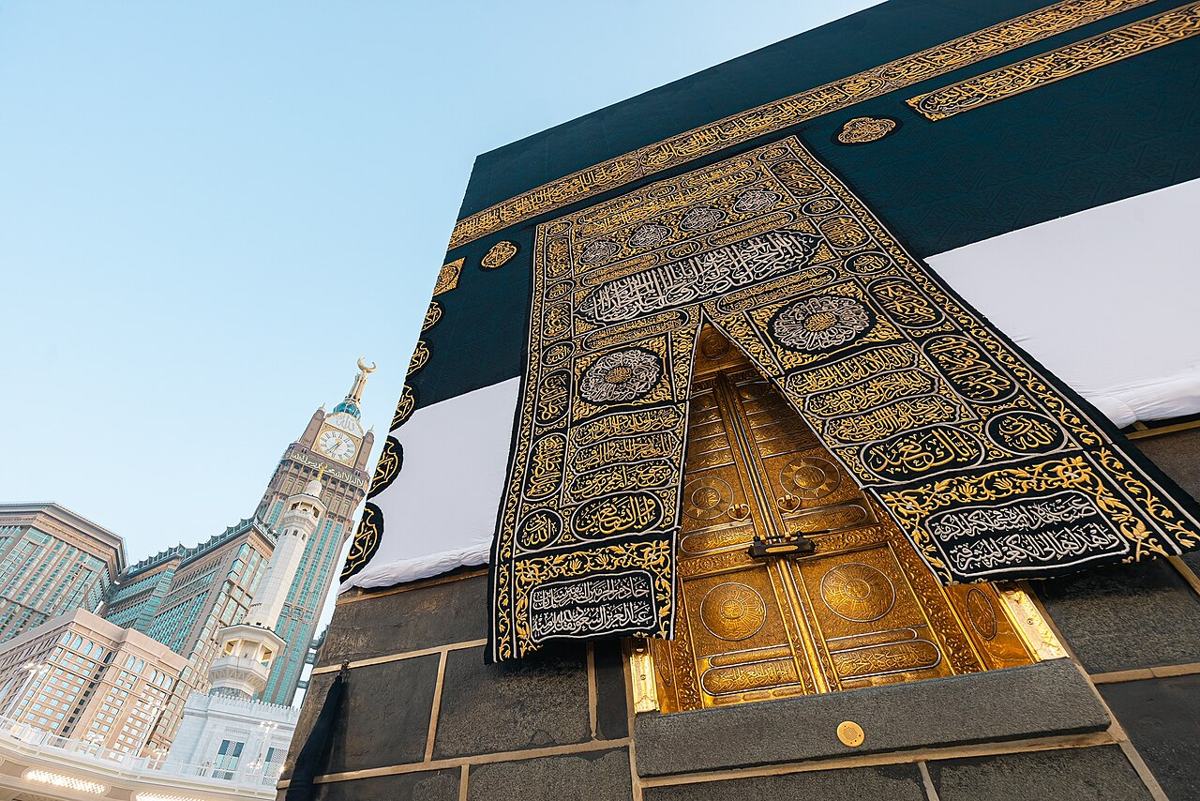
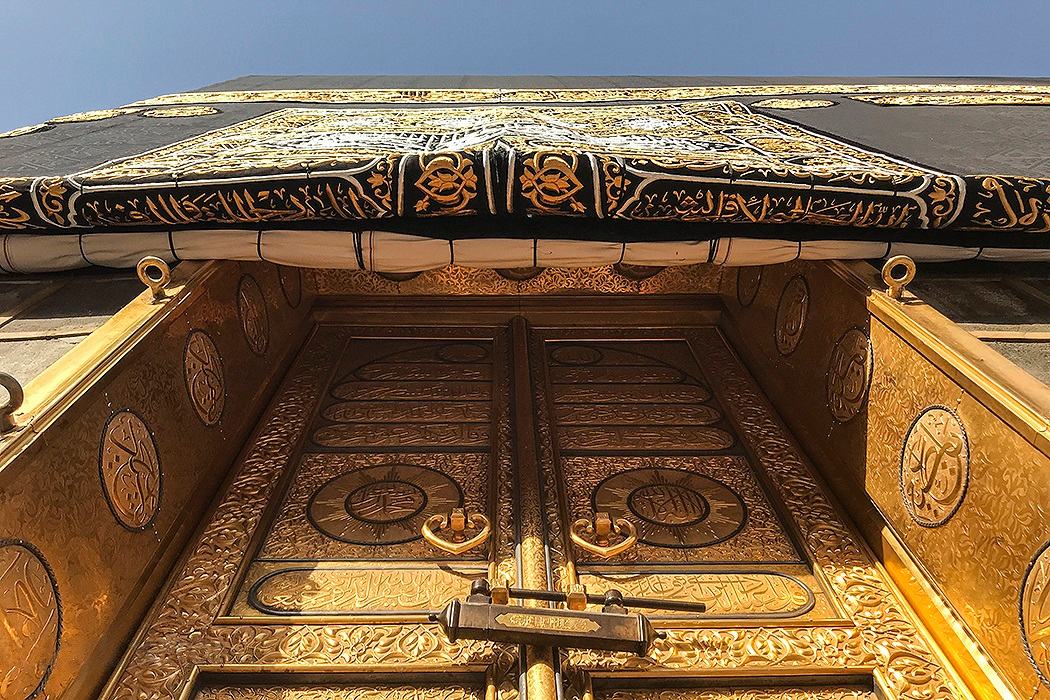
| The door | On the north-eastern wall, about two metres above the ground. |
| Multazam | The wall between the Black Stone and the door, a place where du'a is answered. |
| Mizab (the golden spout) | On the roof edge above the Hijr, draining rainwater. |
| Hijr Ismail | The semicircular area on the north-western side of the Ka'bah. Tawaf must go outside it: touching or entering it during tawaf voids the round. |
| Hatim | The low semicircular wall that encloses the Hijr Ismail. |
| Shadharwan | The sloping marble base along the foot of the walls. It is part of the Ka'bah: do not walk on it during tawaf. |
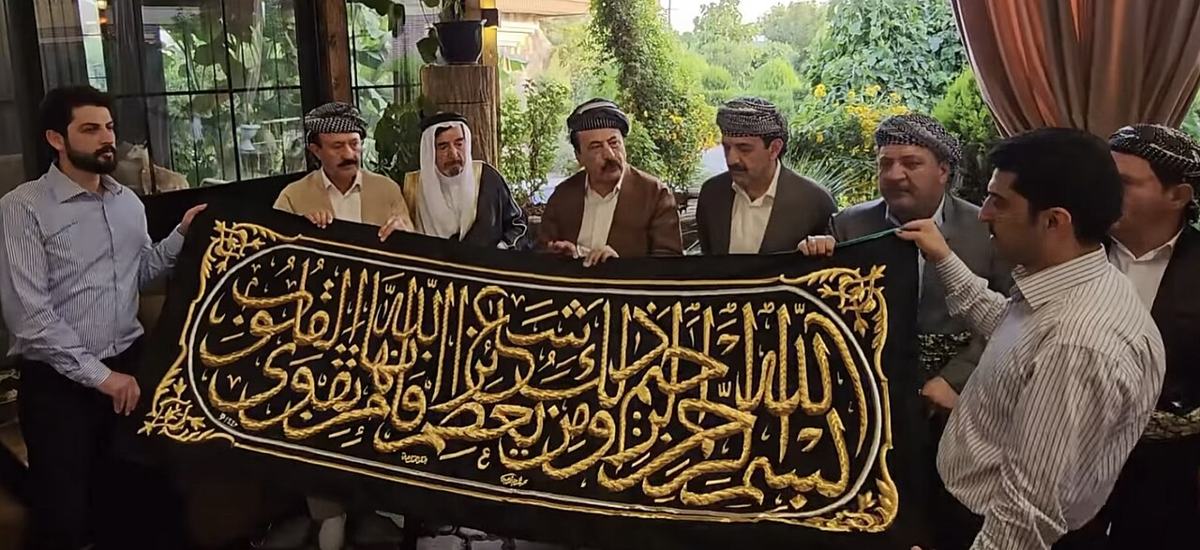
| Kiswah | The black silk cloth embroidered in gold with verses of the Qur'an, replaced every year. |
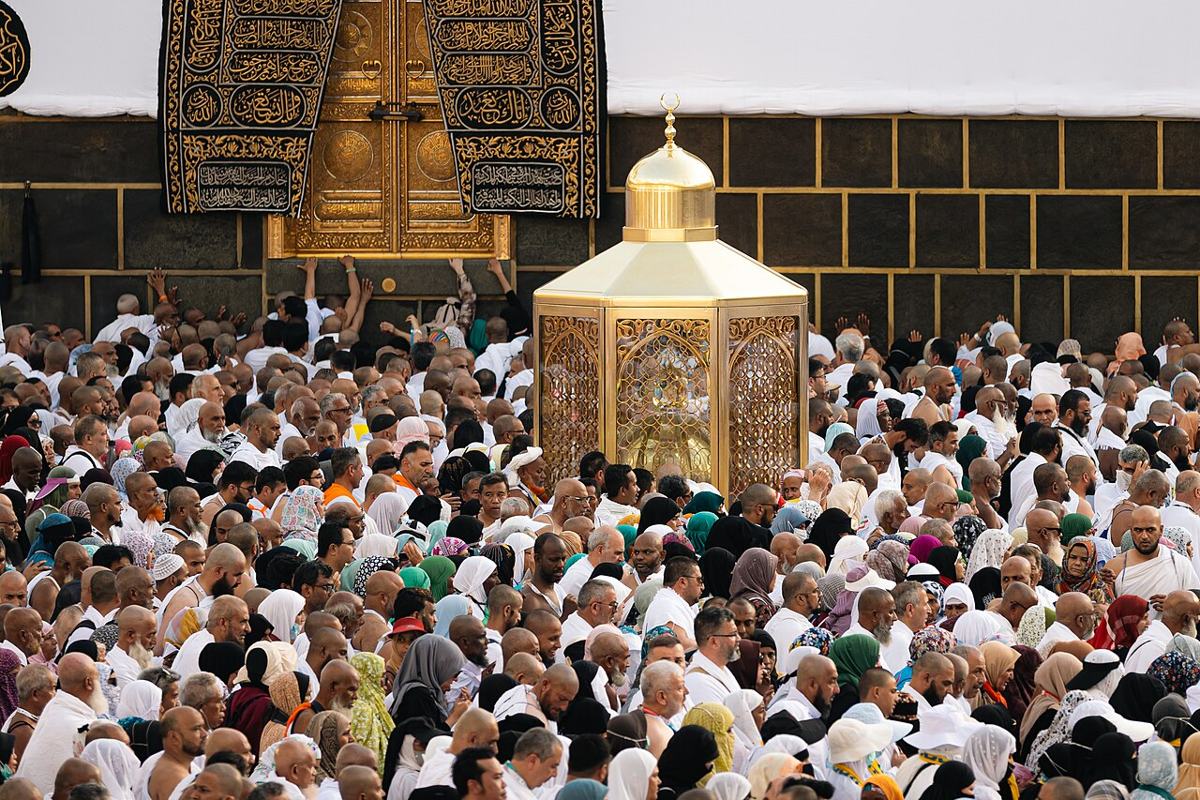
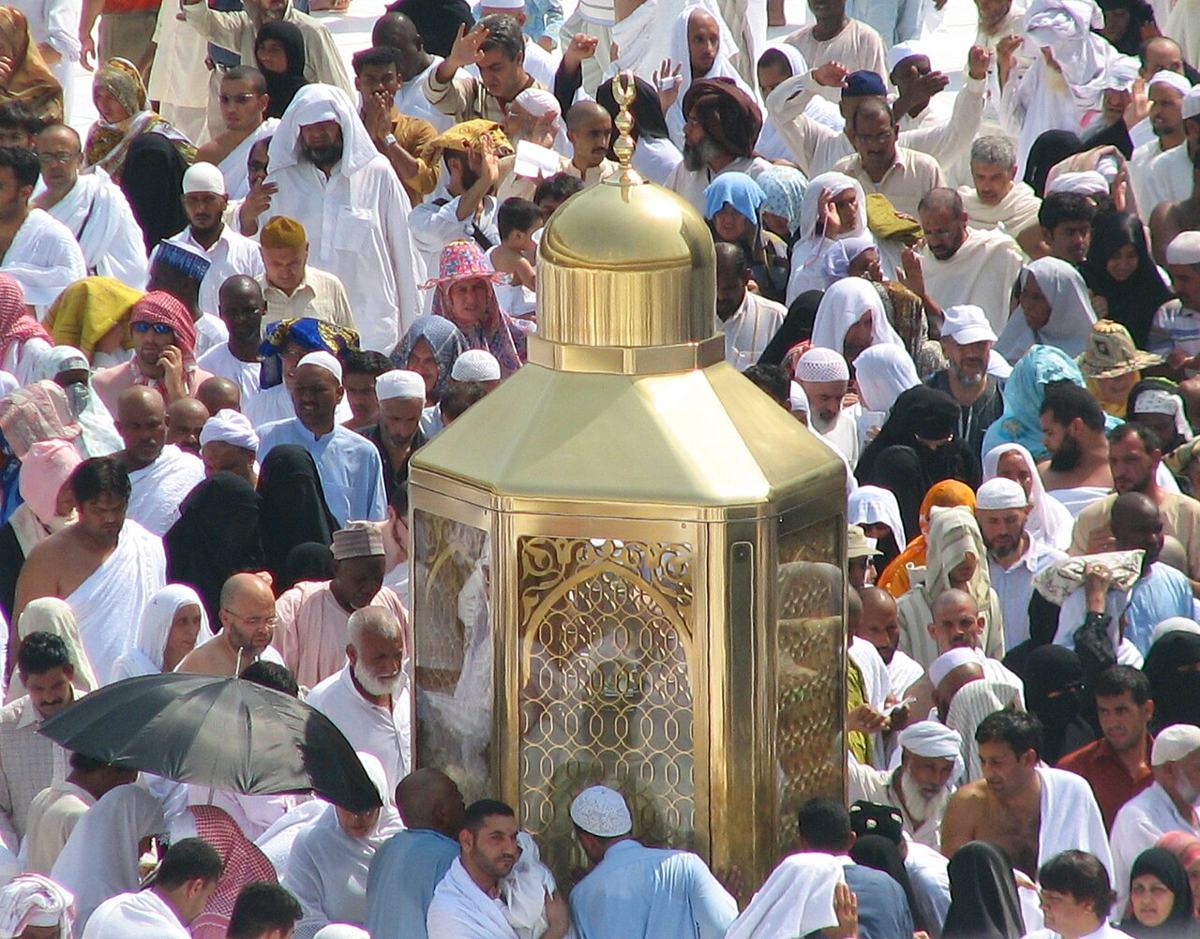
| Maqam Ibrahim | The stone Ibrahim stood on while building, now in a gold-and-glass case opposite the door. |

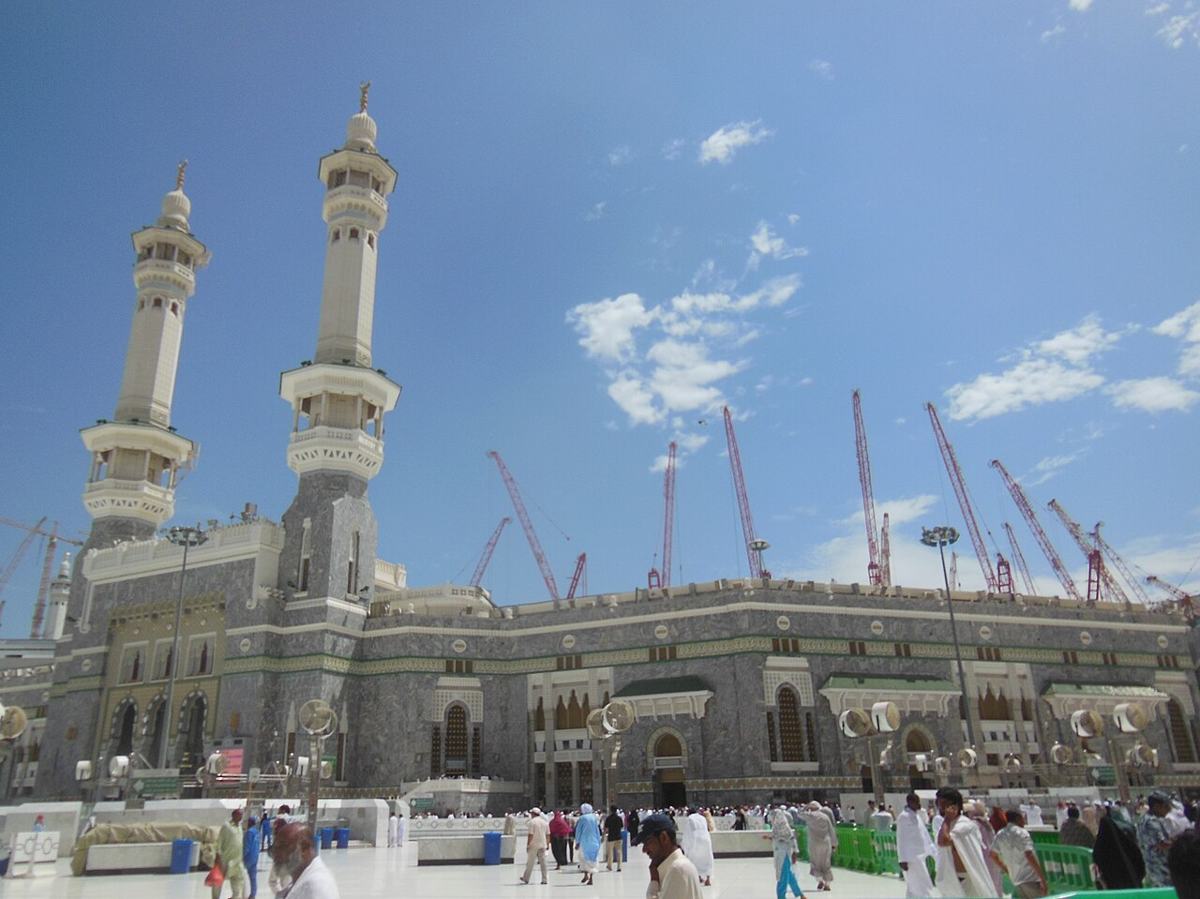
Masjid al-Haram
- Masjid al-Haram is the whole mosque: the Ka'bah, the mataf (the area for tawaf) and the prayer halls around it.
- From the time of Ibrahim until Qusay ibn Kilab, it was an open space around the House with no buildings.
- The Caliph 'Umar enlarged it in 17 AH, and 'Uthman in 26 AH. It has been expanded again and again ever since; today it holds well over a million worshippers, and the mas'a (the gallery for sa'i between Safa and Marwah) is part of the building.
Good deeds in Masjid al-Haram
- Do many righteous deeds, especially tawaf and prayer.
- Read the Qur'an.
- Remember Allah (dhikr).
- Send blessings (selawat) on the Prophet ﷺ.
- Avoid what is disliked and pointless.
- Make the intention of i'tikaf (staying in the mosque for worship) each time you enter.
The virtues of the Haram
The sacred precinct of Makkah (Tanah Haram), a wide area around the city, marked by boundary signs, has virtues that the course lists:
- It is the birthplace of the Prophet ﷺ.
- It is a place of honour, safety and peace.
- It is reported that 120 mercies descend on the Ka'bah each day: 60 for those performing tawaf, 40 for those praying and 20 for those looking at the House.
- A prayer in Masjid al-Haram is worth 100,000 prayers elsewhere. Many scholars hold that this multiplication covers the whole Haram, not only the mosque building, and that other good deeds there are multiplied too.
- There is no forbidden time for voluntary prayer in the Haram of Makkah, even at the times when voluntary prayer without a reason is forbidden elsewhere (Chapter 16).
- Makkah is protected from plague and from the Dajjal.
- It has many places where du'a is answered.
Fifteen places where du'a is answered
According to al-Hasan al-Basri, as quoted in the course, du'a is answered:
- Throughout tawaf around the Ka'bah
- At the Multazam
- Inside the Ka'bah
- At the well of Zamzam
- In the Hijr Ismail
- On Safa
- On Marwah
- In the Mas'a (the place of sa'i)
- Behind Maqam Ibrahim
- At Arafah, throughout the wuquf
- At Muzdalifah, throughout the night
- At Mina, on the Day of Sacrifice and the Days of Tashriq
- At the small Jamrah
- At the middle Jamrah
- At the large Jamrah
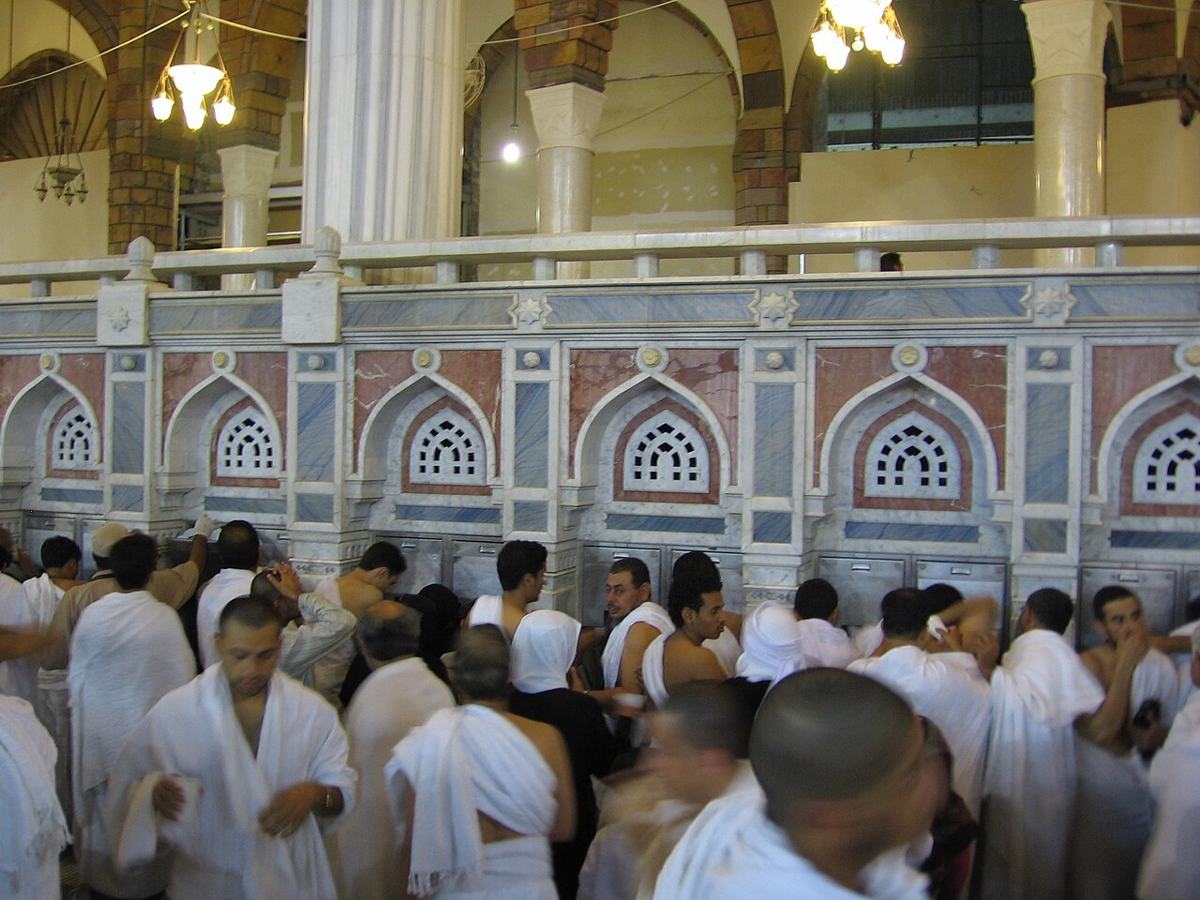
Zamzam
The well of Zamzam lies a few metres from the Ka'bah. Today the water is pumped to coolers and taps throughout both Holy Mosques, and pilgrims are usually allowed to take some home in sealed containers.
The etiquette of drinking Zamzam
- Face the qiblah.
- Say Bismillah.
- Drink with your right hand.
- Drink calmly, in three breaths.
- Make du'a, "Zamzam is for whatever it is drunk for".
- The Prophet ﷺ drank Zamzam both standing and sitting.
اللّٰهُمَّ إِنِّي أَسْأَلُكَ عِلْمًا نَافِعًا، وَرِزْقًا وَاسِعًا، وَشِفَاءً مِنْ كُلِّ دَاءٍ
Reading Allāhumma innī as'aluka ʿilman nāfiʿā, wa rizqan wāsiʿā, wa shifā'an min kulli dā'.
Meaning O Allah, I ask You for beneficial knowledge, abundant provision, and a cure for every illness.
The virtues of Zamzam
- It is a means of healing, but keep taking your prescribed medicines on schedule and follow your doctor's advice. Trusting Allah (tawakkal) includes using the means He has provided.
- It nourishes and strengthens the one who drinks it.
- It serves the purpose for which it is drunk.
- It will not dry up until the Last Day.
- It is the water that was used to wash the heart of the Prophet ﷺ.
- Its benefits have also been studied scientifically.
خَيْرُ مَاءٍ عَلَى وَجْهِ الْأَرْضِ مَاءُ زَمْزَمَ، فِيهِ طَعَامٌ مِنَ الطُّعْمِ، وَشِفَاءٌ مِنَ السُّقْمِ
Reading Khairu mā'in ʿalā wajhil-arḍi mā'u zamzam, fīhi ṭaʿāmun minaṭ-ṭuʿm, wa shifā'un minas-suqm.
Meaning The best water on the face of the earth is the water of Zamzam. In it is nourishing food and a cure for sickness.
Hadith reported by al-Tabarani

The sites of Hajj (al-masha'ir)
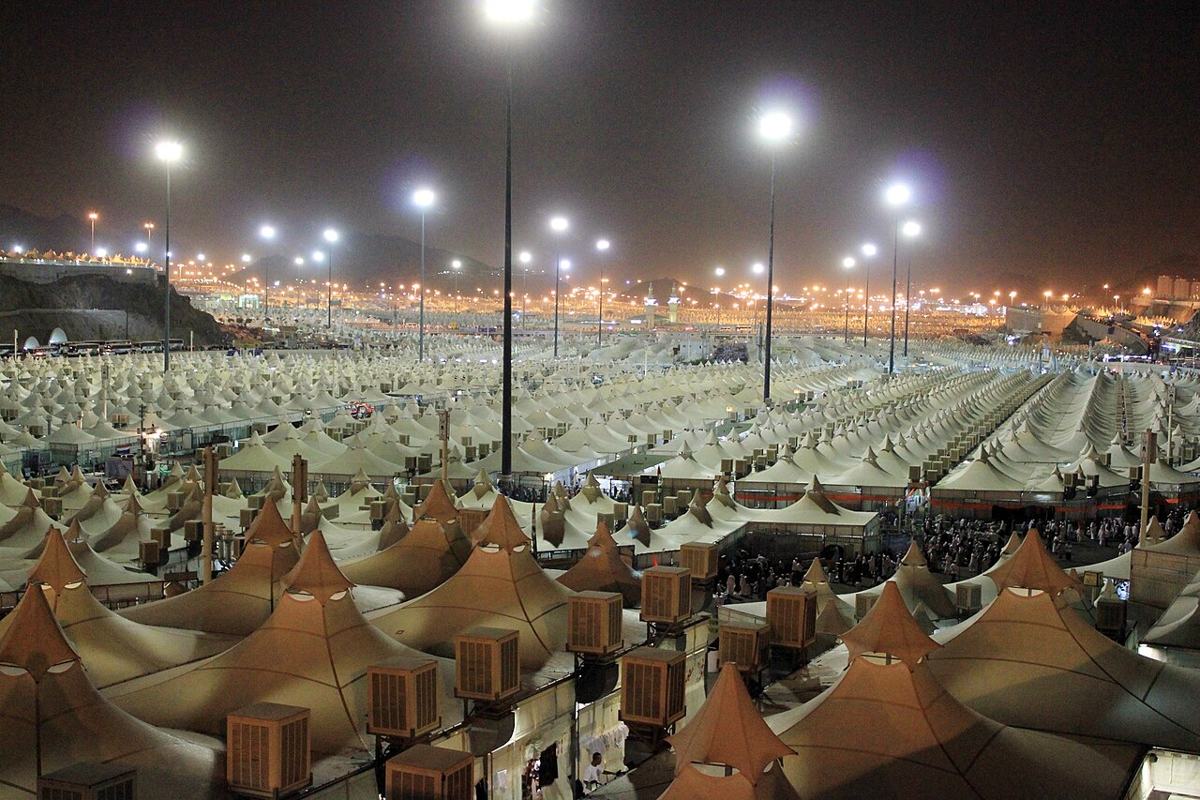
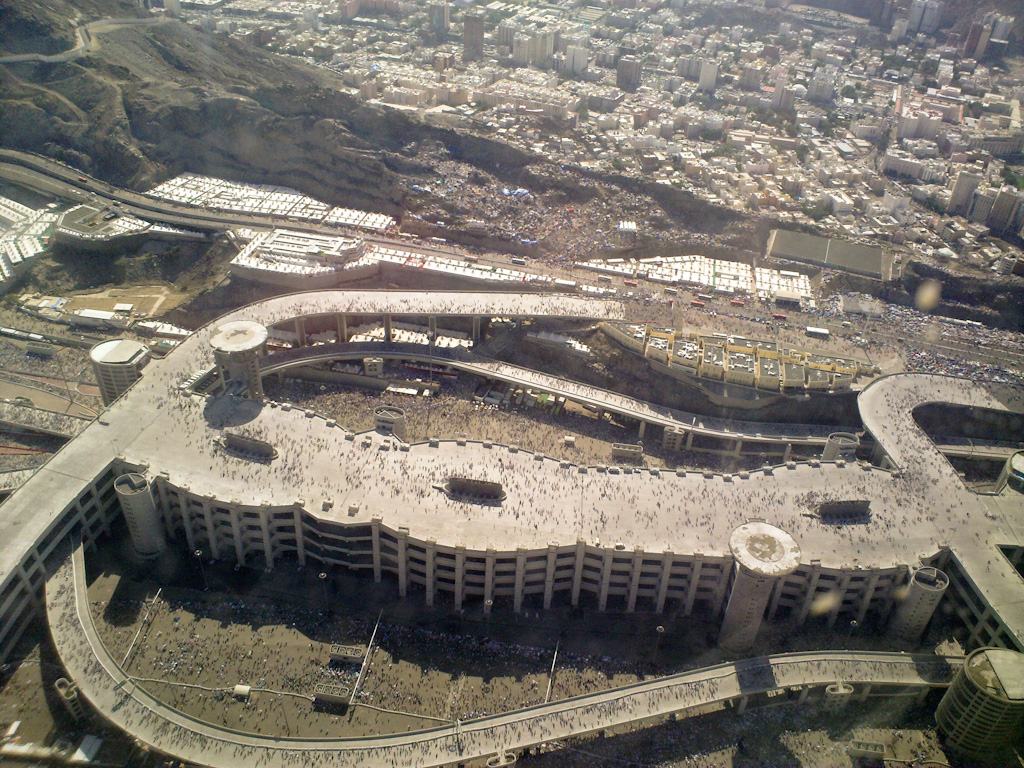
The masha'ir, "the symbols of Allah's religion", are the places where the main rites of Hajj take place: Arafah, Muzdalifah and Mina. Two of them, Muzdalifah and Mina, lie inside the Haram; Arafah lies just outside it.
| Site | What happens there | Geography (from the course) |
|---|---|---|
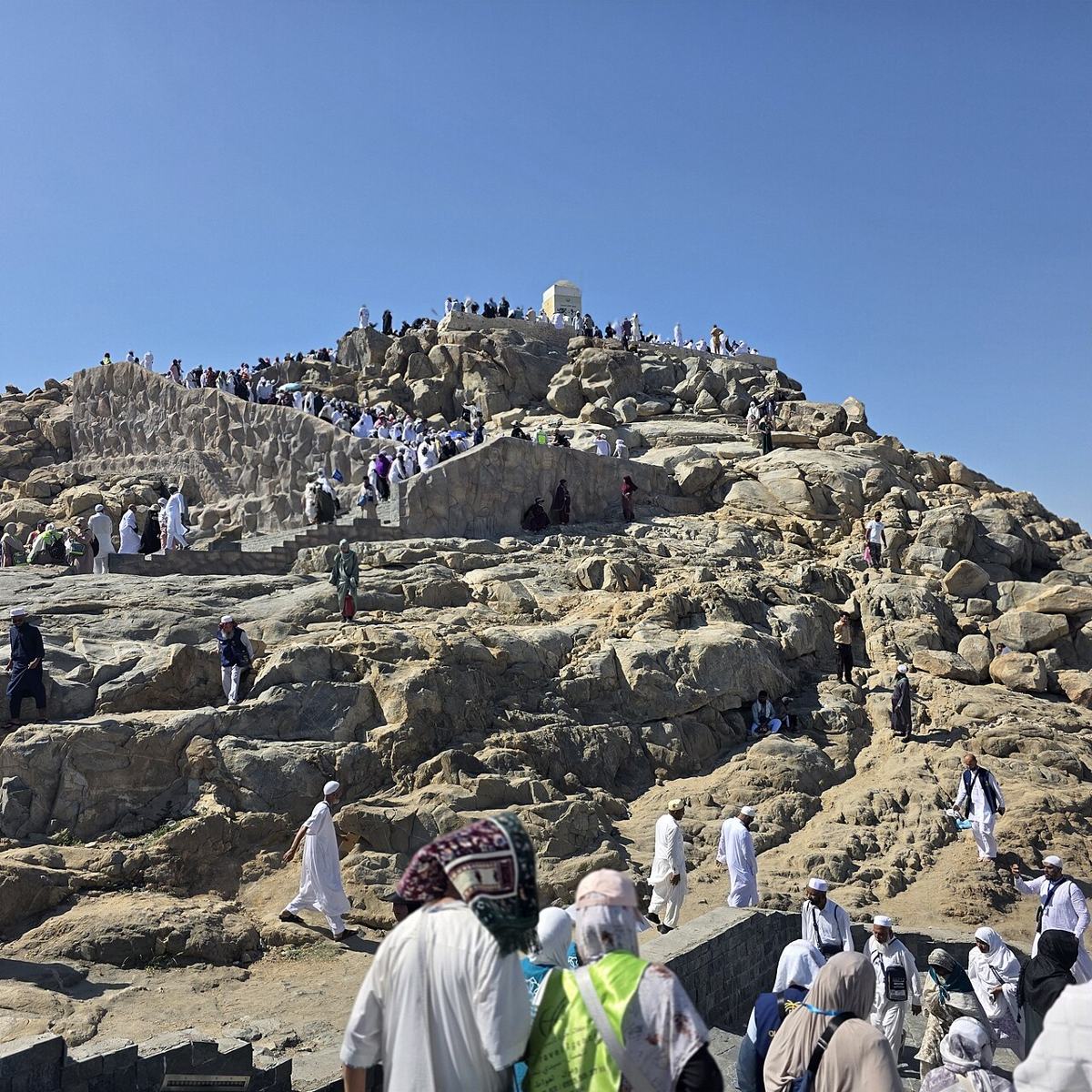
| Arafah | Wuquf on 9 Dhul Hijjah, the essential pillar of Hajj | A wide plain with the hill of Jabal Rahmah. About 21.9 km from Makkah by the original road. Its boundaries are marked by large signs. |
| Muzdalifah | The night of the 10th (mabit); collecting pebbles | Between Arafah and Mina, about 8 km from Arafah and about 6.9 km from Mina. |
| Mina | Stoning the Jamarat; the nights and days of Tashriq | About 7 km from Makkah. About 1.1 km wide, narrowing to about 500 m around the large Jamrah, and about 4.7 km long from the large Jamrah to Wadi Muhassir. There are hills on either side, one of them Mount Thubair. |
Other places you may visit in Makkah
Many groups organise a short tour (ziarah) of historical sites around Makkah. None of these visits is a rite of Hajj, and nothing there should be touched or taken as a source of blessing:
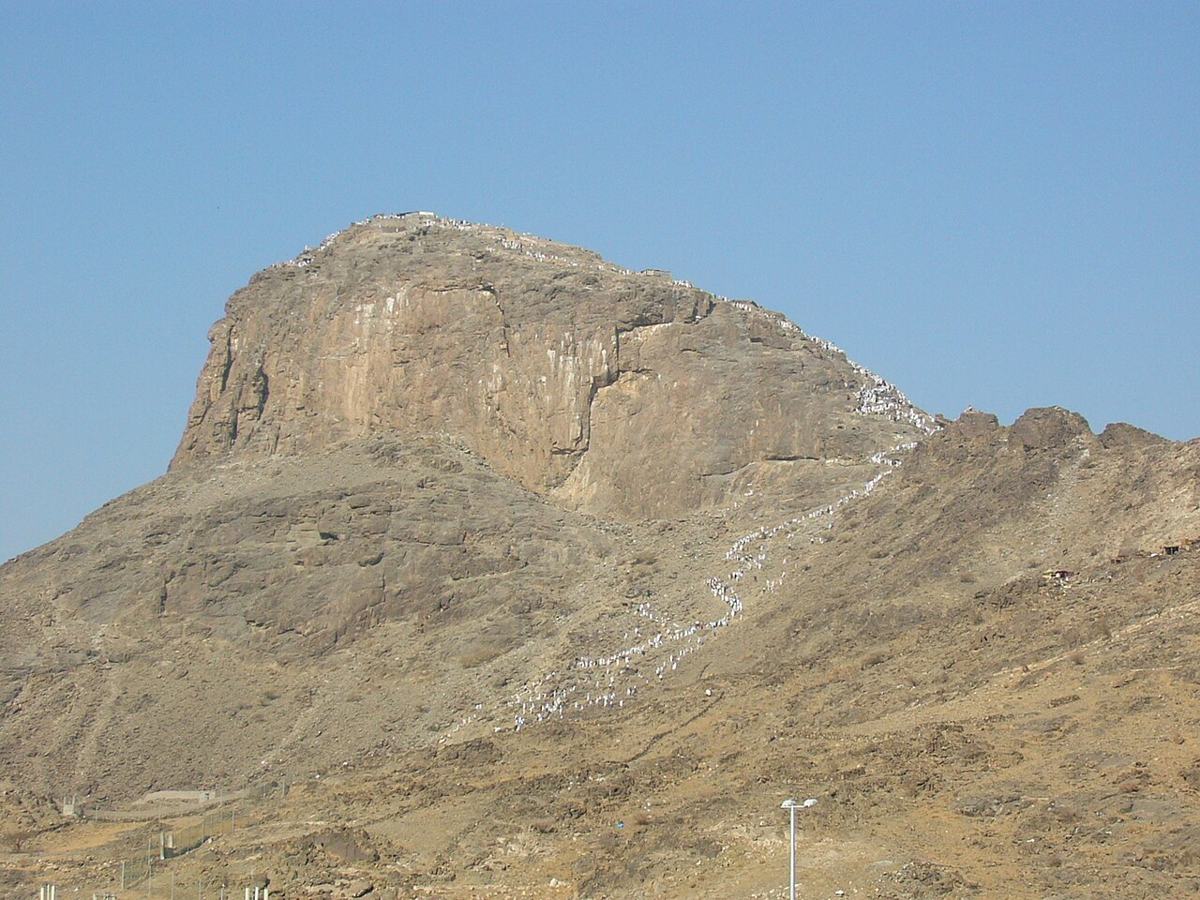
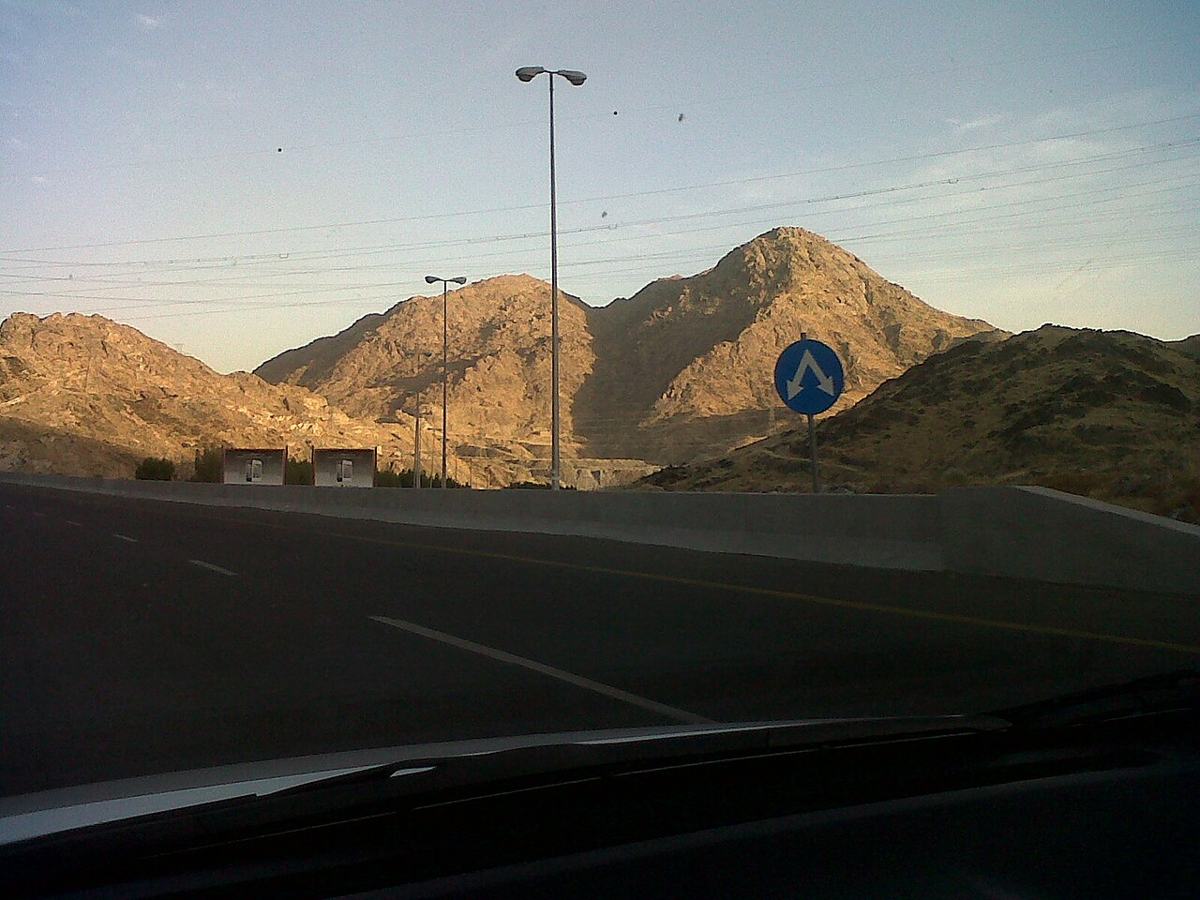
- Jabal al-Nur and the cave of Hira, where the first verses of the Qur'an were revealed.
- Jabal Thawr, where the Prophet ﷺ and Abu Bakr hid during the Hijrah.
- Arafah, Muzdalifah and Mina outside the Hajj days, to see the sites before you need them.
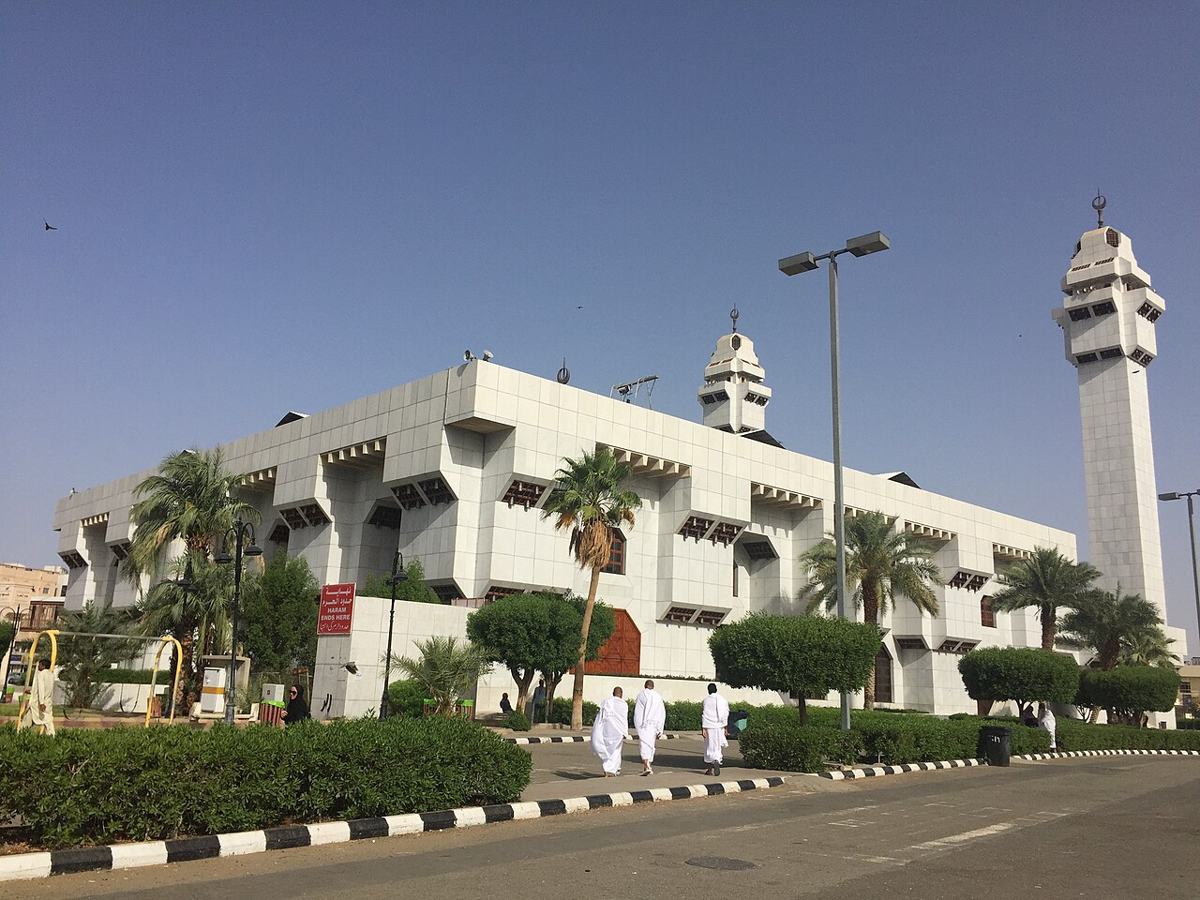
- Masjid al-Ji'ranah and Masjid 'A'ishah at Tan'im, where people staying in Makkah go to enter ihram for Umrah.
Chapter 5
Pillars, Obligations and the Three Ways of Performing Hajj
The six pillars (rukun) and six obligations (wajib) of Hajj, how Umrah differs, and the three ways of combining Hajj and Umrah, Tamattu', Ifrad and Qiran, with the intention for each and the order in which pilgrims usually perform the rites.
The pillars of Hajj
A pillar (rukun) is an act that must be performed for Hajj to be valid. If one is missing, the Hajj is incomplete, "suspended", and the pilgrim remains bound by the prohibitions of ihram until it is done. No dam can replace a pillar.
The six pillars of Hajj in the Shafi'i school are:
- The intention of ihram for Hajj (niat ihram haji).
- Wuquf at Arafah: being present in Arafah between midday on 9 Dhul Hijjah and dawn on the 10th.
- Tawaf: the pillar tawaf of Hajj, called Tawaf al-Ifadah or Tawaf al-Rukn.
- Sa'i: seven laps between Safa and Marwah.
- Shaving or cutting the hair (bercukur or bergunting).
- Order in most of the pillars (tertib): the intention comes before everything else, wuquf before Tawaf al-Ifadah, and tawaf before sa'i.
The obligations of Hajj
An obligation (wajib) is an act that must be performed, but if it is missed the Hajj remains valid: the pilgrim must pay a dam, and is sinful if it was left deliberately without a valid excuse.
The six obligations of Hajj are:
- Making the intention of ihram at the miqat (or before it).
- Avoiding the prohibitions of ihram.
- Spending the night (mabit) in Muzdalifah on the night of the 10th.
- Stoning Jamrah al-Kubra ('Aqabah) on 10 Dhul Hijjah.
- Spending the nights in Mina on the 11th, 12th and 13th (the 13th only if you stay for it).
- Stoning all three Jamarat on the Days of Tashriq.
Tawaf al-Wada' (the farewell tawaf) is also obligatory, in the Shafi'i school, for anyone leaving Makkah after Hajj, see Chapter 18.
How Umrah differs
| Hajj | Umrah | |
|---|---|---|
| Pillars | 1. Intention of ihram for Hajj · 2. Wuquf · 3. Tawaf · 4. Sa'i · 5. Shaving or cutting · 6. Order in most pillars | 1. Intention of ihram for Umrah · 2. Tawaf · 3. Sa'i · 4. Shaving or cutting · 5. Order in all pillars |
| Obligations | Intention at the miqat · avoiding the prohibitions · Muzdalifah · stoning on the 10th · nights in Mina · stoning on the Days of Tashriq | Intention at the miqat · avoiding the prohibitions, nothing else |
| Time | Only in the months of Hajj, with wuquf on 9 Dhul Hijjah | Any time of the year |
The months of Hajj
The intention of ihram for Hajj can only be made in the months of Hajj: from the beginning of Shawwal until just before dawn on 10 Dhul Hijjah. This is the miqat zamani, the "time boundary", of Hajj. An intention for Hajj made outside this period does not become Hajj; it becomes ihram for Umrah.
The three ways of performing Hajj
1. Haji Tamattu', Umrah first, then Hajj
Perform Umrah during the months of Hajj, come out of ihram, then make a new intention for Hajj in the same year, normally on 8 Dhul Hijjah from your building in Makkah.
This is the method most Malaysian pilgrims use, because it allows them to live out of ihram during the weeks of waiting before Hajj.
A dam is due for Tamattu', on these conditions: the pilgrim is not a resident of the Haram; the Umrah was performed in the months of Hajj of the same year; and they did not travel back to a miqat (or as far as one) to make the intention for Hajj. The dam is a sheep or goat (or a seventh share of a cow or camel); someone who cannot afford it fasts ten days, three during Hajj and seven after returning home (Chapter 7).
نَوَيْتُ الْعُمْرَةَ وَأَحْرَمْتُ بِهَا لِلّٰهِ تَعَالَى
Reading Nawaitul-ʿumrata wa aḥramtu bihā lillāhi taʿālā.
Meaning I intend to perform Umrah and I enter ihram for it, for the sake of Allah the Most High.
نَوَيْتُ الْحَجَّ وَأَحْرَمْتُ بِهِ لِلّٰهِ تَعَالَى
Reading Nawaitul-ḥajja wa aḥramtu bihī lillāhi taʿālā.
Meaning I intend to perform Hajj and I enter ihram for it, for the sake of Allah the Most High.
2. Haji Ifrad, Hajj first, then Umrah
Make the intention for Hajj alone at the miqat, perform Hajj, and then perform Umrah afterwards (for example from Tan'im or Ji'ranah). The Shafi'i school regards Ifrad as the best (afdhal) method when Umrah is performed in the same year. No dam is due. It is still counted as Ifrad if the Umrah was performed before the months of Hajj.
An Ifrad pilgrim stays in ihram from the miqat until the tahallul of Hajj, which may be weeks. They perform Tawaf al-Qudum (the arrival tawaf) on reaching Makkah and may do the sa'i of Hajj after it.
3. Haji Qiran, Hajj and Umrah together
Way 1: make the intention for Hajj and Umrah together at the miqat. Perform all the pillars and obligations of Hajj; the Umrah is completed along with it, "two in one". A dam is due, as for Tamattu'.
نَوَيْتُ الْحَجَّ وَالْعُمْرَةَ وَأَحْرَمْتُ بِهِمَا لِلّٰهِ تَعَالَى
Reading Nawaitul-ḥajja wal-ʿumrata wa aḥramtu bihimā lillāhi taʿālā.
Meaning I intend to perform Hajj and Umrah and I enter ihram for both, for the sake of Allah the Most High.
Way 2: make the intention for Umrah only, but before starting its tawaf, add the intention for Hajj. This becomes Qiran.
The course gives the typical case for Way 2: a woman's period began after she intended Umrah (obligatory or voluntary), and it has not ended by the time the group leaves for Arafah. She cannot perform tawaf, so she cannot finish her Umrah. In the Shafi'i school, as long as she has not begun the tawaf of Umrah, she may add the intention for Hajj before leaving for Arafah; her Hajj becomes Qiran and a Qiran dam is due. If she has already begun the tawaf, she can no longer add Hajj (Hajj cannot be put into an Umrah), and she cannot perform Hajj that year. The same applies to a pilgrim who could not finish Umrah because of illness, an obstacle or a coma. (The Maliki school allows Hajj to be added into the Umrah before leaving for Arafah, as long as she has not ended her tawaf with the two rak'ahs of tawaf.) If she has already paid the Tamattu' dam, she should tell the officer in charge that her intention has changed to Qiran.
Summary of the three methods
| Tamattu' | Ifrad | Qiran | |
|---|---|---|---|
| Intention at the miqat | Umrah | Hajj | Hajj and Umrah |
| Out of ihram before Hajj? | Yes, after Umrah | No | No |
| New intention on 8 Dhul Hijjah? | Yes, for Hajj, from Makkah | No (already in ihram) | No (already in ihram) |
| Tawaf al-Qudum | Not applicable | Sunnah | Sunnah |
| Sa'i of Hajj | After Tawaf al-Ifadah | After Tawaf al-Qudum or after Tawaf al-Ifadah | After Tawaf al-Qudum or after Tawaf al-Ifadah |
| Dam | Yes | No | Yes |
The order of the rites after Arafah
After wuquf, pilgrims do not all follow the same order. The course shows several common sequences, all valid, depending on how a group is organised:
| Sequence | 9th | Night of the 10th | 10th onwards |
|---|---|---|---|
| Typical for pilgrims staying in Mina | Wuquf | Muzdalifah after midnight | Stone 'Aqabah → shave/cut (first tahallul) → nights in Mina and stoning on the 11th–13th → Tawaf al-Ifadah and sa'i in Makkah (second tahallul) |
| Tawaf on the 10th | Wuquf | Muzdalifah after midnight | Stone 'Aqabah → shave/cut (first tahallul) → Tawaf al-Ifadah and sa'i (second tahallul) → back to Mina for the nights and stoning |
| Tawaf straight after Muzdalifah | Wuquf | Muzdalifah after midnight → Tawaf al-Ifadah and sa'i in Makkah | Shave/cut (first tahallul) → stone 'Aqabah (second tahallul) → nights in Mina and stoning |
The rules that stay fixed are: wuquf comes before Tawaf al-Ifadah; tawaf comes before sa'i; and the stoning, the hair and Tawaf al-Ifadah can only begin after midnight on the night of the 10th.
Sunnahs of Hajj
Alongside the pillars and obligations, there are many sunnah acts, including: the ritual bath before ihram, wearing white ihram cloths, two rak'ahs before ihram, the talbiah from the intention until the first stone on the 10th, Tawaf al-Qudum for Ifrad and Qiran pilgrims, collecting pebbles at Muzdalifah, and staying in Mina on the night of the 9th (the Sunnah way). Each chapter that follows points out the sunnahs of each rite.
Chapter 6
Miqat and Ihram: Entering the Sacred State
Where and when you must enter ihram, how to prepare your body and clothing, what men and women wear, how to make the intention, and the talbiah you will repeat until the stoning on the 10th.
What ihram is
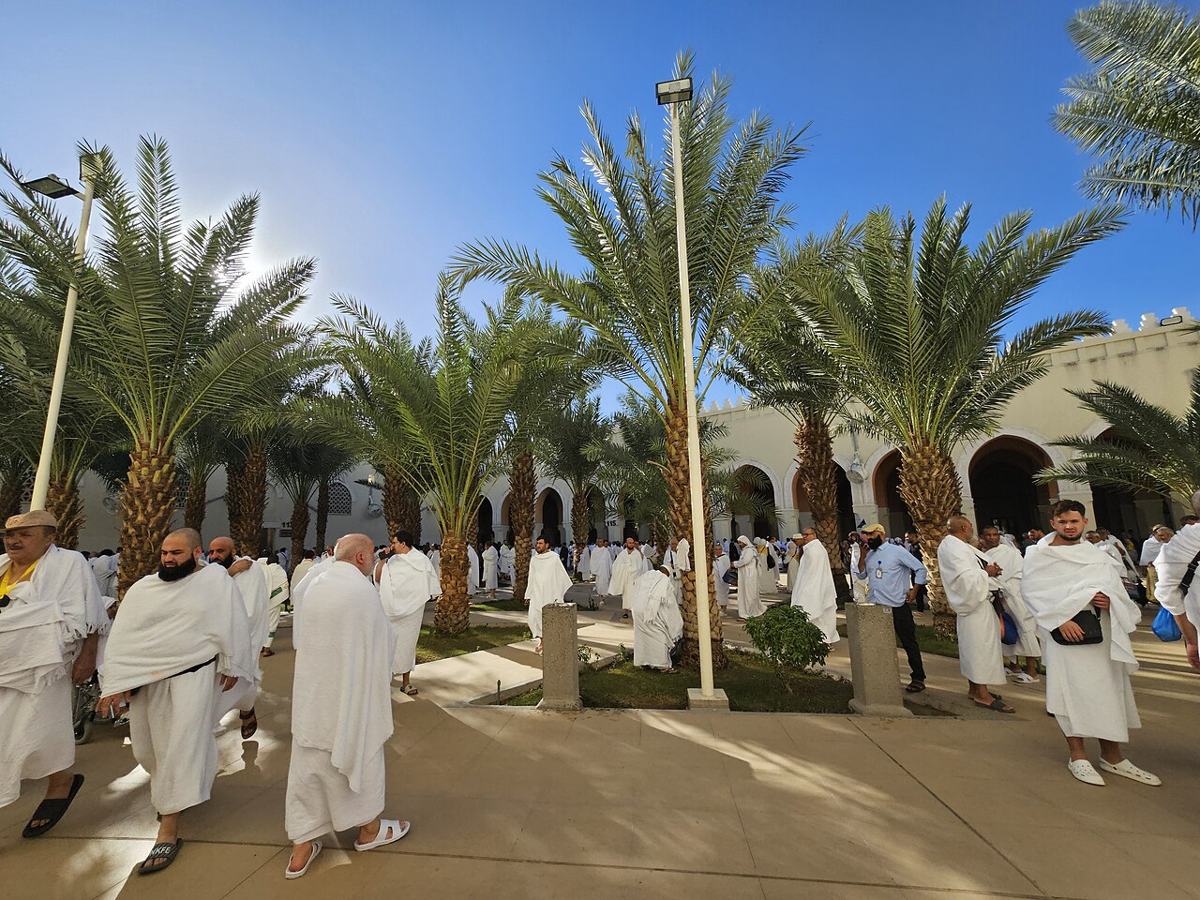
Ihram is the sacred state a pilgrim enters by making the intention (niat) for Hajj or Umrah. It is not the clothing: the white sheets are what a man wears in ihram, but the ihram itself begins with the intention in the heart. From that moment the prohibitions of ihram apply until the pilgrim comes out of it through tahallul.
The miqat: boundaries of time and place
Miqat means a boundary, of time or of place, for entering ihram.
The time boundary (miqat zamani)
- For Hajj: from the start of Shawwal until just before dawn on 10 Dhul Hijjah, the months of Hajj. An ihram for Hajj outside this period is not valid as Hajj; it becomes ihram for Umrah.
- For Umrah: any time of the year, except while you are still busy with the rites of Hajj.
The place boundaries (miqat makani)
Anyone coming from outside the Haram and intending Hajj or Umrah must enter ihram at or before the miqat on their route. The Prophet ﷺ set five:
| Miqat | For people coming from |
|---|---|
| Dhul Hulayfah (Bir Ali) | Madinah |
| Al-Juhfah (today pilgrims use the nearby town of Rabigh) | Syria, Egypt, North Africa |
| Qarn al-Manazil (al-Sayl al-Kabir) | Najd, and pilgrims flying in from Asia, including Malaysia |
| Yalamlam | Yemen |
| Dhat 'Irq | Iraq |
What this means for Malaysian pilgrims
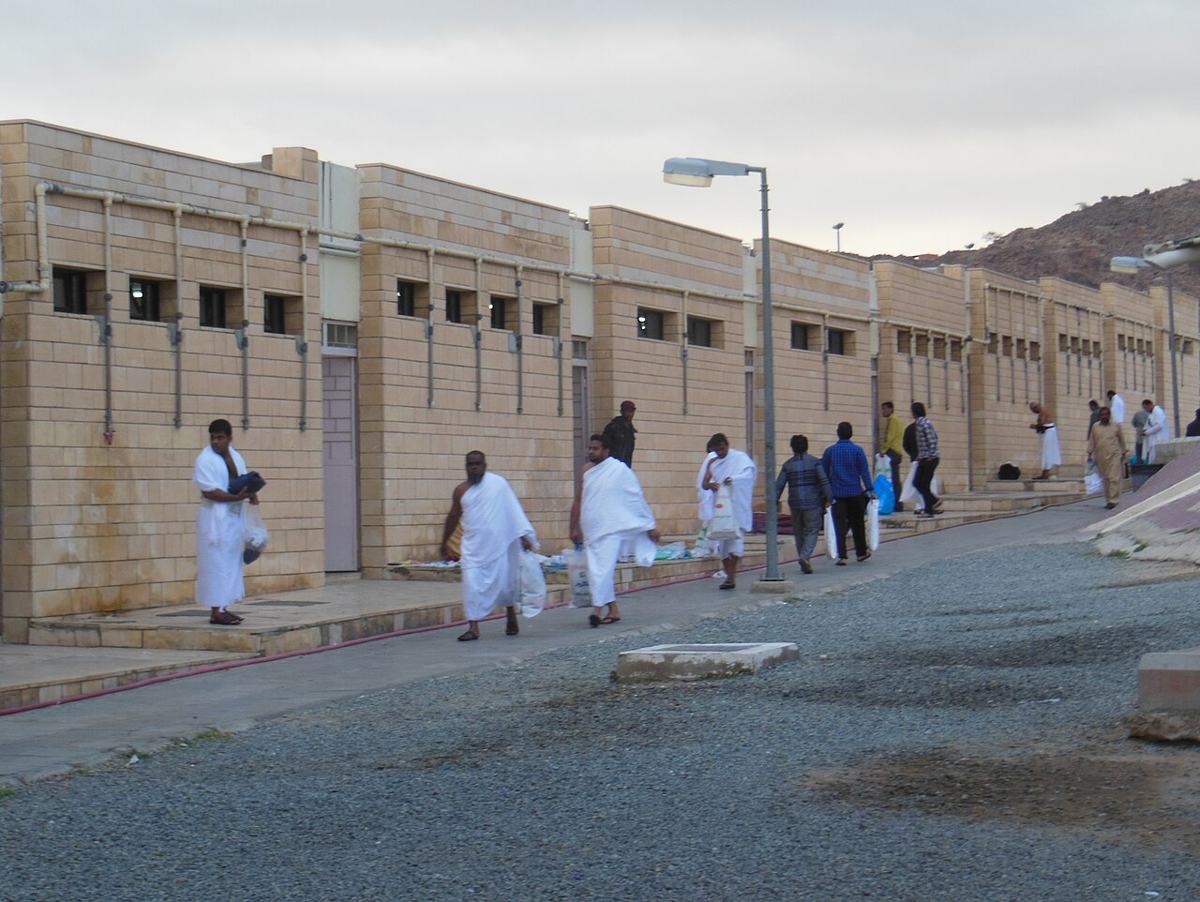
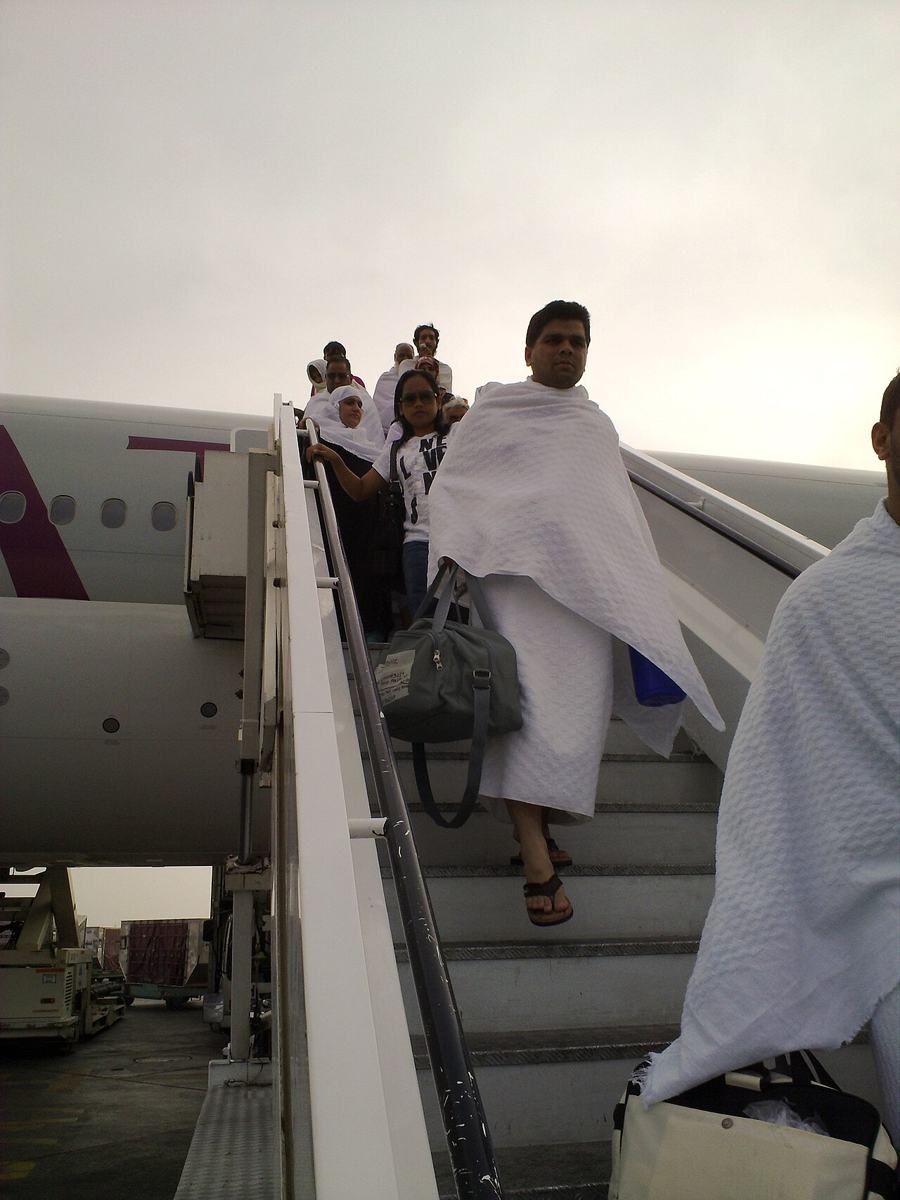
- Going straight to Makkah: your miqat is Qarn al-Manazil. Your flight passes over or near it before landing in Jeddah, so you enter ihram on the plane. Change into ihram clothing before boarding (at home, at the Tabung Haji complex in Kelana Jaya, Bayan Lepas or Kota Kinabalu, or at the airport) and make the intention when the crew announces that you are approaching the miqat. Jeddah is not a miqat for pilgrims flying from Malaysia.
- Going to Makkah from Madinah: your miqat is Dhul Hulayfah (Bir Ali), about 10 km from Madinah. The bus stops at Masjid Miqat, where you can bathe, pray and make your intention.
If you are already in Makkah
Anyone already inside Makkah, for example a pilgrim who wants to perform a voluntary Umrah, must go out of the Haram to the nearest tanah halal (land outside the sacred boundary) to enter ihram for Umrah. The most common places are:
- Ji'ranah: about 22 km, north-east of Makkah, where the Prophet ﷺ entered ihram after the Battle of Hunayn.
- Tan'im: Masjid 'A'ishah (Masjid Tan'im), the nearest, about 5 km from Masjid al-Haram.
- Hudaybiyah: also called Shumaisi, about 29 km west of Makkah, on the road to Jeddah.
For Hajj, a person already in Makkah, including a Tamattu' pilgrim on 8 Dhul Hijjah, enters ihram from where they are, at their building.
Preparing for ihram: the sunnahs
Before the intention
- Cut your nails.
- Trim your beard, moustache and hair.
- Remove armpit and pubic hair.
- Take the ritual bath for ihram (mandi sunat ihram), even a woman who is menstruating should take it.
- Perform wudu.
- Apply perfume to your body: not to the ihram cloth.
- Oil your hair if you wish.
- Men put on two clean white sheets.
- Pray two rak'ahs of the sunnah prayer of ihram, if it is not a disliked time.
While making the intention
- Face the qiblah.
- Be in a state of wudu.
After the intention
- Recite the talbiah, make du'a, read the Qur'an and remember Allah.
- Avoid idle chatter (lagha).
Clothing in ihram
For men
- Two unstitched sheets: one wrapped around the waist covering from the navel to below the knee (izar), the other over the shoulders (rida'). White is sunnah.
- No stitched or fitted garments that surround the body or a limb: no shirts, trousers, underwear, socks or caps.
- The head must stay uncovered.
- Sandals or slippers that leave the toes and heel uncovered. As the course puts it, you should be able to see all five toes and the heel of each foot.
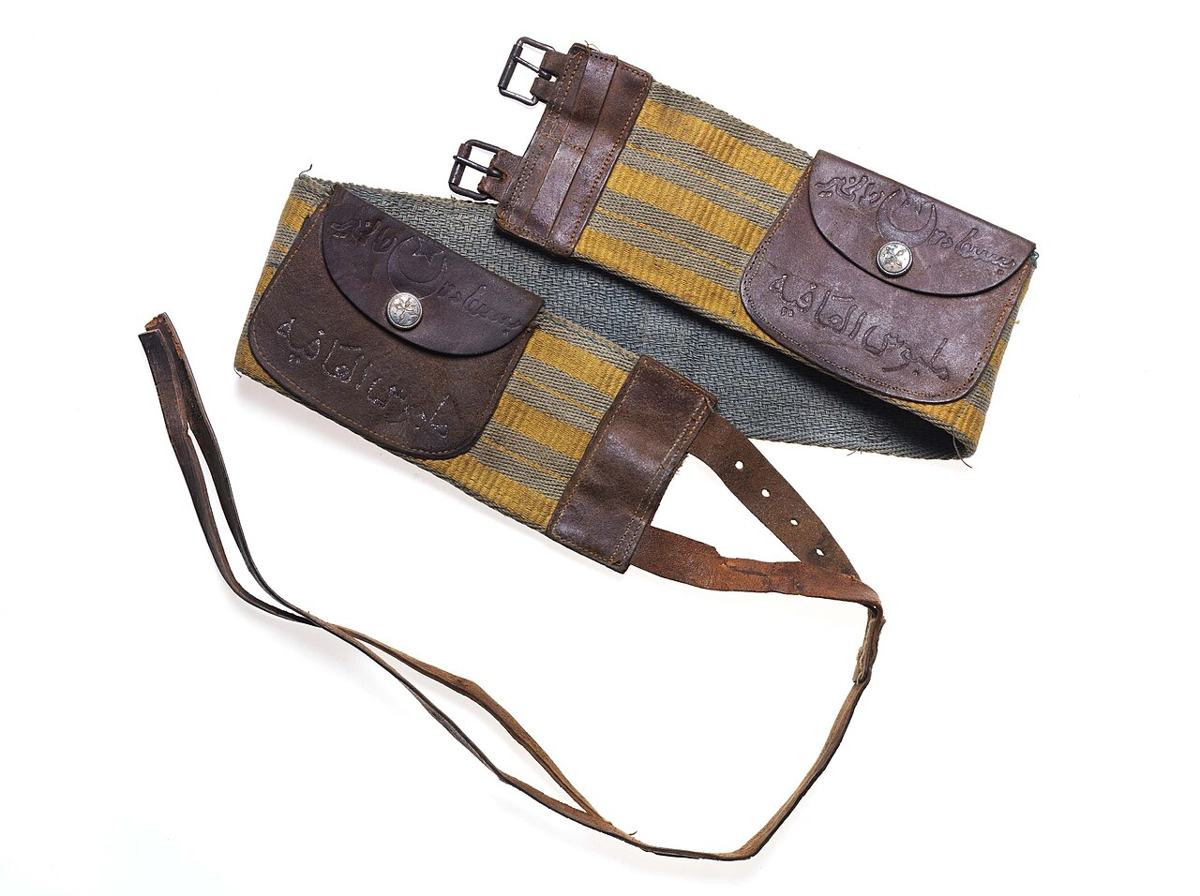
- A belt or money pouch to hold the izar and your documents, a watch, glasses, a ring and a bag hanging from the shoulder are allowed.
Uncovering the right shoulder (idtiba')
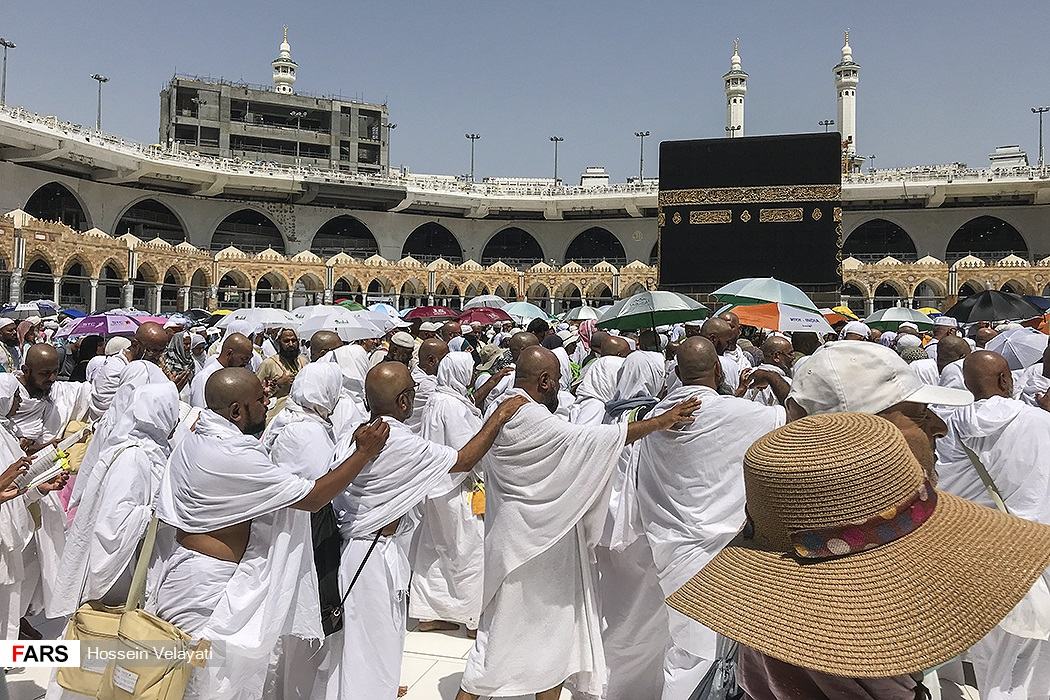
Idtiba' means passing the upper sheet under the right arm and over the left shoulder, leaving the right shoulder bare. It is sunnah only during a tawaf that is followed by sa'i, and during that sa'i, and you begin it only when you are about to start the tawaf. Do not do it at other times, not at the airport, not on the bus, and not in prayer, where it is disliked. Cover both shoulders again before praying the two rak'ahs after tawaf.
For women
- No special garment. A woman wears ordinary clothing that covers her whole body except the face and the hands. Any colour is permitted; most choose white or plain colours.
- The face must be uncovered: no niqab or anything that sits on the face. A woman may lower a cloth that hangs away from the face if men are near.
- No gloves covering the fingers and palms.
- Wear socks: thick, long socks that do not show the colour of the skin are recommended.
- Avoid make-up without need: it invites attention and showing off.
- Make sure your telekung or headscarf is suitable, covers properly and is not see-through.
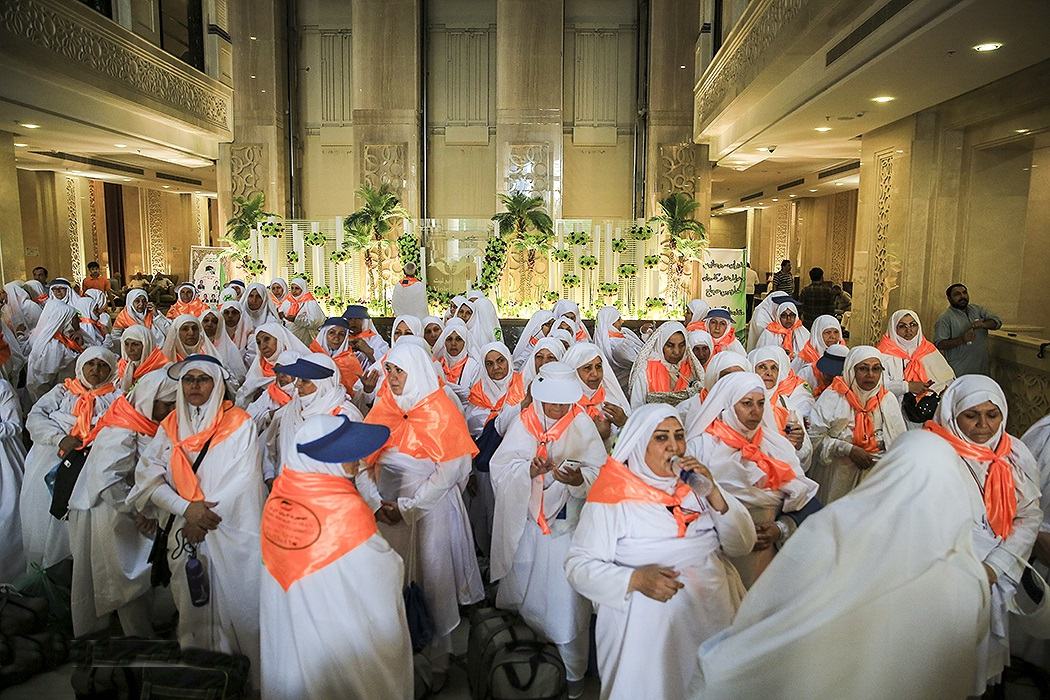
Making the intention
When everything is ready, at the miqat, or on the plane when the announcement is made:
- Face the qiblah if you can.
- Make the intention in your heart for Umrah (Tamattu'), Hajj (Ifrad) or both (Qiran). You may also say it.
- Begin the talbiah straight away.
نَوَيْتُ الْعُمْرَةَ وَأَحْرَمْتُ بِهَا لِلّٰهِ تَعَالَى
Reading Nawaitul-ʿumrata wa aḥramtu bihā lillāhi taʿālā.
Meaning I intend to perform Umrah and I enter ihram for it, for the sake of Allah the Most High.
نَوَيْتُ الْحَجَّ وَأَحْرَمْتُ بِهِ لِلّٰهِ تَعَالَى
Reading Nawaitul-ḥajja wa aḥramtu bihī lillāhi taʿālā.
Meaning I intend to perform Hajj and I enter ihram for it, for the sake of Allah the Most High.
The talbiah
The talbiah is the pilgrim's answer to Allah's call. Men say it aloud; women say it so that only they can hear. Repeat it often, when you set out, when you climb or descend, when you meet others, after prayers, from the moment of your intention:
- for Umrah: until you begin tawaf;
- for Hajj: until you throw your first pebble at Jamrah al-'Aqabah on the 10th.
لَبَّيْكَ اللّٰهُمَّ لَبَّيْكَ، لَبَّيْكَ لَا شَرِيكَ لَكَ لَبَّيْكَ، إِنَّ الْحَمْدَ وَالنِّعْمَةَ لَكَ وَالْمُلْكَ، لَا شَرِيكَ لَكَ
Reading Labbaik Allāhumma labbaik, labbaika lā sharīka laka labbaik, innal-ḥamda wan-niʿmata laka wal-mulk, lā sharīka lak.
Meaning Here I am, O Allah, here I am. Here I am, You have no partner, here I am. All praise, all blessings and all sovereignty belong to You. You have no partner.
After the talbiah it is sunnah to send blessings on the Prophet ﷺ and ask Allah for His pleasure and Paradise, and for protection from the Fire.
Ihram step by step
- At home or at the departure complex: cut nails, trim hair, bathe, put on perfume (body only).
- Men: put on the two ihram sheets and suitable sandals. Women: put on modest clothing, socks and a proper headscarf, leaving the face and hands uncovered.
- Pray two rak'ahs if possible.
- At the miqat (or on the plane at the announcement): face the qiblah and make your intention.
- Recite the talbiah, and keep it up throughout the journey.
- From now on, observe every prohibition of ihram (Chapter 7).
Chapter 7
The Prohibitions of Ihram and Dam
The thirteen things forbidden in ihram, grouped so they are easy to remember; what remains allowed; why some mistakes carry a penalty even when made by accident; and the different kinds of dam, when each is due and how it is paid.
The prohibitions, in five groups
The course groups the prohibitions of ihram into five categories: clothing, perfume, grooming, the natural environment, and relations between the sexes.
1. Clothing
- Men: wearing stitched or fitted clothing that encloses the body or a limb, shirts, trousers, underwear, socks.
- Men: covering the head, or part of it, with anything that touches it, a cap, a turban, a towel.
- Women: covering the face.
- Men and women: wearing gloves.
2. Perfume
- Using perfume on the body, on clothing, in food or drink, or deliberately sniffing it, men and women. Avoid scented soap, scented wet wipes, perfumed creams and scented tissues while in ihram.
3. Grooming
- Oiling the hair of the head or beard: and any facial hair other than what grows on the cheeks and forehead, men and women.
- Removing hair from any part of the body, by cutting, shaving, plucking or pulling, men and women.
- Cutting or breaking off nails: men and women.
4. The natural environment
- Cutting, felling or uprooting trees and plants in the Haram (Makkah, Mina and Muzdalifah). This applies to everyone in the Haram, whether in ihram or not. Cutting plants on tanah halal such as Arafah does not incur dam.
- Hunting or harming wild game that is lawful to eat, for someone in ihram, both inside and outside the Haram; and for anyone, in ihram or not, inside the Haram. Even a locust counts as game.
5. Relations between the sexes
- Foreplay: touching with desire, kissing, embracing.
- Sexual intercourse.
- Marriage: getting married, marrying someone off, or acting as a representative in a marriage contract.
The course adds detail from the national Hajj council (Muzakarah Haji): deliberate skin-to-skin contact between a man and a woman with desire during ihram is sinful and incurs dam for the man, whether or not there is ejaculation; contact through a barrier with desire is sinful but carries no dam; and the same applies to contact with desire between two people of the same sex.
What is still allowed
- Bathing and washing, gently, without trying to remove hair.
- Changing and washing your ihram sheets.
- Wearing a watch, glasses, a ring, a belt or money pouch, and a shoulder bag.
- Shade from an umbrella, a tent or a vehicle roof.
- Wearing sandals that leave the toes and heel uncovered (men).
- Killing harmful creatures such as scorpions, snakes, rats and mosquitoes.
- Taking medicines, injections and eye drops (unperfumed).
- Using unscented soap and unscented toiletries.
Two kinds of violation: taraffuh and itlaf
This distinction explains why some mistakes carry a penalty even when made by accident.
| Taraffuh, enjoyment | Itlaf, destruction | |
|---|---|---|
| What it covers | Things people do for comfort and pleasure: stitched clothes, covering the head or face, gloves, perfume, oiling hair, intercourse and foreplay, marriage | Things that remove or destroy: hair, nails, game, plants |
| If done deliberately | Sinful, and dam is due | Sinful, and dam is due |
| If done by forgetting, or not knowing the ruling | No sin and no dam | No sin, but dam is still due |
So if you forgot you were in ihram and covered your head, simply uncover it as soon as you remember. But if you trimmed your nails out of habit, a dam is still due, because something has been destroyed.
What dam means
Dam literally means "blood". In the shariah it is a compensation made by slaughtering a sheep, goat, cow or camel in the Haram, or a substitute of food for the poor of the Haram, or fasting, required of a pilgrim for specific reasons. A dam is due for:
- doing something forbidden in ihram;
- leaving an obligation (wajib) of Hajj or Umrah;
- performing Tamattu' or Qiran (on their conditions);
- missing the wuquf at Arafah after entering ihram;
- leaving Tawaf al-Wada' without a valid excuse;
- being prevented from completing Hajj or Umrah after entering ihram (ihsar);
- breaking a vow (nazar) made in connection with Hajj.
In the course, food is measured in cupak (one mudd, roughly a double handful of the local staple). Your Hajj body will tell you the current price of a dam and of a cupak; pay through the official channel.
The kinds of dam
1. Dam in order and fixed in amount (tartib dan taqdir)
When it is due: Tamattu'; Qiran; passing the miqat without ihram; missing wuquf; missing the stoning; missing the nights in Mina or at Muzdalifah (without excuse); leaving Tawaf al-Wada'; breaking a Hajj-related vow.
What to pay, in order, you move to the next only if you cannot do the one before:
- Slaughter a sheep or goat, or a seventh share of a cow or camel.
- If you cannot, fast ten days: three during the Hajj (while still in ihram for Hajj) and seven after returning home.
If a person dies before completing the fast, ten cupak of food are paid from their estate in place of it.
2. Dam with a choice, fixed in amount (takhyir dan taqdir)
When it is due: removing three or more hairs; cutting nails (three or more); men wearing fitted clothing; covering the head (men) or face (women); wearing gloves; using perfume; oiling the hair or beard; and, with the dam on the man only, foreplay, intercourse after the first tahallul but before the second, and a second act of intercourse after one that spoiled the Hajj.
What to pay, choose one:
- slaughter a sheep or goat; or
- give three gantang (twelve cupak) of food to six poor people of the Haram, two cupak each; or
- fast three days.
For one hair or one nail the penalty is one cupak of food; for two, two cupak.
3. Dam in order, with a valuation (tartib dan ta'dil): intercourse that spoils the Hajj
Intercourse before the first tahallul in Hajj, or before completing Umrah, spoils it. The pilgrim must still complete the spoiled Hajj or Umrah, make it up (qada') in a later year, and pay, the husband only, in this order:
- a camel; if not possible,
- a cow; if not possible,
- seven sheep or goats; if not possible,
- food to the value of a camel, given to the poor of the Haram; if not possible,
- fast one day for every cupak of food that the value of a camel would buy.
4. Dam with a choice and a valuation (takhyir dan ta'dil): game and plants
For hunting or killing game, choose one:
- slaughter an animal similar to the game killed (for example a cow for a deer, a goat for a gazelle); or
- buy food to the value of that animal and give it to the poor of Makkah; or
- fast one day for every cupak that value would buy.
For cutting, felling or uprooting a tree in the Haram of Makkah (except a dead tree) the same applies: a cow for a large tree, a goat for a small one, or their value in food or fasting.
5. Dam of ihsar: when you are prevented from finishing
Ihsar is when a pilgrim in ihram is prevented from completing the pillars of Hajj or Umrah, blocked by an enemy, besieged, or held back by serious illness. To leave ihram:
- Slaughter a sheep or goat and shave or cut the hair, with the intention of tahallul;
- if not possible, buy food to the value of a goat for the poor where the tahallul is made, and shave or cut;
- if not possible, fast one day for every cupak that value would buy, and shave or cut. The tahallul takes effect with the shaving, even before the fasting is finished.
The course gives two common modern cases: a woman whose period has not ended and who must fly home before Tawaf al-Ifadah or the tawaf of Umrah, and a seriously ill pilgrim sent home for treatment before finishing. They perform the tahallul of ihsar after they have travelled two marhalah (about 91 km) from Makkah, or once home.
Meaning "I slaughter this goat as the dam of ihsar for the tahallul of my Hajj (or Umrah).", or, "I shave (or cut) my hair for the tahallul of my Hajj (or Umrah).", or, "I give this food in place of the goat of ihsar for the tahallul of my Hajj (or Umrah).", or, "I fast tomorrow in place of the goat of ihsar for the tahallul of my Hajj (or Umrah)."
Practical tips
- Before your intention, finish cutting nails and trimming hair.
- Pack unscented soap, shampoo, deodorant and wet wipes.
- Do not scratch your head hard, comb your hair or rub your beard, loose hairs may fall. If a hair falls by itself without your action, there is nothing on you.
- Keep a spare ihram sheet in your bag.
- If you are unsure whether you owe a dam, ask your group's religious guide before you leave Makkah. Pay through Tabung Haji or your official Hajj body, never to unofficial collectors.
Chapter 8
Tawaf: Circling the Ka'bah
The kinds of tawaf, the conditions that make it valid, how to perform it round by round, its sunnahs and du'a, what breaks it and what is merely disliked, how to resume a broken tawaf, and tawaf in a wheelchair or on the upper floors.
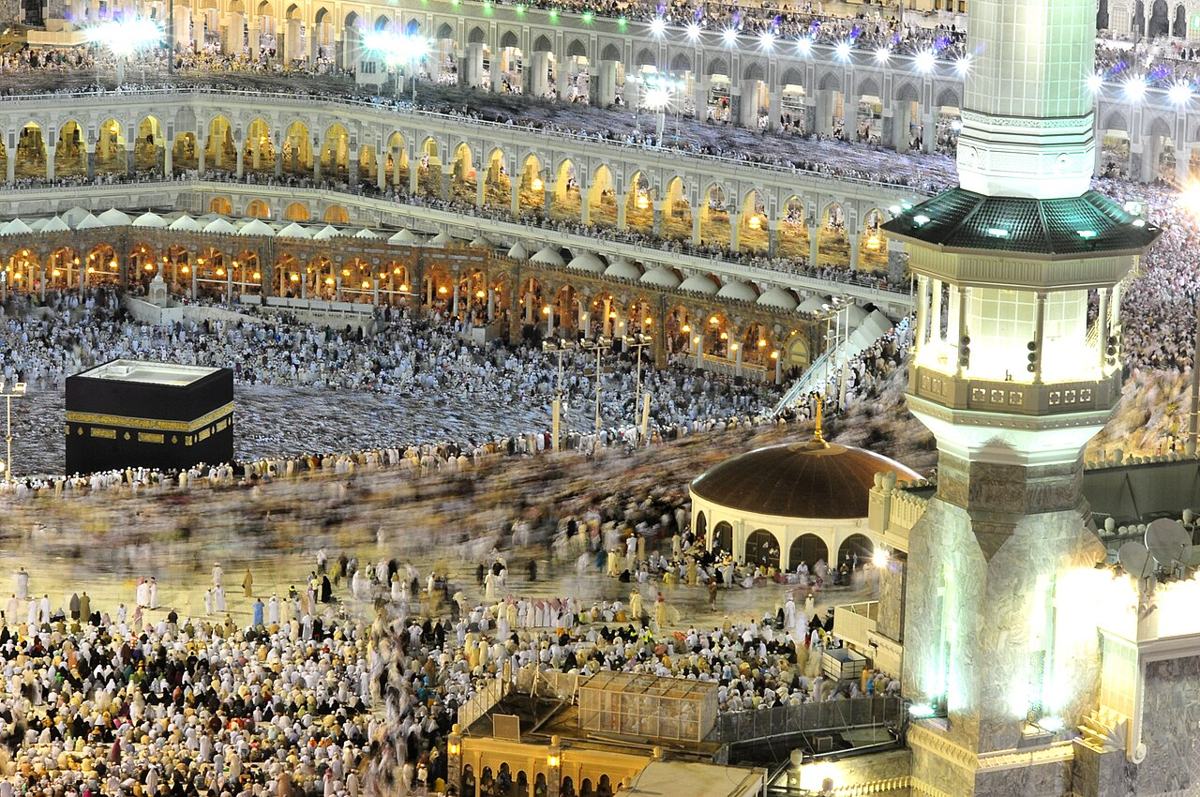
What tawaf is
Tawaf is walking around the Ka'bah seven times according to its conditions. Some kinds of tawaf are pillars, some obligations and some sunnah, but they are all performed in the same way.
The kinds of tawaf
| Tawaf | Ruling | When |
|---|---|---|
| Tawaf al-Rukn: Tawaf al-Ifadah for Hajj, the tawaf of Umrah for Umrah | Pillar | Hajj: from midnight of the 10th onwards. Umrah: on arrival in Makkah. |
| Tawaf al-Qudum (arrival) | Sunnah, for Ifrad and Qiran pilgrims, or a visitor to Makkah not in ihram | On arriving in Makkah |
| Tawaf al-Wada' (farewell) | Obligatory before leaving Makkah | Just before departure (Chapter 18) |
| Tawaf tahiyyat al-Bait (greeting the House) | Sunnah | On entering Masjid al-Haram |
| Tawaf sunat (voluntary) | Sunnah | Any time |
| Tawaf nazar (vowed) | Obligatory on the one who vowed it | As vowed |
Is a spoken intention needed?
- For the tawaf of Umrah, Tawaf al-Ifadah and the Tawaf al-Qudum of an Ifrad or Qiran pilgrim, no separate intention is required: they are part of the ihram you already entered.
- For a voluntary tawaf, a vowed tawaf, Tawaf al-Wada', tawaf greeting the House, and Tawaf al-Qudum of someone simply visiting Makkah, you must make the intention, for example:
Meaning "O Allah, I intend to circle Your Sacred House seven times as a [voluntary / farewell / vowed] tawaf. Make it easy for me and accept it from me, for the sake of Allah."
The conditions of a valid tawaf
- Purity from minor and major ritual impurity (hadas), you must have wudu, and be free of janabah, menstruation and post-natal bleeding.
- Purity of body, clothing and the ground from najis (filth).
- Covering the 'awrah: throughout every round.
- Starting at the Black Stone, with your whole body passing it.
- Keeping the Ka'bah on your left and walking forwards.
- Seven complete rounds, with certainty.
- Inside Masjid al-Haram (any floor), and outside the Hijr Ismail and the Shadharwan.
- Walking for the purpose of tawaf: your intention must not be diverted to something else, such as searching for a friend.
Wudu and the crowds: the ruling on touching
In the main Shafi'i position, skin contact between a man and a woman who are not mahram breaks wudu. In the crushing crowds of the mataf this would make tawaf almost impossible. The Malaysian national Hajj council (Muzakarah Haji, 21st and 22nd sessions) therefore allowed pilgrims, as a concession (rukhsah) in genuine hardship, to follow the weaker opinion within the Shafi'i school: contact without desire, in the crowd, does not break wudu.
This concession applies:
- from the time you leave your building until you are inside Masjid al-Haram or Masjid Nabawi; and
- in situations of genuine hardship during the Hajj or Umrah journey, such as on crowded planes or buses.
It does not cover anything else that breaks wudu. If you pass wind or use the toilet, your wudu is broken and must be renewed.
Be careful of najis
The course warns pilgrims to watch for impurity during tawaf from:
- sandals carried in a bag, wrap them in a plastic bag;
- small children in nappies being carried;
- soiled clothing;
- bird droppings falling in the open mataf.
The 'awrah of men in tawaf
- A man's 'awrah is from the navel to the knee.
- As a matter of courtesy, men should also keep the upper body covered.
- Idtiba' is only for a tawaf followed by sa'i, and is begun only when you are about to start that tawaf.
The details for women are in Chapter 15.
The start line
A green light on a pillar of the mosque, directly opposite the Black Stone, marks the place where tawaf starts and ends. Because of the expansion of Masjid al-Haram and the mataf, the area may look different from older pictures, but the green light is still in line with the Black Stone as the marker for starting tawaf. The upper floor has its own marked place for starting and ending tawaf.
Tawaf, step by step
- Make sure you have wudu, your 'awrah is covered and your clothes are clean. Men performing a tawaf followed by sa'i uncover the right shoulder (idtiba').
- For a tawaf that needs one, make the intention.
- Stand level with the Black Stone, facing it, a little before the green light so your whole body passes the start.
- Touch or kiss the Black Stone if you can do so without hurting anyone. Otherwise, which will be the case for almost everyone, raise your right hand towards it (istilam), say "Bismillah, Allahu Akbar", and kiss your hand. Do not push.
- Turn so the Ka'bah is on your left and begin walking.
- Men performing a tawaf followed by sa'i walk briskly with short steps (ramal) in the first three rounds only, if the crowd allows. Walk normally in rounds four to seven. Women always walk normally.
- Make du'a and dhikr in any language. There is no fixed du'a for each round; booklets are helpful, but understanding what you say matters more.
- At the Rukn Yamani, touch it (istilam) with your right hand if you can do so without pushing, without kissing it.
- Between the Rukn Yamani and the Black Stone, recite "Rabbana atina…".
- When you reach the Black Stone line again, one round is complete. Gesture to the Stone and say "Bismillah, Allahu Akbar" at the start of each new round.
- After the seventh round, cover your right shoulder again.
- Pray two rak'ahs of tawaf at Maqam Ibrahim if possible, but anywhere in the mosque is valid. Do not block people in the mataf to pray right behind the Maqam.
- Make du'a at the Multazam, if you can reach it calmly.
- Drink Zamzam and make du'a.
- If it is a tawaf followed by sa'i, go on to Safa.
بِسْمِ اللّٰهِ وَاللّٰهُ أَكْبَرُ
Reading Bismillāhi wallāhu akbar.
Meaning In the name of Allah, and Allah is the Greatest.
رَبَّنَا آتِنَا فِي الدُّنْيَا حَسَنَةً وَفِي الْآخِرَةِ حَسَنَةً وَقِنَا عَذَابَ النَّارِ
Reading Rabbanā ātinā fid-dunyā ḥasanah, wa fil-ākhirati ḥasanah, wa qinā ʿadhāban-nār.
Meaning Our Lord, give us good in this world and good in the Hereafter, and protect us from the punishment of the Fire.
Surah al-Baqarah 2:201
وَاتَّخِذُوا مِن مَّقَامِ إِبْرَاهِيمَ مُصَلًّى
Reading Wattakhidhū min maqāmi Ibrāhīma muṣallā.
Meaning And take the station of Ibrahim as a place of prayer.
Surah al-Baqarah 2:125
The sunnahs of tawaf
- Idtiba' (men, for a tawaf followed by sa'i).
- Ramal in the first three rounds (men, for a tawaf followed by sa'i).
- Touching and kissing the Black Stone, or gesturing to it.
- Touching the Rukn Yamani without kissing it.
- Dhikr and du'a throughout.
- Performing the seven rounds continuously, one after another.
- Humility (tawadhu') and concentration (khusyuk).
- Walking, if able.
- Two rak'ahs after tawaf.
What breaks tawaf
The course lists these as invalidating the round in which they happen:
- Deliberately exposing the 'awrah.
- Touching the Ka'bah or its cloth, including stepping on the Shadharwan.
- Being diverted from the intention of tawaf: for example walking round searching for a friend until you forget you are in tawaf.
- Touching or entering the Hijr Ismail.
- Not being certain of the seven rounds without adding a round to make sure. If you are unsure whether you have done six or seven, add one more round.
Losing your wudu also interrupts tawaf, because purity is one of its conditions.
What is disliked but does not break tawaf
- Eating or drinking during tawaf.
- Unbecoming conversation.
- Reciting du'a loudly in a way that disturbs others.
- Talking on the mobile phone.
- Ramal in all seven rounds (it is only for the first three).
- Holding in wind or the need to urinate or open the bowels, go and relieve yourself, renew wudu and resume.
How to resume a broken tawaf
If your wudu breaks or a round becomes invalid:
- Leave, renew your wudu (or fix the problem) and come back.
- You may continue from the point where the round was broken.
- It is better, though, to repeat that round from the Black Stone.
- The rounds already completed are still counted.
If the call to a congregational prayer (iqamah) is made while you are in tawaf, join the prayer, then continue from where you stopped.
Wheelchairs and the upper floors
- Tawaf on the first floor and roof is valid, they are part of the mosque. The rounds are much longer (the roof round can be over a kilometre), so allow more time.
- There is a dedicated route for wheelchairs on the upper level. Family members are encouraged to push the wheelchair of their own relatives, or to walk beside a hired pusher.
- When one person pushes another in a wheelchair, the tawaf counts for both of them, as long as each has the intention. This is different from carrying someone, where only one person's tawaf counts.
Tawaf tips
- Keep your sandals in a small bag (wrapped) or leave them at the shoe racks near your gate. Note the rack number.
- Agree a meeting point with your companions, for example the green light, or a numbered gate, before you start.
- Avoid the peak times after the obligatory prayers, especially Maghrib and Isha. Late morning is often easier.
- Keep your bag in front of you and your money hidden.
- Use a counter (a ring counter or simply your fingers) if you are worried about losing count.
- Do not stop in the flow of people to take photographs.
- Wider rounds with calm are better than close rounds with a struggle, never push to get near the Ka'bah or the Black Stone.
Chapter 9
Sa'i: Walking between Safa and Marwah
Walking seven times between the hills of Safa and Marwah in the footsteps of Hajar: its conditions, how to count the laps, the sunnahs and du'a, the green lights, and the details to watch on the upper and lower floors.
What sa'i is
Sa'i is walking back and forth between the hills of Safa and Marwah seven times, according to its conditions. It is a pillar of both Hajj and Umrah. It recalls the search of Hajar, who ran between these two hills looking for water for her son Ismail until Allah brought forth the spring of Zamzam (Chapter 4).
إِنَّ الصَّفَا وَالْمَرْوَةَ مِن شَعَائِرِ اللَّهِ ۖ فَمَنْ حَجَّ الْبَيْتَ أَوِ اعْتَمَرَ فَلَا جُنَاحَ عَلَيْهِ أَن يَطَّوَّفَ بِهِمَا
Reading Innaṣ-ṣafā wal-marwata min shaʿā'irillāh, faman ḥajjal-baita awiʿtamara falā junāḥa ʿalaihi an yaṭṭawwafa bihimā.
Meaning Safa and Marwah are among the symbols of Allah. So whoever performs Hajj or Umrah to the House, there is no blame on them for walking between them.
Surah al-Baqarah 2:158
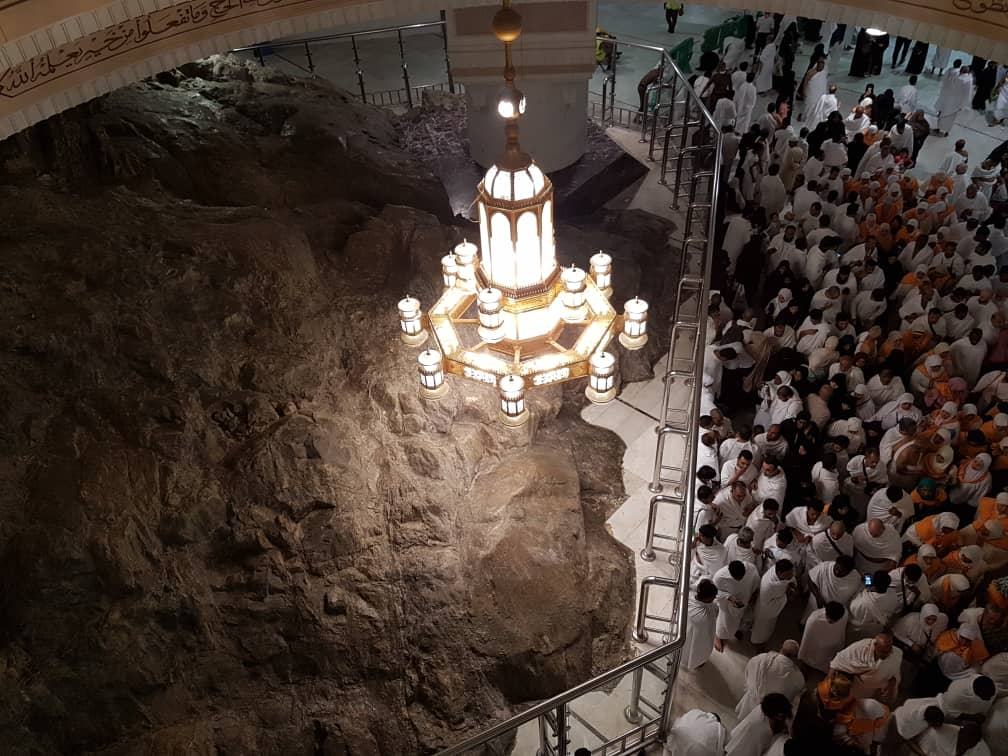
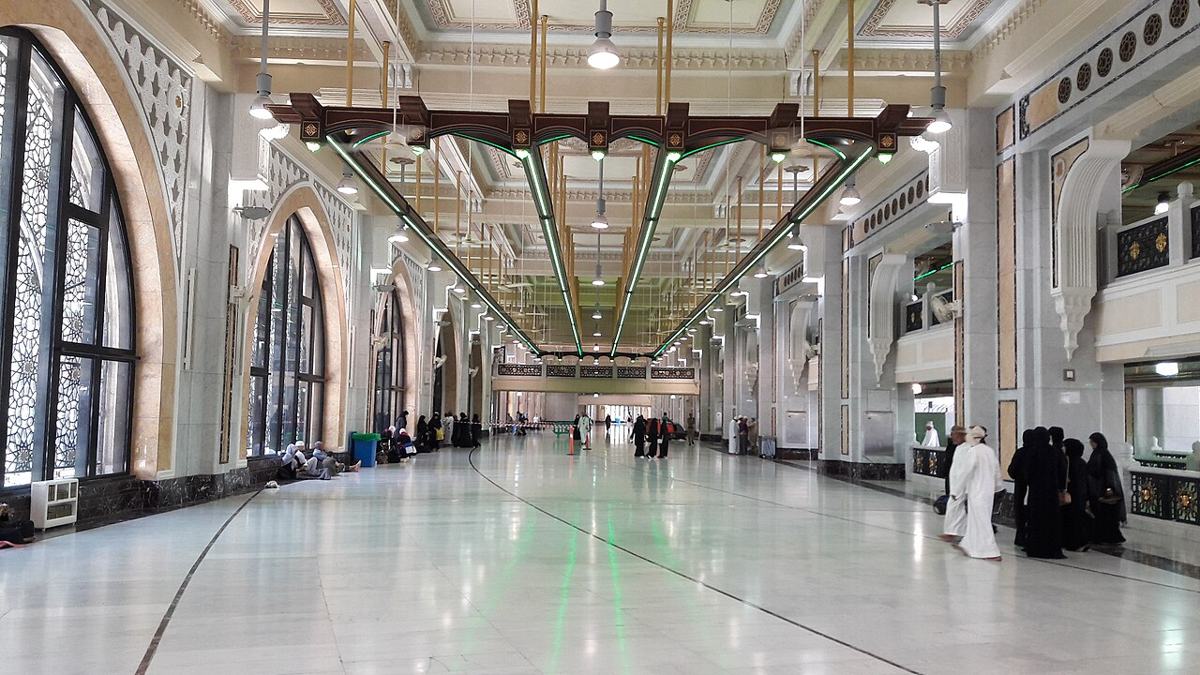
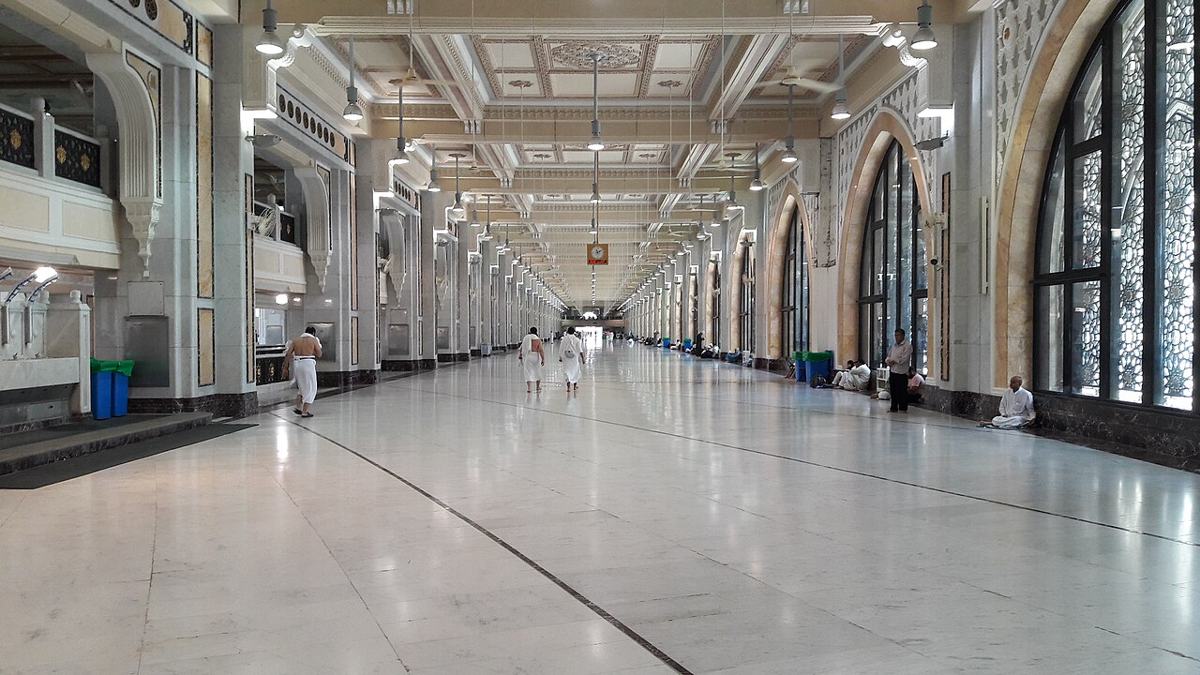
Today both hills and the path between them, the Mas'a, about 420 metres long, are inside Masjid al-Haram, in a long, air-conditioned gallery on several floors. The original rock of each hill is still visible behind glass at either end.
The conditions of a valid sa'i
- It must come after a valid tawaf: the tawaf of Umrah, Tawaf al-Ifadah, or (for Ifrad and Qiran) Tawaf al-Qudum.
- Start at Safa and finish at Marwah.
- Seven laps, with certainty. Safa to Marwah is one; Marwah back to Safa is two. So you finish the seventh lap at Marwah.
- Cover the whole distance: reach the end of the walkway at the foot of each hill (there are signs). You do not have to climb up the hill itself.
- Stay within the Mas'a (the established route, batn al-wadi).
- Keep the intention of sa'i: do not turn it into a walk for another purpose.
The sunnahs of sa'i
- Being in a state of wudu.
- Performing it straight after tawaf.
- Going to the Mas'a through the Safa gate (Bab al-Safa).
- Men climb a little onto Safa and Marwah.
- On Safa and Marwah, face the Ka'bah (the qiblah), say takbir, and make du'a with raised hands.
- Performing the laps continuously (muwalat).
- Men walk briskly or jog lightly (ramal) in the stretch between the green lights. Women walk normally.
- Men keep the right shoulder uncovered (idtiba') throughout.
- Du'a and dhikr throughout.
- Walking, if able.
Sa'i, step by step
- After the two rak'ahs of tawaf, du'a at the Multazam and drinking Zamzam, go to Safa.
- As you approach Safa, recite the verse "Inna-s-Safa wal-Marwata min sha'a'irillah…" and say "Abda'u bima bada'allahu bih", "I begin with what Allah began with."
- Climb a little (men), face the Ka'bah, raise your hands, and say Allahu Akbar three times and the dhikr below. Make du'a for whatever you wish. The Prophet ﷺ repeated this three times, making du'a in between.
- Walk towards Marwah. Between the green lights, men walk briskly.
- Reach Marwah, that is lap one. Face the Ka'bah and repeat the dhikr and du'a as on Safa.
- Walk back to Safa: lap two.
- Continue until you finish lap seven at Marwah.
- Then shave or cut your hair (for Umrah, or for Hajj if it is due), see Chapter 10.
اللّٰهُ أَكْبَرُ، اللّٰهُ أَكْبَرُ، اللّٰهُ أَكْبَرُ. لَا إِلٰهَ إِلَّا اللّٰهُ وَحْدَهُ لَا شَرِيكَ لَهُ، لَهُ الْمُلْكُ وَلَهُ الْحَمْدُ، وَهُوَ عَلَى كُلِّ شَيْءٍ قَدِيرٌ. لَا إِلٰهَ إِلَّا اللّٰهُ وَحْدَهُ، أَنْجَزَ وَعْدَهُ، وَنَصَرَ عَبْدَهُ، وَهَزَمَ الْأَحْزَابَ وَحْدَهُ
Reading Allāhu akbar (×3). Lā ilāha illallāhu waḥdahū lā sharīka lah, lahul-mulku wa lahul-ḥamd, wa huwa ʿalā kulli shai'in qadīr. Lā ilāha illallāhu waḥdah, anjaza waʿdah, wa naṣara ʿabdah, wa hazamal-aḥzāba waḥdah.
Meaning Allah is the Greatest (three times). There is no god but Allah alone, without partner; His is the dominion and His is the praise, and He has power over all things. There is no god but Allah alone; He fulfilled His promise, gave victory to His servant, and defeated the confederates alone.
From the description of the Prophet's Hajj in Sahih Muslim
رَبِّ اغْفِرْ وَارْحَمْ، إِنَّكَ أَنْتَ الْأَعَزُّ الْأَكْرَمُ
Reading Rabbighfir warḥam, innaka antal-aʿazzul-akram.
Meaning My Lord, forgive and have mercy. Truly You are the Most Mighty, the Most Generous.
Reported from Ibn Mas'ud and Ibn 'Umar
Points to watch
- Wheelchair lanes: the special lanes for wheelchairs turn around before the foot of each hill. Turning at the end of these lanes counts as reaching the hill, you do not need to go up onto the raised area.
- Stopping for Zamzam: if you stop to drink Zamzam during sa'i, step back a little from the point where you stopped before you carry on, so that no part of the distance is skipped.
- The lower floor: on the lower ground (basement) level, the end of the walkway at Marwah is very close to the glass wall. Make sure you actually reach the end at both Safa and Marwah.
- Not a mosque area for i'tikaf: the Mas'a is not counted as part of the mosque for the prayer of greeting the mosque or the intention of i'tikaf. A woman in her period may be in the Mas'a.
- There is no voluntary sa'i. Sa'i is only ever performed as part of Hajj or Umrah, after a tawaf.
- Beware of unofficial "barbers" at Marwah who cut pilgrims' hair and then demand high fees.
If you lose count or are interrupted
- If you are unsure whether you have completed five or six laps, take the lower number and continue.
- If the iqamah for an obligatory prayer is called, pray with the congregation, then continue from where you stopped.
- If you are exhausted, you may rest and then continue, continuity is a sunnah, not a condition.
Chapter 10
Shaving or Cutting the Hair, Tahallul and the Order of the Pillars
Removing the hair is a pillar of both Hajj and Umrah, and it is how you come out of ihram. This chapter explains how much hair, when, by whom, and how the first and second tahallul of Hajj are reached.
What it is
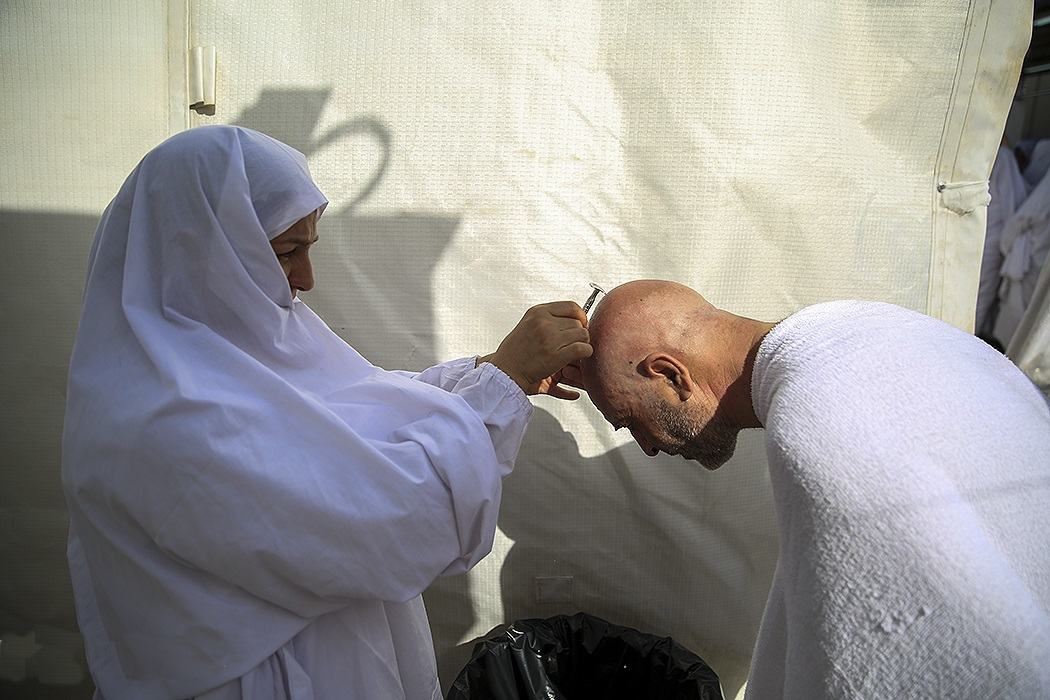
Shaving or cutting the hair (bercukur or bergunting, halq or taqsir) means removing at least three hairs from the head, on these conditions:
- Its time has begun.
- The hair is from the head, not the beard or elsewhere.
- No fewer than three hairs.
Shaving the whole head is best for men; cutting is enough. For women, shaving is not permitted: it is enough for a woman to cut the ends of her hair, the length of one finger joint.
Meaning The Prophet ﷺ prayed three times, "O Allah, have mercy on those who shave their heads," and when the Companions asked, "And those who cut, O Messenger of Allah?", he included them on the fourth. (Reported by al-Bukhari and Muslim.)
When
- Umrah: after tawaf and sa'i have been completed.
- Hajj: from after midnight on the night of the 10th of Dhul Hijjah, once wuquf is behind you. The best time is on the 10th, after stoning Jamrah al-'Aqabah.
Useful details from the course
- Once the time has begun, you may cut your own hair or someone else's, even if they are also in ihram, because removing hair is now part of your worship, not a violation.
- It is better to have your own hair cut first, before cutting anyone else's.
- Women must keep their 'awrah covered while their hair is cut, do it in your room or among women.
- Cutting just the ends of the hair is valid.
- You can do it at your building, it does not have to be at Marwah or Mina.
- A completely bald man should pass a razor over his scalp; this is sunnah.
What tahallul means
Tahallul means releasing yourself from the prohibitions of ihram.
Tahallul of Umrah
Umrah has a single tahallul. Once you have completed tawaf, sa'i and the shaving or cutting, in that order, every prohibition is lifted.
Tahallul of Hajj: the first and the second
Hajj has two stages, built on three acts:
- Ⓐ Stoning Jamrah al-'Aqabah (the large Jamrah) on the 10th.
- Ⓑ Shaving or cutting the hair.
- Ⓒ Tawaf al-Ifadah, together with sa'i, if the sa'i of Hajj has not yet been done.
First tahallul (tahallul awwal): reached after completing any two of the three. Everything forbidden in ihram becomes permitted except three things:
- marriage and anything to do with a marriage contract;
- foreplay;
- sexual intercourse.
So after the first tahallul, men may put on normal clothes and cover their heads, and everyone may use perfume and cut their nails.
Second tahallul (tahallul thani): reached after completing all three. Every prohibition of ihram is lifted.
Where the first tahallul usually happens
| Order you follow | First tahallul is reached… |
|---|---|
| Stone 'Aqabah in Mina → cut the hair (in Mina or anywhere) | in Mina, after the hair |
| Stone 'Aqabah in Mina → Tawaf al-Ifadah and sa'i in Makkah | in Makkah, after sa'i |
| Tawaf al-Ifadah and sa'i in Makkah → cut the hair | in Makkah, after the hair |
Order (tertib) in the pillars
Umrah: order is required in all its pillars, intention, then tawaf, then sa'i, then hair. Cutting the hair before finishing sa'i is a violation of ihram (and incurs dam), not the end of your Umrah.
Hajj: order is required in most of its pillars:
- the intention comes before all the other pillars;
- wuquf comes before Tawaf al-Ifadah (and before the hair);
- tawaf comes before sa'i.
But some pillars may change place:
- Sa'i of Hajj may be performed before wuquf by Ifrad and Qiran pilgrims, after their Tawaf al-Qudum.
- The hair may be cut after wuquf, once its time has begun, before Tawaf al-Ifadah.
Chapter 11
The 8th and 9th: Tarwiyah and the Wuquf at Arafah
"Hajj is Arafah." How Tamattu' pilgrims enter ihram for Hajj on the 8th, the move out to Arafah, the time and conditions of wuquf, what to do on the most important afternoon of your life, and the superstitions to ignore.
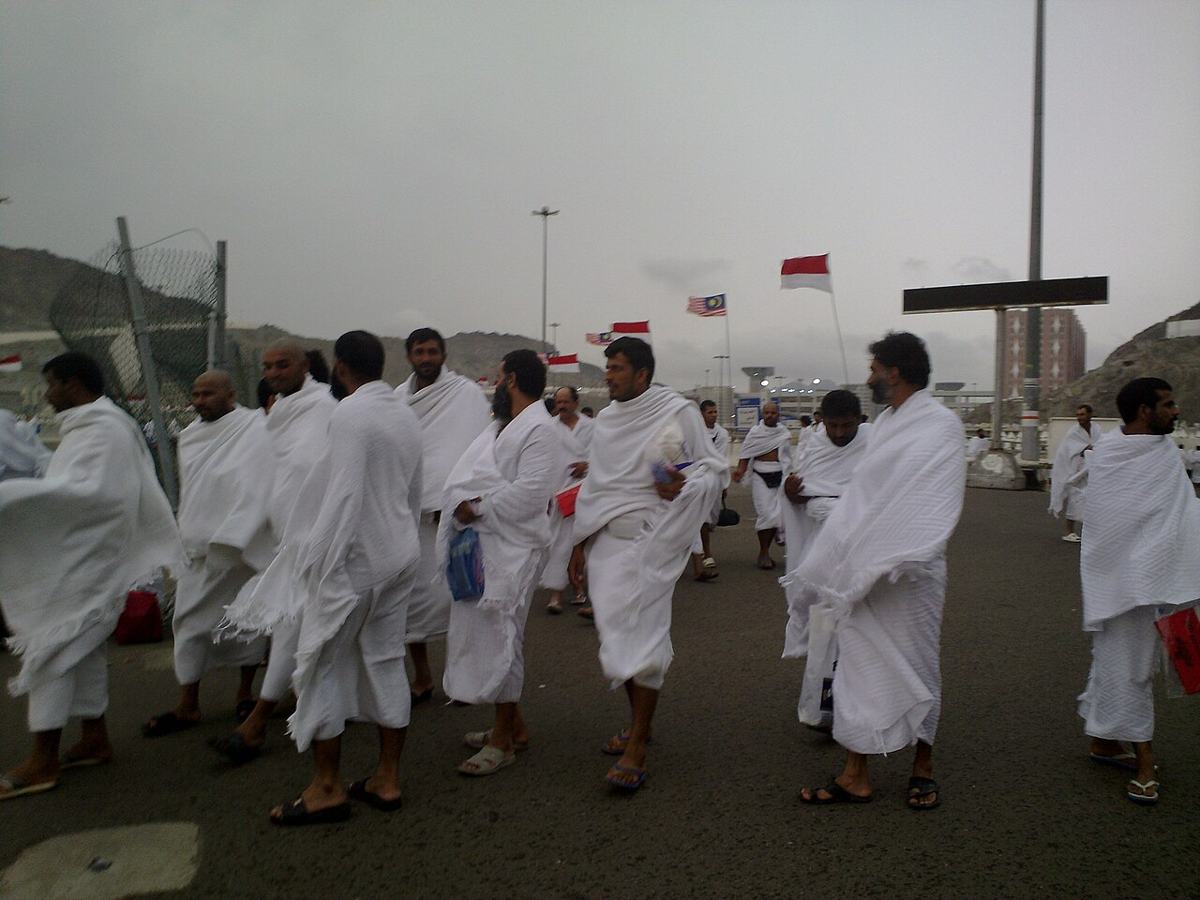
The 8th of Dhul Hijjah: Yawm al-Tarwiyah
The 8th is called the Day of Tarwiyah, traditionally the day pilgrims gathered water for the days ahead.
Entering ihram for Hajj (Tamattu' pilgrims)
- Cut your nails and trim your hair if needed, and bathe.
- Apply perfume to your body (not the cloth).
- Men put on the two ihram sheets; women put on modest clothing leaving the face and hands uncovered.
- Pray two rak'ahs if it is not a disliked time.
- At your building in Makkah, make the intention for Hajj.
- Begin the talbiah.
نَوَيْتُ الْحَجَّ وَأَحْرَمْتُ بِهِ لِلّٰهِ تَعَالَى
Reading Nawaitul-ḥajja wa aḥramtu bihī lillāhi taʿālā.
Meaning I intend to perform Hajj and I enter ihram for it, for the sake of Allah the Most High.
Ifrad and Qiran pilgrims are still in the ihram they entered at the miqat and do not repeat the intention.
Moving out of Makkah

The Sunnah is to go to Mina on the 8th, pray Zuhr, Asr, Maghrib, Isha and Fajr there, and move to Arafah after sunrise on the 9th. Because millions must move at once, many official groups, including Tabung Haji, take their pilgrims directly to Arafah on the 8th (often in the evening or night). Skipping Mina on the night of the 9th means missing a sunnah, but it carries no penalty. Follow your group's schedule and be ready at the time you are given.
What wuquf is
Wuquf is being present in the land of Arafah, even for a moment and in any state, standing, sitting, lying down, awake or asleep, at any time between the sun passing its zenith (zawal) on 9 Dhul Hijjah and just before dawn on 10 Dhul Hijjah.
It is the one pillar that cannot be made up. A pilgrim who misses it has missed Hajj that year: they must come out of ihram by performing the acts of Umrah, pay a dam, and perform Hajj in another year.
The best time
The best wuquf combines part of the day of the 9th with part of the night of the 10th, that is, staying in Arafah until after sunset before leaving. Leaving before sunset means missing the best time; do not leave early without need, and follow your group.
The conditions of a valid wuquf
- You have already entered ihram for Hajj.
- You are fit for worship during the time of wuquf, not insane, intoxicated, unconscious throughout or an apostate.
- You are within the boundaries of Arafah, even for a moment, within its time.
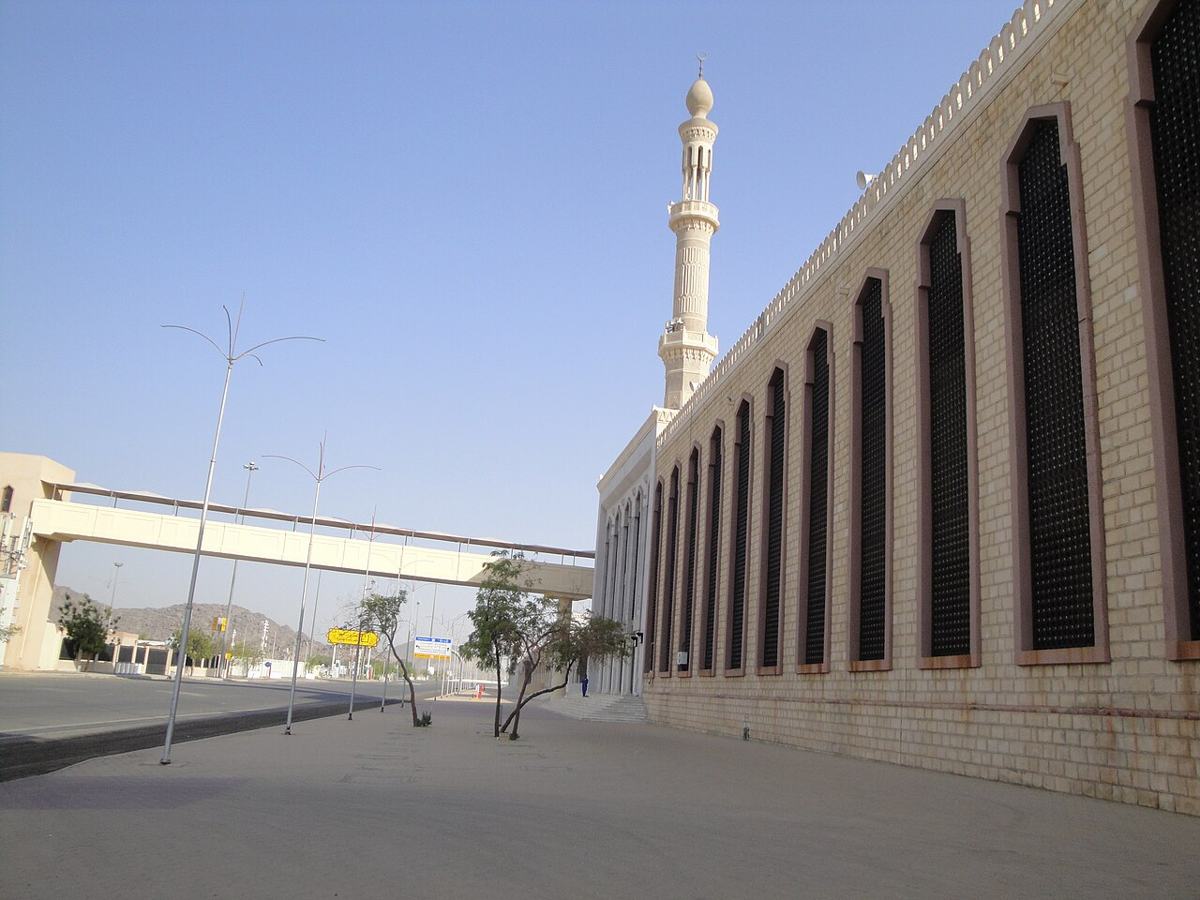
The day of Arafah, step by step
- Arrive and settle in your tent. Know your tent number, the toilets, water points and clinic.
- Rest in the morning if you arrived at night. Drink water regularly.
- At Zuhr time, after the sermon (broadcast on radio and screens), pray Zuhr and Asr together at the time of Zuhr (jamak taqdim), in congregation with your group, in full, four rak'ahs each, not shortened. The course teaches that at Arafah and Mina prayers may be combined because of the rites (nusuk) and hardship (masyaqqah), but are prayed in full (Chapter 16).
- From zawal until sunset, devote yourself to du'a. This is the time to pour out your heart. Face the qiblah, raise your hands, and ask Allah for everything you need in this world and the next, for yourself, your parents, your family, your teachers, the Muslims, and everyone who asked you to pray for them.
- Recite the talbiah, dhikr, istighfar, selawat and Qur'an.
- After sunset, leave calmly for Muzdalifah with your group. Maghrib and Isha are prayed together at Muzdalifah.
لَا إِلٰهَ إِلَّا اللّٰهُ وَحْدَهُ لَا شَرِيكَ لَهُ، لَهُ الْمُلْكُ وَلَهُ الْحَمْدُ، وَهُوَ عَلَى كُلِّ شَيْءٍ قَدِيرٌ
Reading Lā ilāha illallāhu waḥdahū lā sharīka lah, lahul-mulku wa lahul-ḥamd, wa huwa ʿalā kulli shai'in qadīr.
Meaning There is no god but Allah alone, without partner. His is the dominion and His is the praise, and He has power over all things.
"The best du'a is the du'a of the Day of Arafah, and the best thing that I and the prophets before me have said is…", reported by al-Tirmidhi
رَبَّنَا ظَلَمْنَا أَنفُسَنَا وَإِن لَّمْ تَغْفِرْ لَنَا وَتَرْحَمْنَا لَنَكُونَنَّ مِنَ الْخَاسِرِينَ
Reading Rabbanā ẓalamnā anfusanā wa in lam taghfir lanā wa tarḥamnā lanakūnanna minal-khāsirīn.
Meaning Our Lord, we have wronged ourselves. If You do not forgive us and have mercy on us, we will surely be among the losers.
The du'a of Adam and Hawa, Surah al-A'raf 7:23
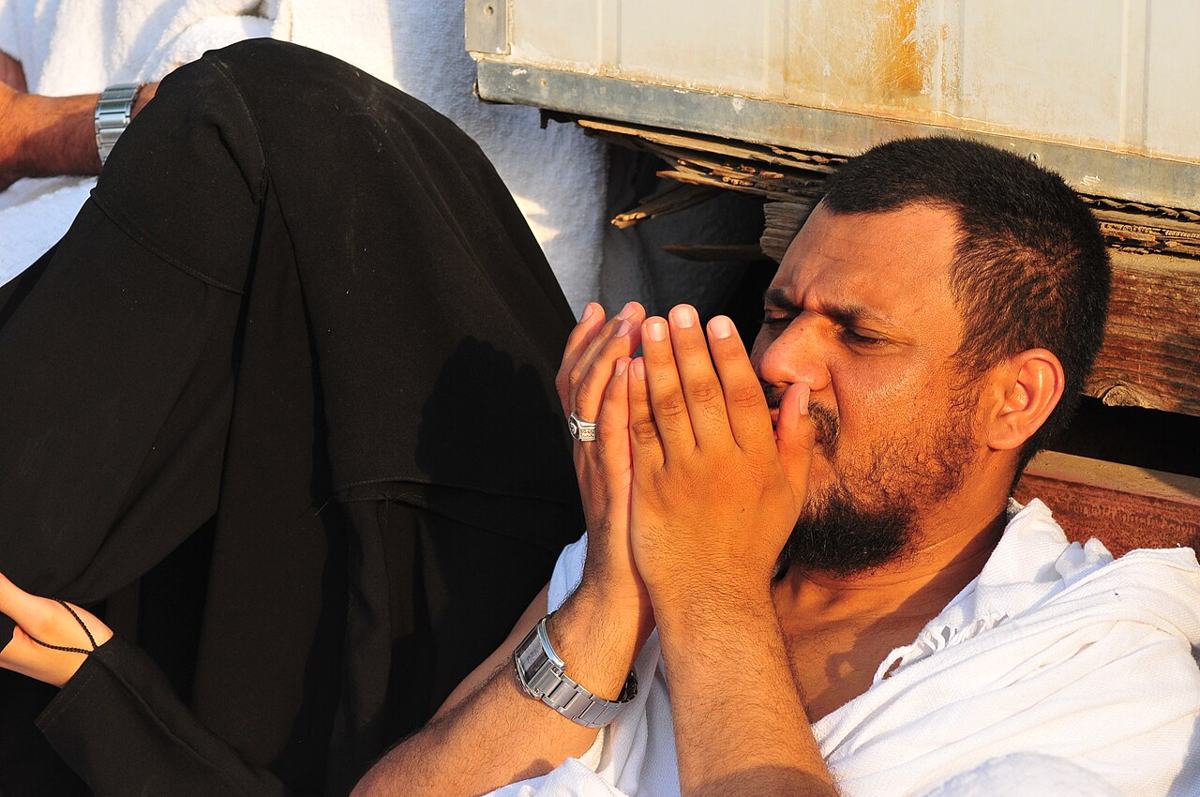
The sunnahs of wuquf
- Praying in congregation.
- The talbiah.
- Du'a, selawat and istighfar.
- Dhikr.
- Reading the Qur'an.
- Voluntary prayer.
Jabal Rahmah
Jabal Rahmah: the "Mount of Mercy", is a small rocky hill in the east of Arafah. The Prophet ﷺ stood at its foot near the large rocks during his wuquf. Climbing it is not a rite of Hajj, and on the Day of Arafah it is dangerously crowded and hot. The whole of Arafah is a place of wuquf: your tent is as good as the hill.
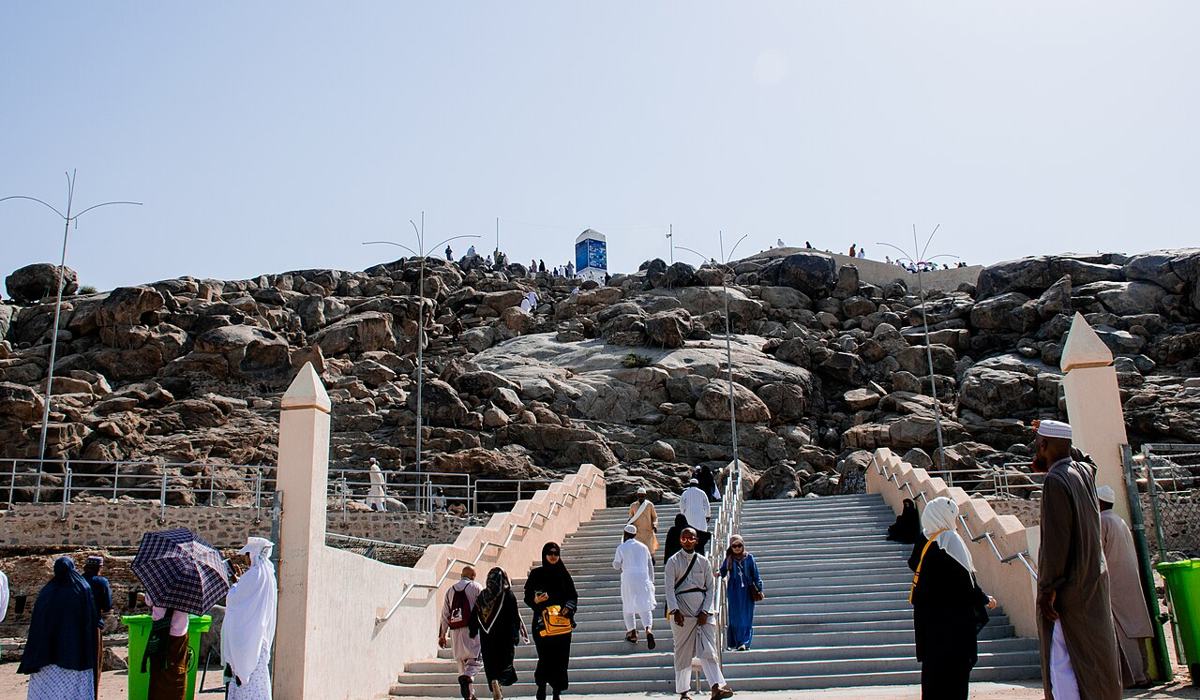
Superstitions at Arafah
Ignore these practices, which have no basis in the religion:
| Practice | The false belief behind it |
|---|---|
| Drying rice in the sun at Arafah, then soaking it in Zamzam at home and giving it out | That it brightens the heart |
| Burying seven stones in Arafah | That they will testify for you and close the seven gates of Hell |
| Secretly cutting ropes at Arafah | That it stops children crying, brings customers or bigger catches |
| Taking sand from Arafah for a toddler's first steps | That the child will reach Arafah, become famous, healthy or brave |
Staying safe on the Day of Arafah
- Stay in the shade in the afternoon. Use an umbrella if you must walk.
- Drink water little and often, even if you do not feel thirsty, and eat something.
- Take your medicines on time.
- Do not walk off alone. If you get lost, go to the nearest Saudi security post or Malaysian (or your country's) mission tent and show your card.
- After sunset, the move to Muzdalifah can take hours. Be patient and stay with your group.
Chapter 12
The Night at Muzdalifah
After sunset on the Day of Arafah, pilgrims move to Muzdalifah. What the obligatory mabit is, how long you must stay, the prayers and sunnahs of the night, collecting pebbles, and who is excused.
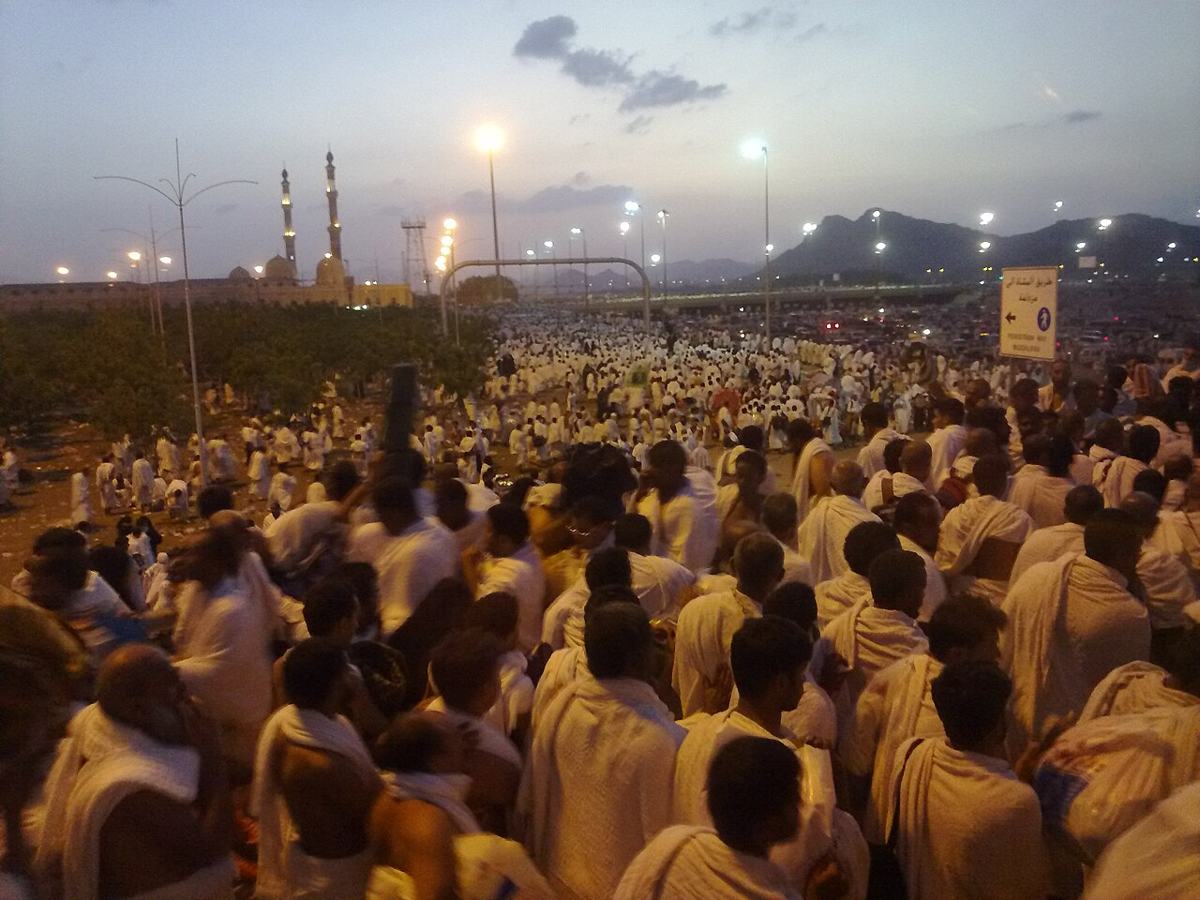
What the mabit at Muzdalifah is
Mabit means "spending the night". At Muzdalifah it means being present in the land of Muzdalifah, even for a moment, at some point between midnight on the night of the 10th of Dhul Hijjah and dawn.
It is an obligation (wajib) of Hajj. Leaving it without a valid excuse is sinful and a dam is due (Chapter 7).
Muzdalifah lies between Arafah and Mina, inside the Haram. Its boundaries are marked with signs. Inside it stands Masjid al-Mash'ar al-Haram, built at the place where the Prophet ﷺ stood in du'a after Fajr.
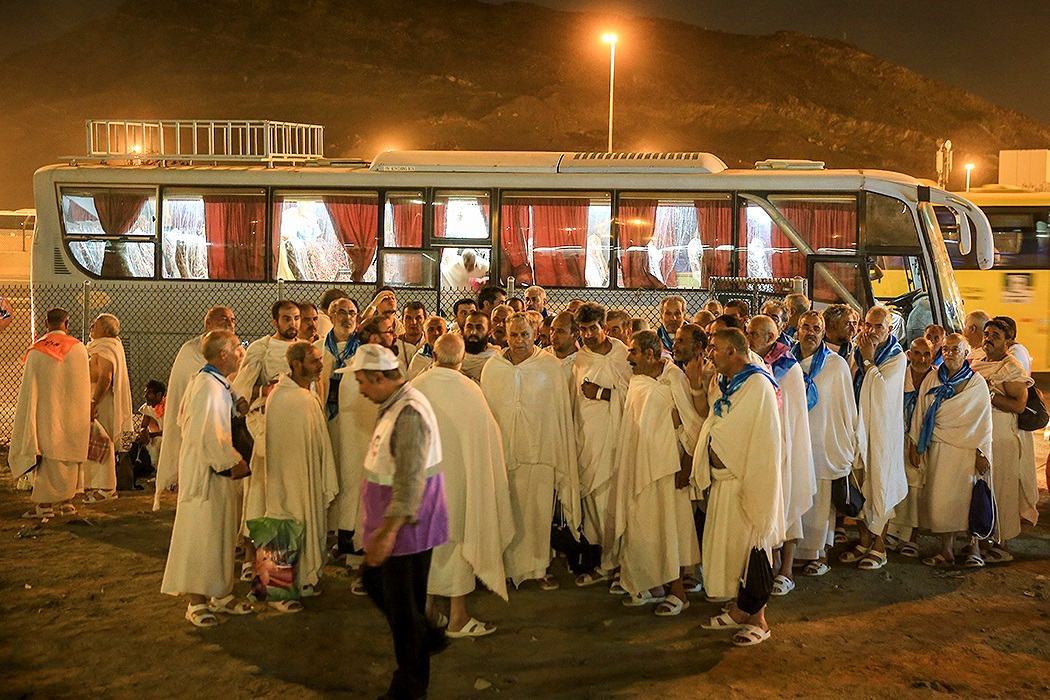
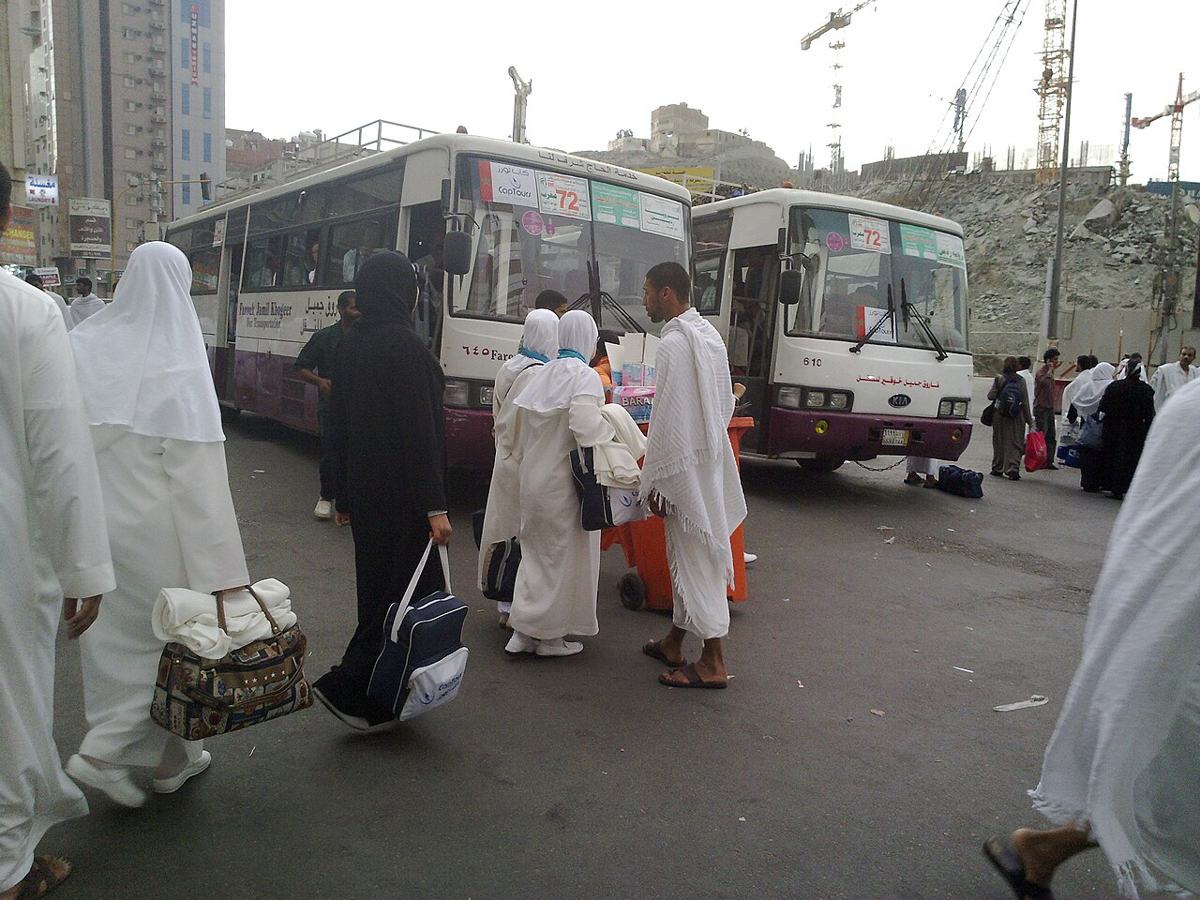
The night, step by step
- Leave Arafah after sunset, calmly, with the talbiah on your tongue. Do not push.
- On arrival, pray Maghrib and Isha together at Isha time (jamak ta'khir), led by your group's religious guide. Remember the course's ruling for the masha'ir: prayers are combined but prayed in full, not shortened (Chapter 16). Do not let the time of Isha pass because of a delayed bus, if needed, pray on the way.
- Collect your pebbles. You need seven for the 10th, and 21 a day for the Days of Tashriq, 49 if you leave on the 12th (Nafar Awwal) or 70 if you stay for the 13th (Nafar Thani). Take a few extra in case some miss. Many pilgrims collect only seven here and the rest in Mina, which is also permitted.
- Rest and sleep if you can, tomorrow is the longest day of Hajj.
- Make sure you are in Muzdalifah after midnight. Your group will tell you when the buses leave; some groups leave soon after midnight, others after Fajr.
- Ideally, pray Fajr at Muzdalifah, then stand facing the qiblah in du'a and dhikr until the sky is bright, before setting off for Mina before sunrise.
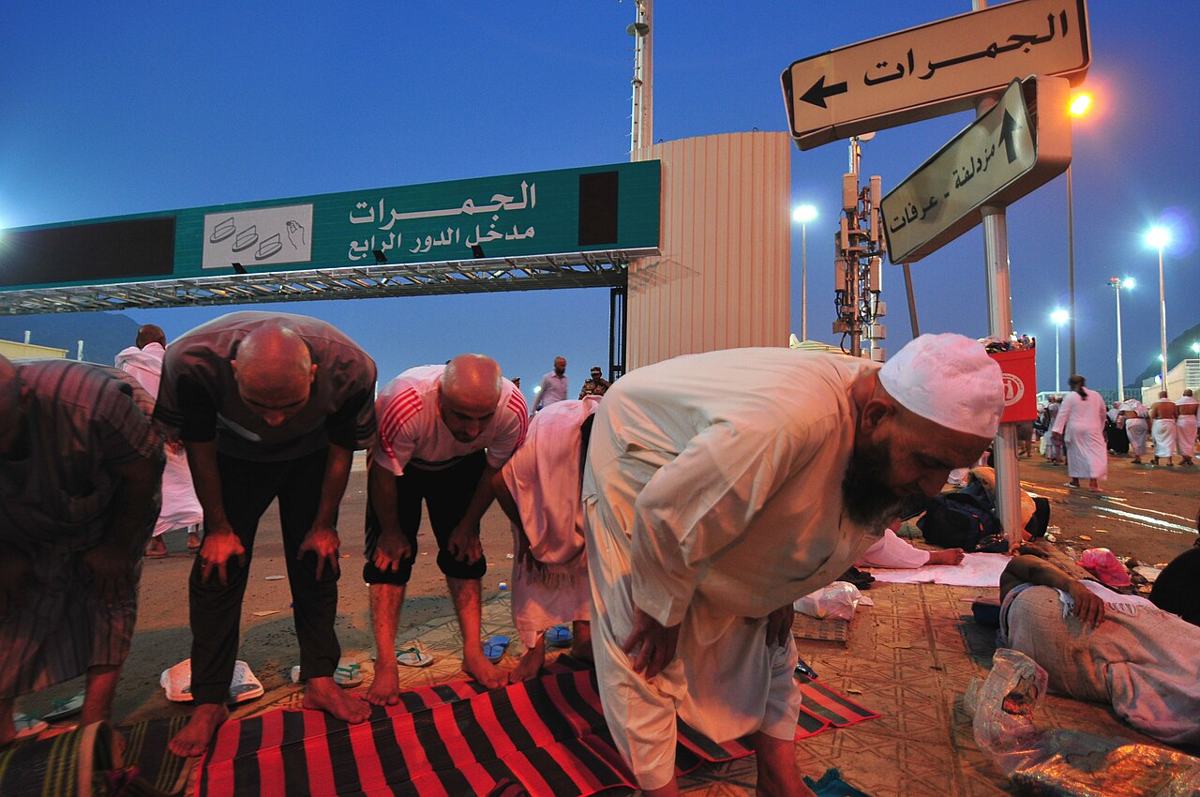
The pebbles
- Each pebble should be small, about the size of a chickpea or a date stone, roughly the tip of your finger. Larger stones are not better and can injure people.
- Any stone or rock material is valid.
- You do not need to wash them.
- Keep them in a small pouch or bottle, and count them.
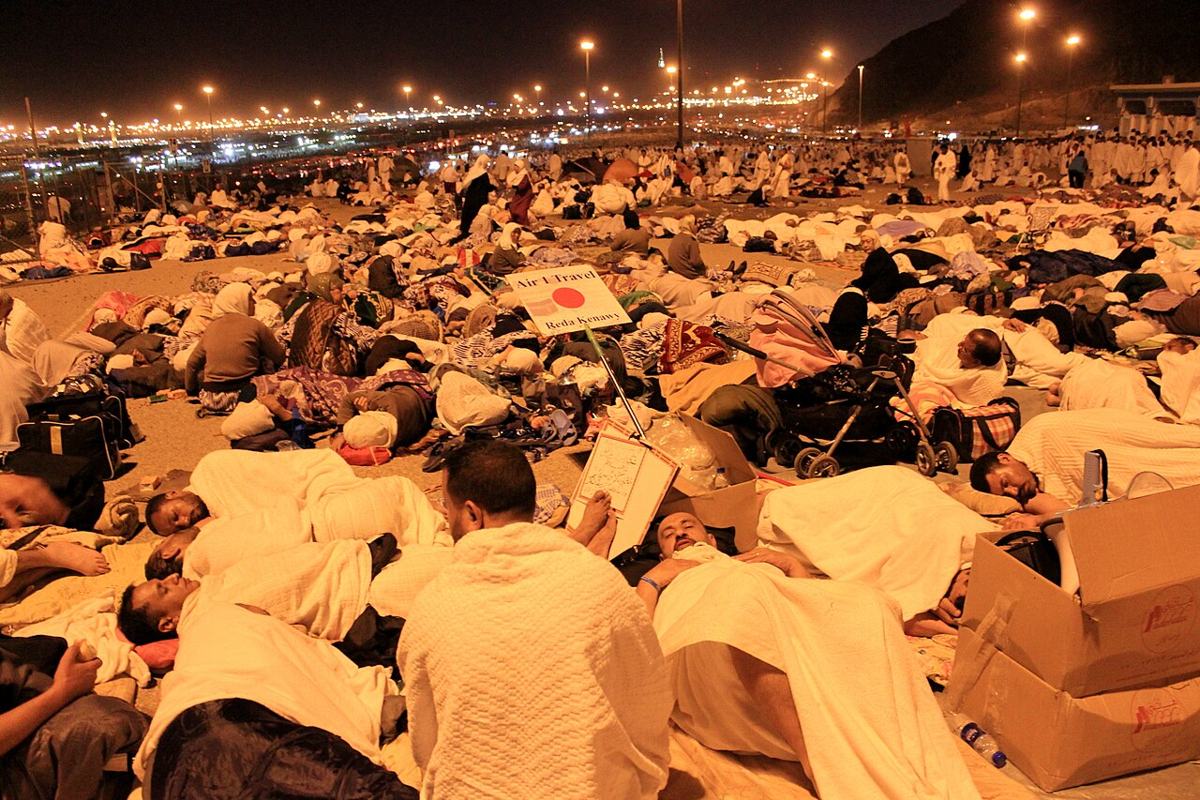
The sunnahs of the night
- The talbiah.
- Du'a.
- Dhikr.
- Voluntary prayer.
- Collecting the pebbles.
فَإِذَا أَفَضْتُم مِّنْ عَرَفَاتٍ فَاذْكُرُوا اللَّهَ عِندَ الْمَشْعَرِ الْحَرَامِ ۖ وَاذْكُرُوهُ كَمَا هَدَاكُمْ
Reading Fa idhā afaḍtum min ʿarafātin fadhkurullāha ʿindal-mashʿaril-ḥarām, wadhkurūhu kamā hadākum.
Meaning When you pour forth from Arafah, remember Allah at al-Mash'ar al-Haram, and remember Him as He has guided you.
Surah al-Baqarah 2:198
Who is excused from the mabit
A pilgrim with a genuine excuse who cannot be at Muzdalifah after midnight is not sinful and owes no dam. The excuses listed in the course are:
- Fear for your life or property.
- Caring for or accompanying a sick person.
- Searching for a lost companion or family member, or a missing worker under your responsibility.
- Illness that makes it very difficult to stay.
- Being forced, for example, being left behind by your transport.
Moving on to Mina
Weak pilgrims, women, the elderly and those caring for them may leave after midnight, as the Prophet ﷺ allowed for his weaker family members. Others leave after Fajr. On reaching Mina, the first task is stoning Jamrah al-'Aqabah, see the next chapter.
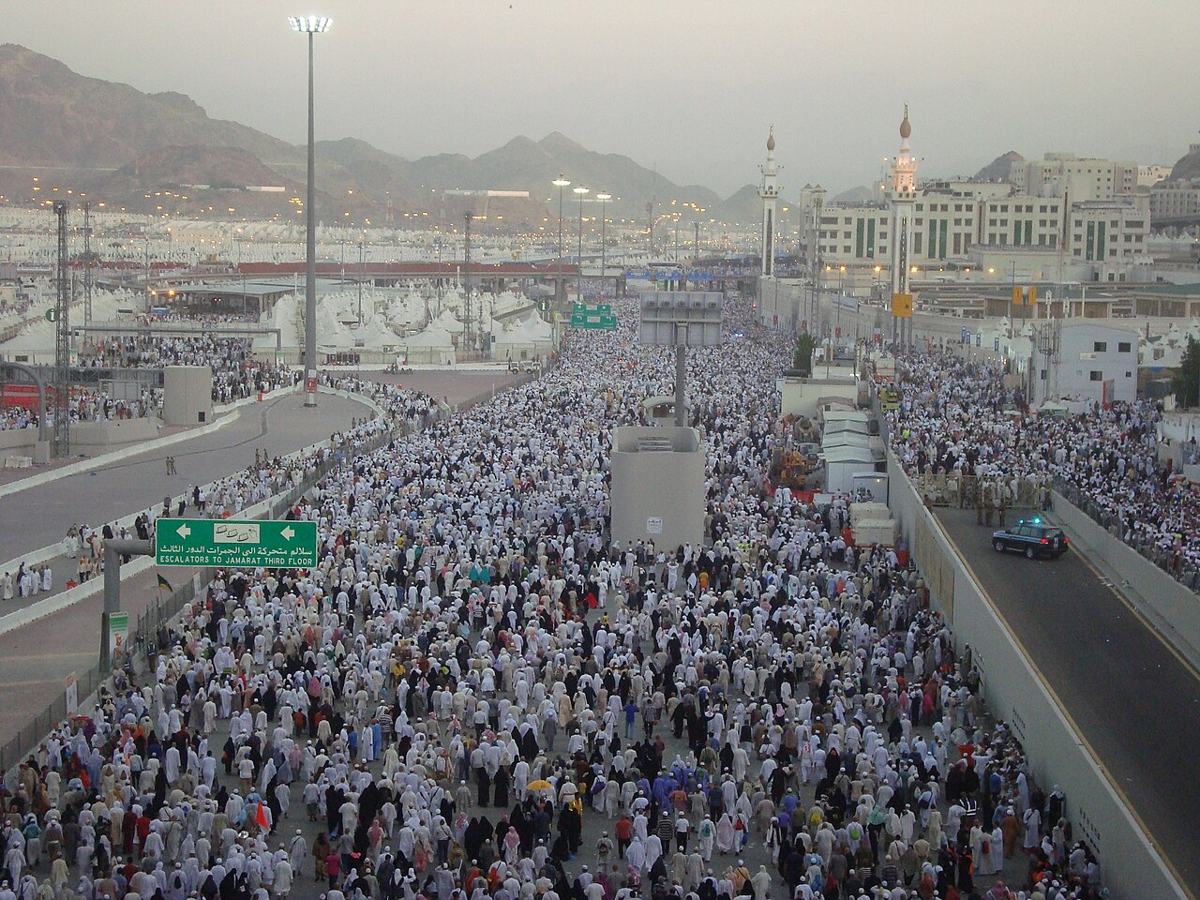
Chapter 13
Mina and the Stoning of the Jamarat
The Day of Sacrifice and the three Days of Tashriq: stoning Jamrah al-'Aqabah on the 10th, the nights in Mina, stoning all three Jamarat on the 11th to 13th, the conditions of a valid throw, leaving early (Nafar Awwal), stoning on behalf of others, and staying safe in the crowds.
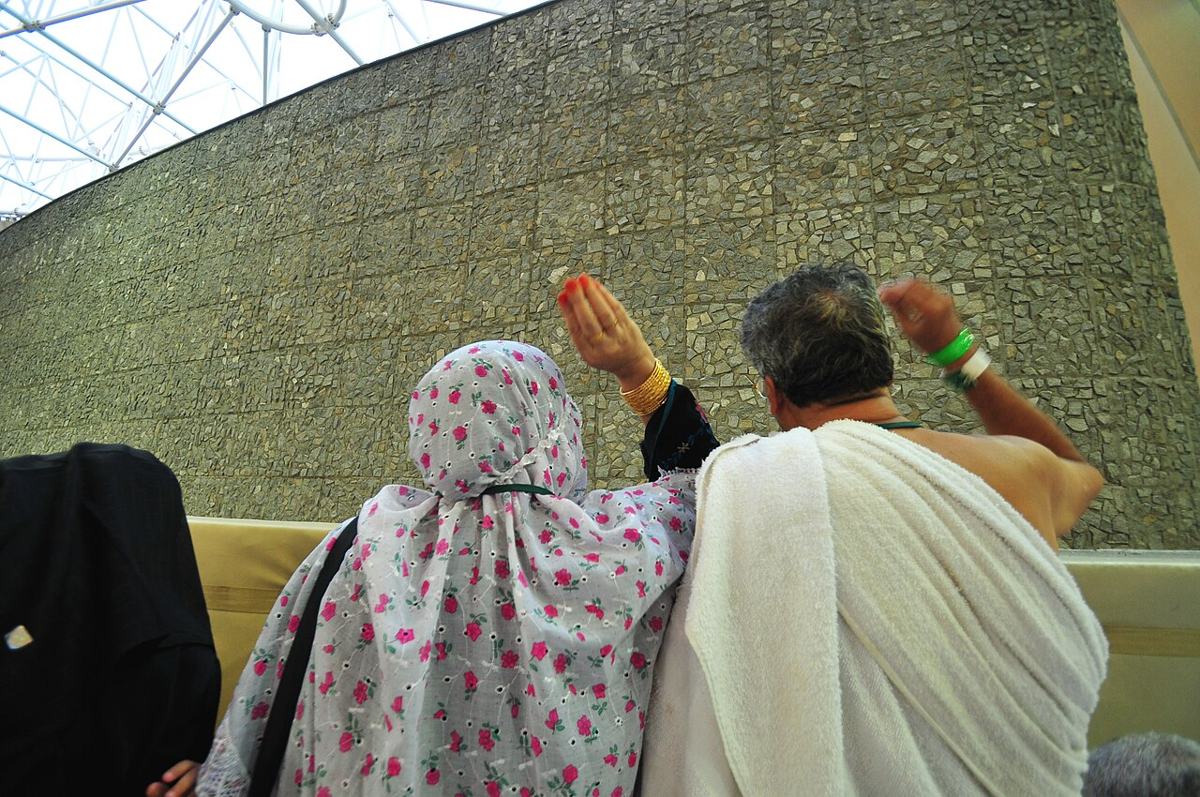
Mina
Mina is a narrow valley inside the Haram, about 7 km east of Masjid al-Haram, between Makkah and Muzdalifah. For most of the year it is empty; during Hajj it becomes a city of fireproof, air-conditioned tents where pilgrims stay for up to four nights. At its western end, towards Makkah, stand the three Jamarat, pillars, now long walls, marking the places where, according to tradition, Ibrahim drove away Iblis.
Today the Jamarat stand inside a multi-storey building with entrances on several levels and one-way routes, so that hundreds of thousands of pilgrims can stone every hour.
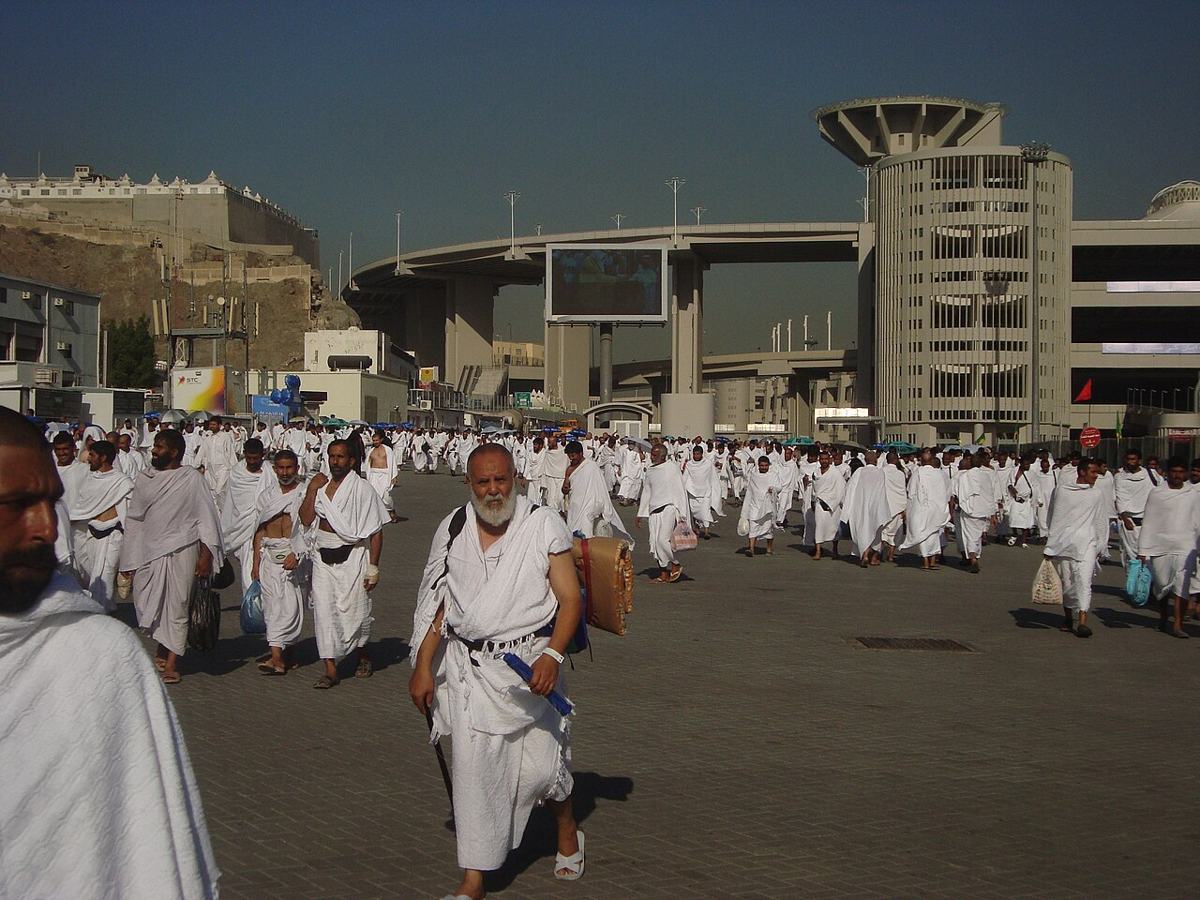
| Jamrah | Also called | Distance |
|---|---|---|
| Sughra: the small | al-Ula, the first | nearest Masjid al-Khayf and the camps |
| Wusta: the middle | about 200 m from the Sughra | |
| Kubra: the large | 'Aqabah | about 247 m from the Wusta, towards Makkah |
The 10th: stoning Jamrah al-'Aqabah
On the Day of Sacrifice, you stone only Jamrah al-Kubra ('Aqabah), with seven pebbles. This is an obligation of Hajj. You are still in ihram when you do it.
| Time | |
|---|---|
| Best | Morning (dhuha) of the 10th, after sunrise |
| Permitted | From after midnight on the night of the 10th until sunset on the 13th |
Stop the talbiah with your first pebble, and begin the takbir instead.
بِسْمِ اللّٰهِ، اللّٰهُ أَكْبَرُ
Reading Bismillāh, Allāhu akbar.
Meaning In the name of Allah. Allah is the Greatest.
After the seven pebbles at 'Aqabah on the 10th, you do not stop for du'a, move on.
The conditions of a valid throw
The same eight conditions apply on every day:
- The time for stoning has begun.
- You throw stone, a pebble or any kind of rock. Not shoes, wood, metal or plastic.
- You throw with your hand.
- It is a real throw, not placing or dropping the pebble.
- One pebble at a time: seven separate throws. Throwing seven together counts as one.
- You are sure the pebble lands in the basin (marma) around the pillar. It does not have to hit the pillar itself.
- Your aim is the Jamrah, not something else.
- Seven pebbles, with certainty. If unsure, throw another.
On the Days of Tashriq one more condition is added: the order of the three Jamarat, Sughra, then Wusta, then Kubra.
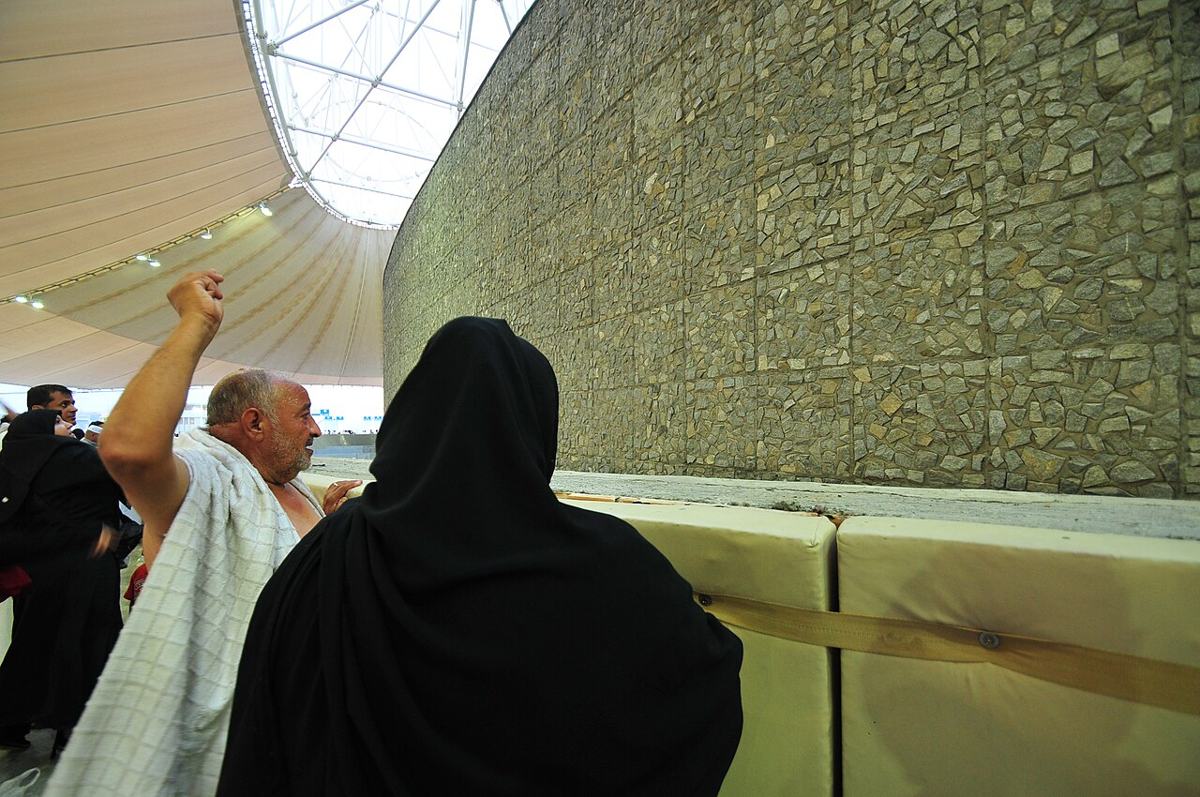
The rest of the 10th
After stoning 'Aqabah, the remaining acts of the day, in the Sunnah order, are:
- The sacrifice. Tamattu' and Qiran pilgrims owe a dam; most official Hajj bodies slaughter it for you through the Saudi sacrifice programme, and you will be told when it has been done. A voluntary qurban may also be offered.
- Shave or cut your hair: and with stoning plus hair, you reach the first tahallul. Change into normal clothes.
- Tawaf al-Ifadah (and sa'i if not yet done) in Makkah, on the 10th if your group arranges it, or later. With it you reach the second tahallul (Chapter 10).
The nights in Mina (mabit)
Spending the nights of the 11th, 12th and 13th in Mina is an obligation of Hajj.
How long you must stay
The course explains two opinions:
- The relied-upon view (al-asah): you must be in Mina for more than half of the night (from Maghrib to Fajr). This is the official practice of Tabung Haji.
- A weaker view: it is enough to be in Mina when Fajr comes in (when the azan of Subh is called). This is not encouraged, and only used in particular cases of need.
Two nights or three
| Choice | Nights in Mina | Stoning days |
|---|---|---|
| Nafar Awwal: the first departure | Nights of the 11th and 12th | 11th and 12th |
| Nafar Thani: the second departure | Nights of the 11th, 12th and 13th | 11th, 12th and 13th |
Both are permitted: "Whoever hurries on in two days, there is no sin on him; and whoever delays, there is no sin on him" (Surah al-Baqarah 2:203).
Who is excused from the nights in Mina
The same excuses as at Muzdalifah: fear for your life or property; caring for a sick person; searching for a lost companion or worker; illness that makes it very hard to stay; or being forced to leave. Leaving the mabit without excuse is sinful and a dam is due.
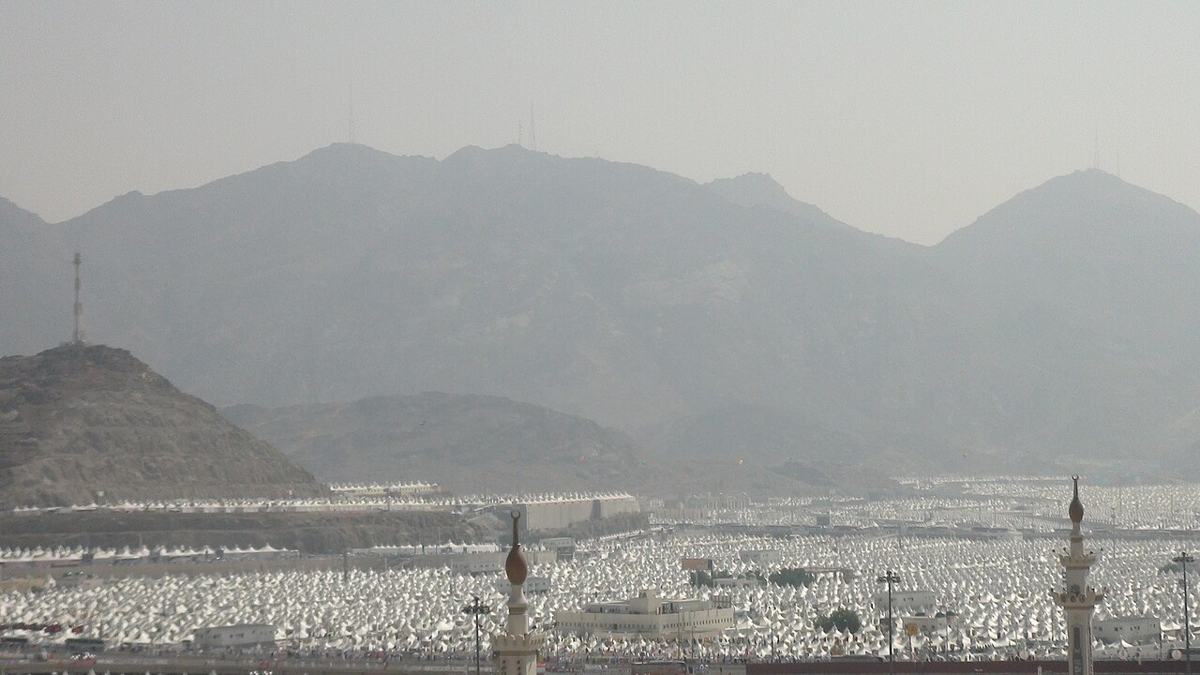
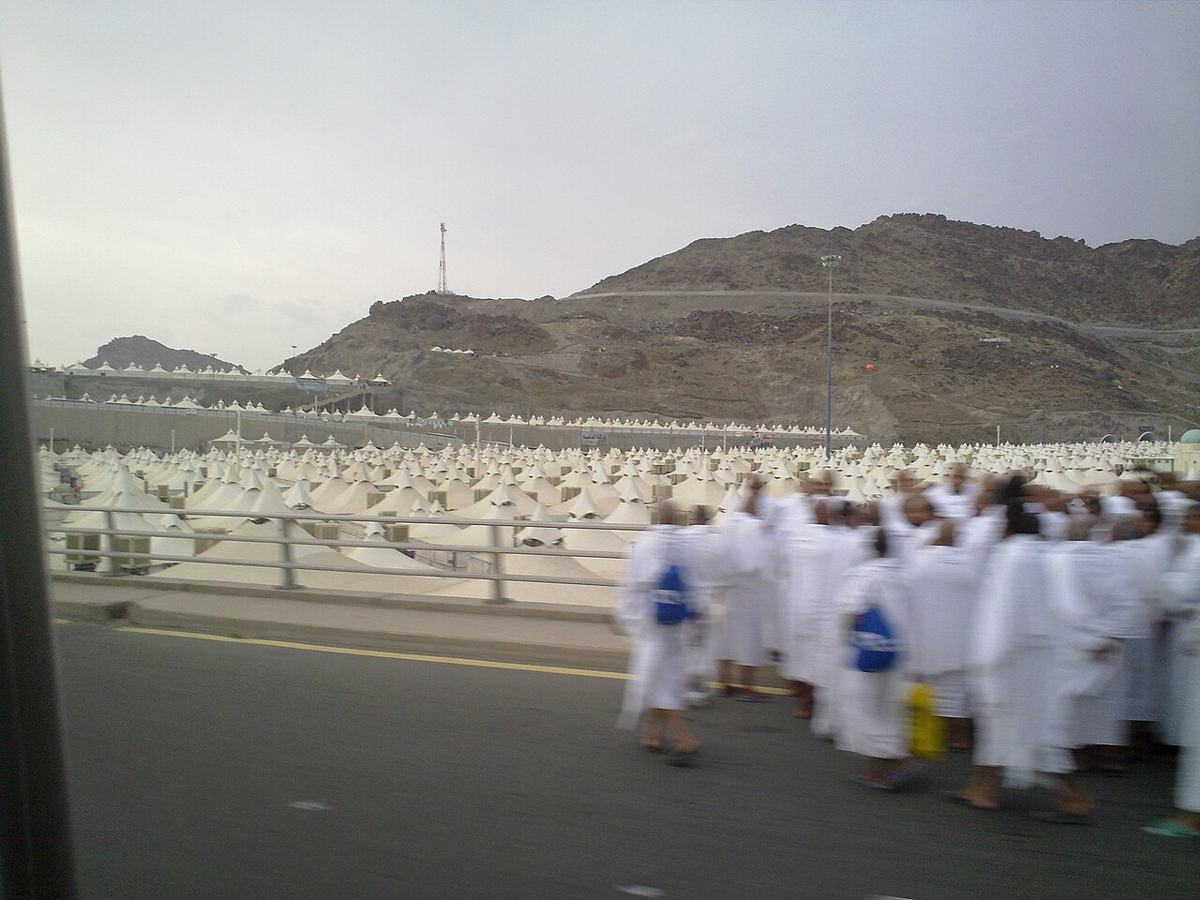
The Days of Tashriq: stoning all three Jamarat
On each of the 11th, 12th (and 13th, if you stay):
- Go to the Jamrah Sughra first. Throw seven pebbles, one by one, with Bismillah, Allahu akbar.
- Step aside, out of the crowd, face the qiblah and make a long du'a.
- Go to the Jamrah Wusta. Throw seven.
- Step aside, face the qiblah and make du'a again.
- Go to the Jamrah Kubra ('Aqabah). Throw seven. Do not stop for du'a, leave.
The time
| Time | |
|---|---|
| Best | After the sun passes its zenith (zawal, Zuhr time) on that day |
| Permitted, according to the course | From after dawn of that day until sunset on the 13th, following the view of Imam al-Rafi'i, al-Asnawi and others |
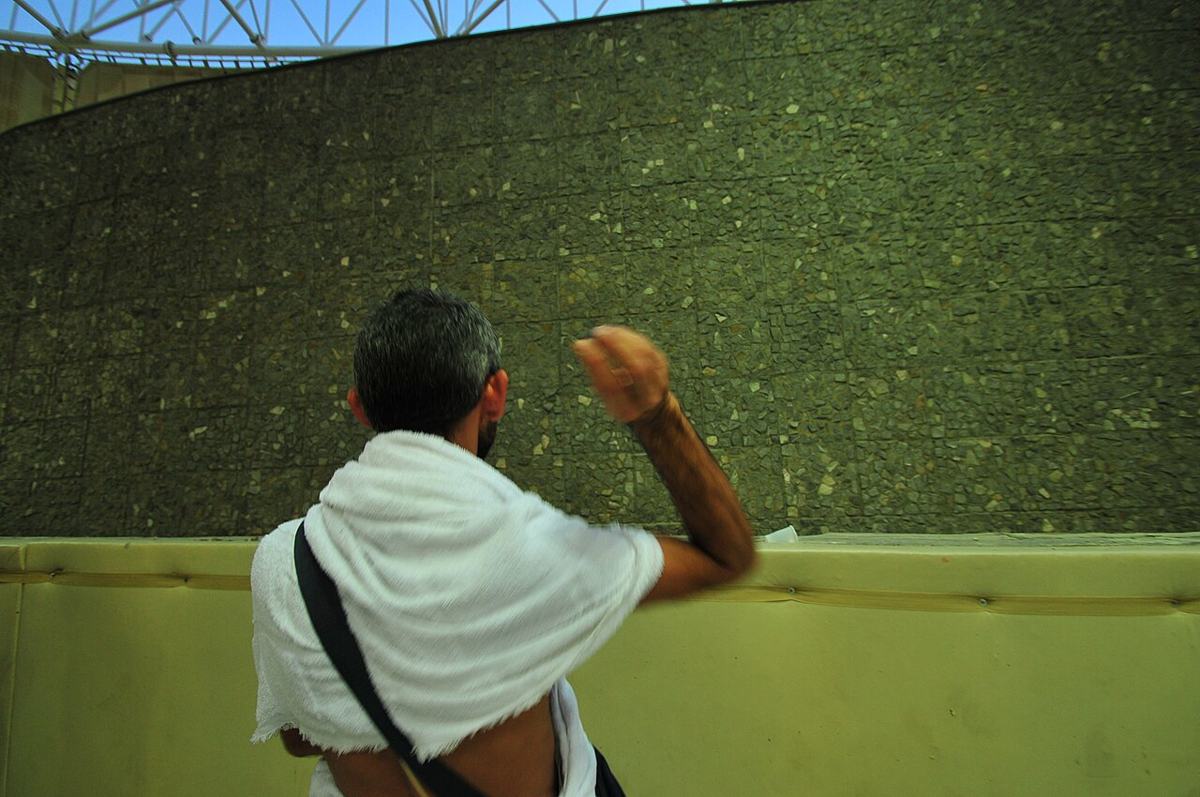
Leaving early: Nafar Awwal
To leave Mina on the 12th without staying the night of the 13th and stoning on the 13th, all of these conditions must be met:
- You spent the nights of the 11th and 12th in Mina.
- You completed the stoning of all three Jamarat on the 11th and 12th.
- You intended Nafar Awwal, after stoning the Kubra on the 12th, but before crossing the boundary of Mina.
- You leave Mina before sunset on the 12th.
- You do not intend to return to Mina.
If the sun sets while you are still in Mina, you must stay the night of the 13th and stone on the 13th.
Stoning on behalf of others (wakil)
A pilgrim who cannot stone because of illness, old age, pregnancy or other genuine incapacity may appoint someone to stone for them. The course sets out these rules:
- Check first with the medical officer and your group's religious guide that you really qualify.
- The person stoning for you must have permission. It is best that they stone for themselves first, all three Jamarat, and then for you. Stoning for someone else is not valid before completing your own stoning for that day.
- The proxy may only stone for you once the time for that day's stoning has begun, unless you are a patient being treated elsewhere and cannot be reached, in which case early arrangements are allowed.
- You may appoint a proxy by telephone or text message, as long as both sides clearly understand what is being asked.
Safety in Mina
- Be patient, do not push, and follow instructions: as the course puts it for Mina. Serious crowd accidents in the past have happened near the Jamarat.
- Go at your assigned time and use the assigned route and floor.
- Do not carry large bags or umbrellas into the Jamarat. Leave valuables in your tent.
- Walk with the flow. If someone falls, stop and help them up, and shout to those behind to slow down.
- If you are separated from your group, go to the nearest guide post or security officer and show your card.
- The walk from many camps to the Jamarat and back can be several kilometres each day. Rest, drink and protect your feet.
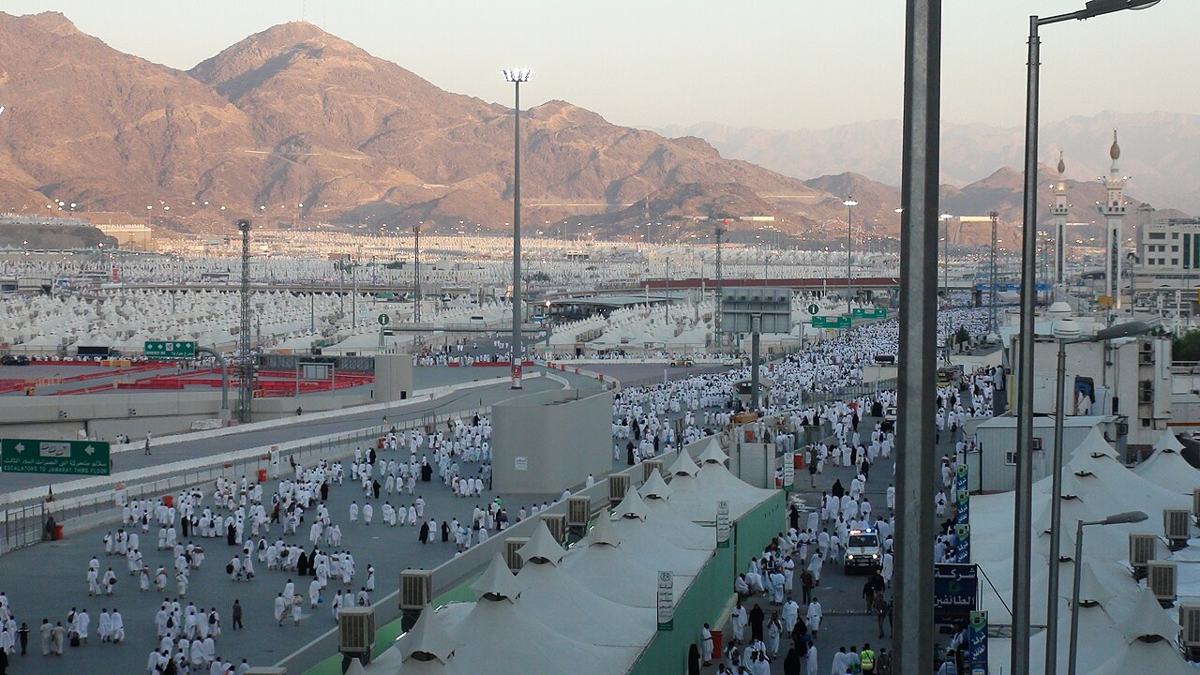
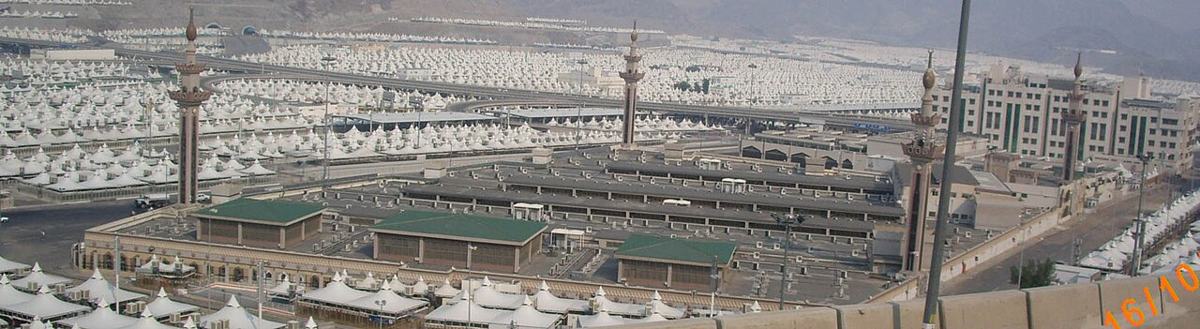
Chapter 14
Umrah Step by Step, and the Conditional Intention
A complete walk-through of Umrah as taught in Tabung Haji's basic Umrah course (Kursus Asas Umrah): its pillars and obligations, ihram, the miqat, tawaf, sa'i and the hair, Umrah from Tan'im for pilgrims already in Makkah, the conditional intention (niat bersyarat), and the farewell tawaf.
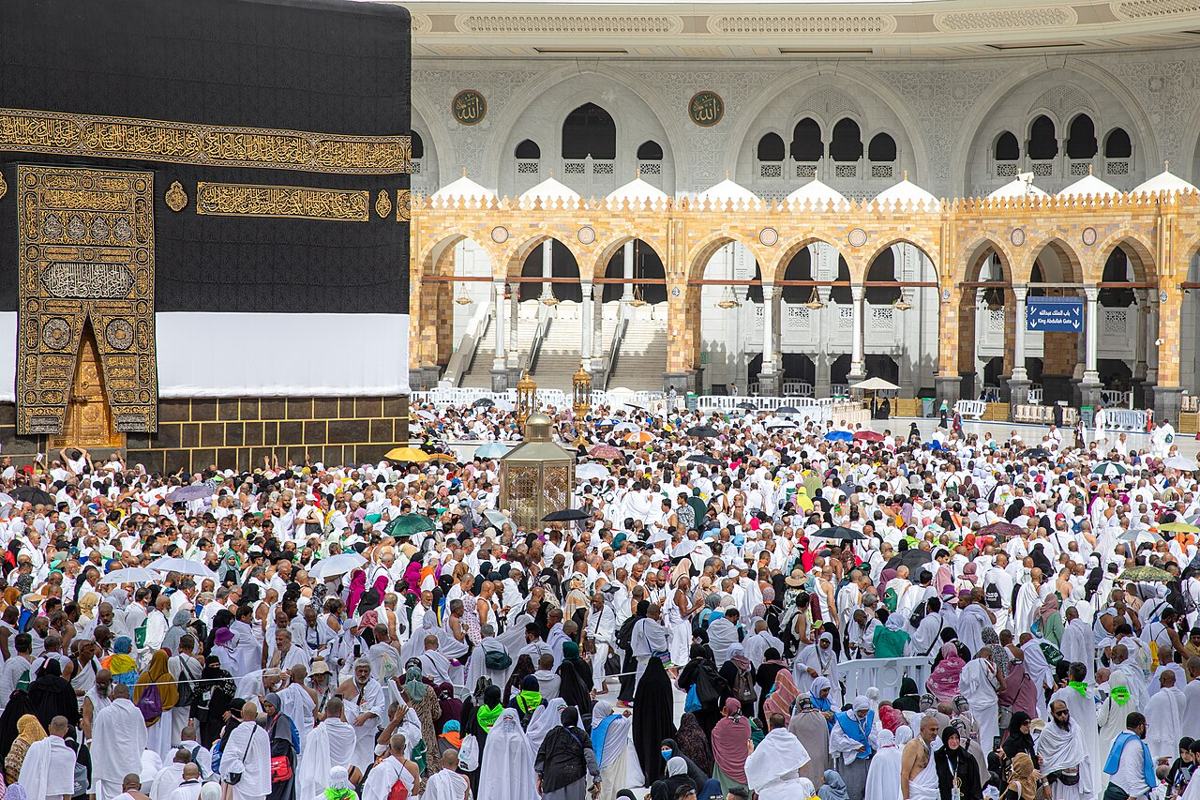
What Umrah is
Umrah is visiting Baitullah al-Haram (the Ka'bah) in Makkah at any time to perform particular acts of worship according to their conditions.
The evidence that Umrah is obligatory
وَقَالَ ابْنُ عُمَرَ رَضِيَ اللّٰهُ عَنْهُمَا: لَيْسَ أَحَدٌ إِلَّا وَعَلَيْهِ حَجَّةٌ وَعُمْرَةٌ. وَقَالَ ابْنُ عَبَّاسٍ رَضِيَ اللّٰهُ عَنْهُمَا: إِنَّهَا لَقَرِينَتُهَا فِي كِتَابِ اللّٰهِ: وَأَتِمُّوا الْحَجَّ وَالْعُمْرَةَ لِلّٰهِ
Meaning Ibn 'Umar said: "There is no one except that a Hajj and an Umrah are due from him." Ibn 'Abbas said: "It is paired with it (Hajj) in the Book of Allah: And complete the Hajj and the Umrah for Allah (al-Baqarah 2:196)." Because Umrah is mentioned together with Hajj in a command, and a command indicates obligation, Umrah is obligatory once, like Hajj.
Reported by Imam al-Bukhari, in the chapters on Umrah
Pillars and obligations of Umrah
| Pillars (rukun) | Obligations (wajib) |
|---|---|
| 1. Intention of ihram for Umrah | 1. Making the intention of ihram at the miqat (it may also be made before reaching it) |
| 2. Tawaf of Umrah | 2. Avoiding the prohibitions of ihram once the intention has been made |
| 3. Sa'i of Umrah | |
| 4. Shaving or cutting the hair | |
| 5. Order (tertib) in all the pillars |
Order is valid when the pillars of Umrah are done in their set sequence, what comes first is done first, and what comes later is done later.
How Umrah is performed
| Step | Ruling | Where | When |
|---|---|---|---|
| Ritual bath for ihram | Sunnah | Anywhere | Before the intention |
| Putting on ihram clothing | Obligatory | Anywhere | Before the intention |
| Two rak'ahs of the sunnah prayer of ihram | Sunnah | Anywhere | Before the intention |
| Intention of Umrah | Pillar | At the miqat | |
| Making the intention at the miqat | Obligation | At the miqat | |
| Avoiding the prohibitions of ihram | Obligation | Everywhere | From the intention until the hair is cut |
| Talbiah | Sunnah | Everywhere | From the intention until tawaf begins |
| Tawaf | Pillar | Around the Ka'bah | |
| Sa'i | Pillar | In the Mas'a | After tawaf |
| Shaving or cutting the hair | Pillar | At Marwah, or anywhere | After tawaf and sa'i are complete |
| Order in all the pillars | Pillar |
Ihram
Clothing
- Men: two unjoined, unstitched sheets, one covering the 'awrah between the navel and the knee, the other worn over the shoulders. White is sunnah.
- Women: clothing that covers the whole body except the face and the hands up to the wrists. There is no special garment as there is for men.
The course's reminders for women: avoid make-up without need (it invites fitnah and showing off); make sure the 'awrah is properly covered; wear a suitable telekung that does not show the 'awrah; and wear socks that are not thin, thick, long socks are recommended.
Men's sandals must leave all five toes (and the heel) uncovered.
Uncovering the right shoulder (idtiba') is sunnah only during a tawaf that is followed by sa'i, or during that sa'i. It is not sunnah anywhere else, at the departure station and so on, and in prayer it is disliked.
The sunnahs of ihram
Before the intention
- Cutting the nails.
- Tidying the beard, moustache and hair.
- Removing armpit and pubic hair.
- The ritual bath for ihram.
- Taking wudu.
- Applying perfume to the body (not to the ihram cloth).
- Oiling the hair.
- Wearing white ihram cloths.
- The sunnah prayer of ihram.
While making the intention
- Facing the qiblah.
- Being in a state of wudu.
After the intention
- The talbiah, du'a, reading the Qur'an and dhikr.
- Avoiding idle talk (lagha).
The intention
The intention is made, made present, in the heart. Its words in Malay are: "Sahaja aku mengerjakan umrah dan berihram dengannya kerana Allah Ta'ala."
نَوَيْتُ الْعُمْرَةَ وَأَحْرَمْتُ بِهَا لِلّٰهِ تَعَالَى
Reading Nawaitul-ʿumrata wa aḥramtu bihā lillāhi taʿālā.
Meaning I intend to perform Umrah and I enter ihram for it, for the sake of Allah the Most High.
لَبَّيْكَ اللّٰهُمَّ لَبَّيْكَ، لَبَّيْكَ لَا شَرِيكَ لَكَ لَبَّيْكَ، إِنَّ الْحَمْدَ وَالنِّعْمَةَ لَكَ وَالْمُلْكَ، لَا شَرِيكَ لَكَ
Reading Labbaik Allāhumma labbaik, labbaika lā sharīka laka labbaik, innal-ḥamda wan-niʿmata laka wal-mulk, lā sharīka lak.
Meaning Here I am, O Allah, here I am. Here I am, You have no partner, here I am. All praise, all blessings and all sovereignty belong to You. You have no partner.
The miqat for Umrah
For people coming from outside Makkah
- Yalamlam: for those coming from the direction of Yemen.
- Bir Ali (Dhul Hulayfah), from the direction of Madinah.
- Al-Juhfah: from the direction of Syria (al-Sham).
- Qarn al-Manazil: for those coming from the direction of Asia.
- Dhat 'Irq: from the direction of Iraq.
For pilgrims and residents already in Makkah
They must go out to the tanah halal, land outside the Haram, such as:
- Ji'ranah: about 22 km from Masjid al-Haram.
- Tan'im: about 5 km; Masjid 'A'ishah (Masjid Tan'im), the one most pilgrims use.
- Hudaybiyah: also known as Shumaisi, about 29 km.
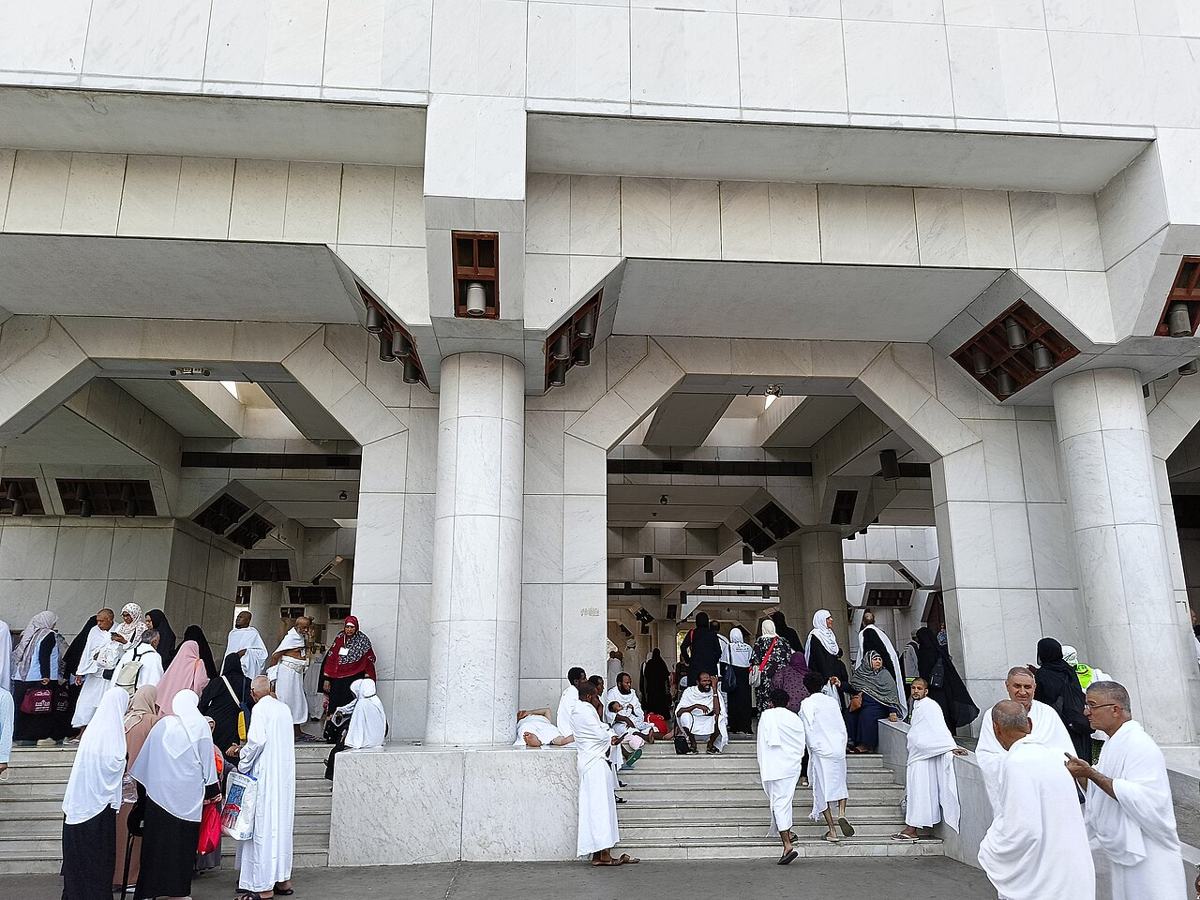
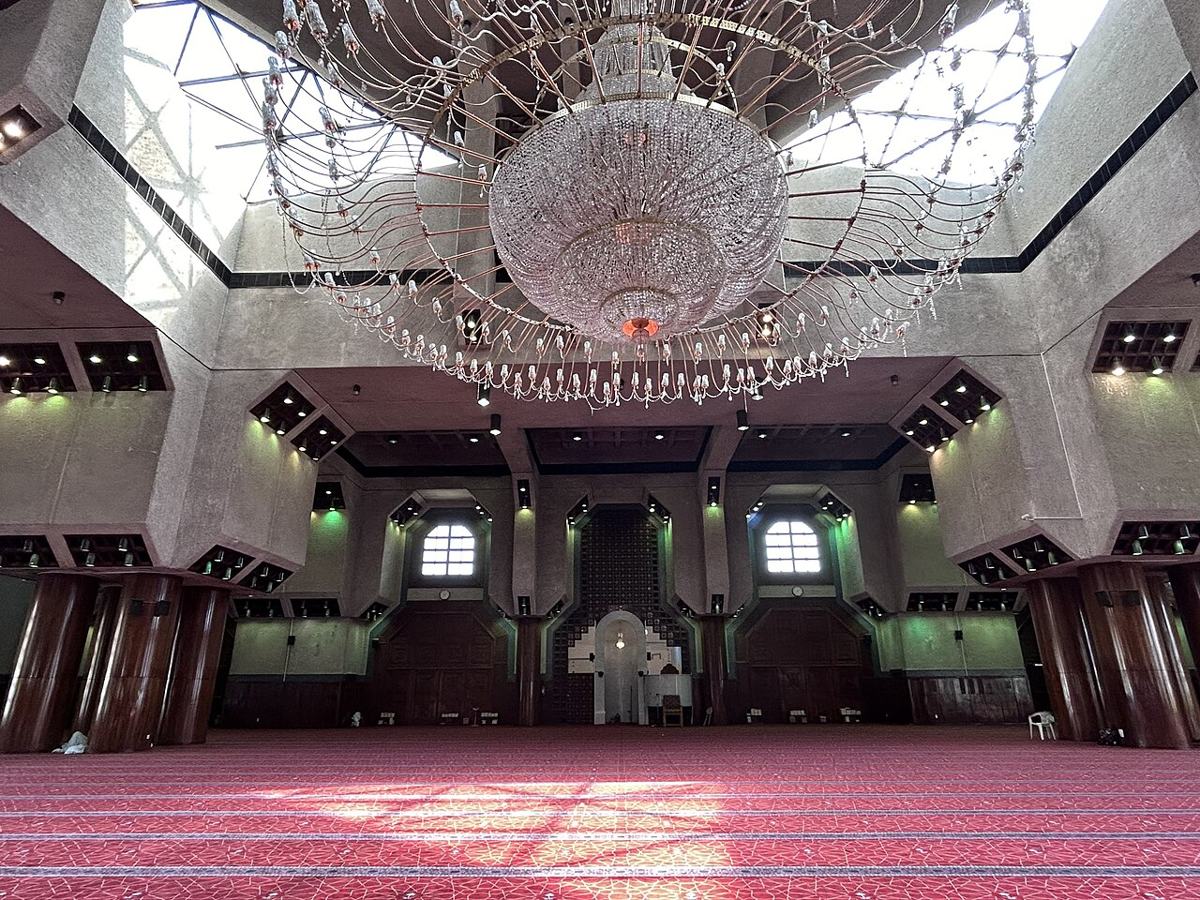
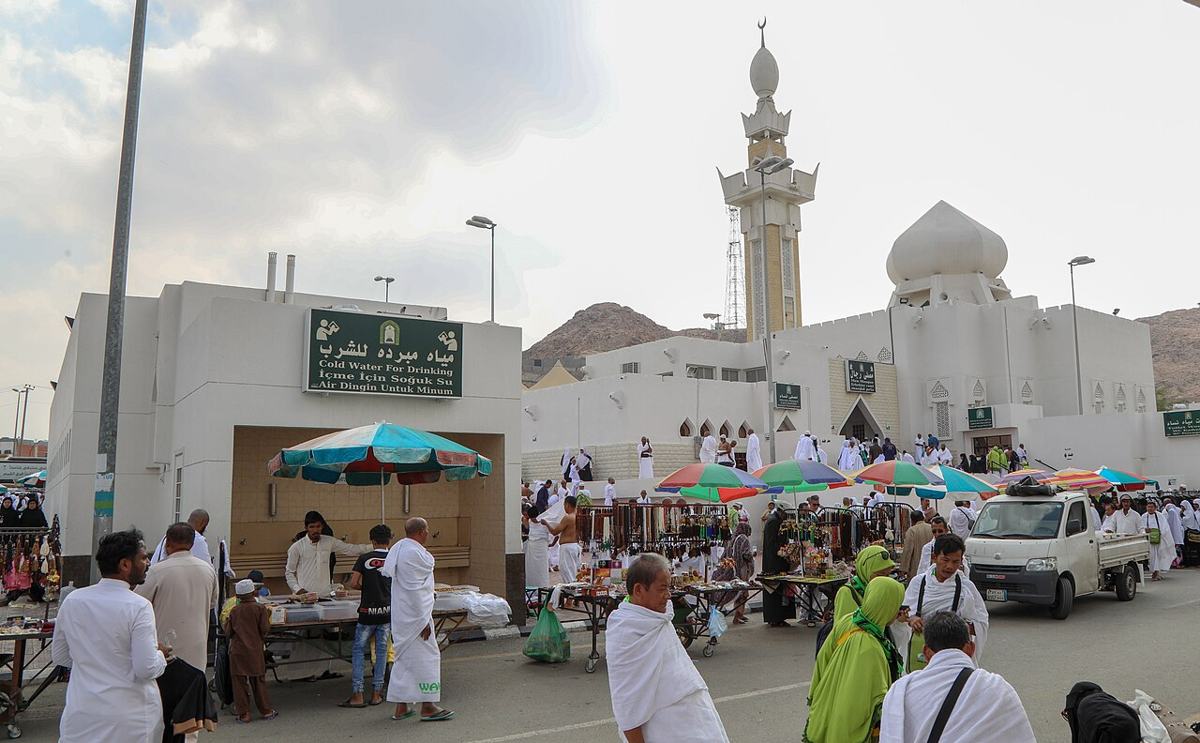
The prohibitions of ihram
Once the intention is made, these thirteen things are forbidden until the hair is cut:
- Wearing stitched or fitted clothing that encloses the body (men).
- Covering the head or any part of it (men).
- Covering the face (women).
- Wearing gloves (men and women).
- Using perfume, on the body, clothing, food or drink, or sniffing it.
- Cutting, felling or uprooting trees and plants in the Haram.
- Oiling the hair of the head or beard, or facial hair other than what grows on the cheeks and forehead.
- Removing hair or body hair.
- Hunting game.
- Cutting or trimming the nails.
- Getting married, marrying someone off, or acting as a representative in a marriage.
- Foreplay.
- Sexual intercourse.
The details, and the dam due for each, are in Chapter 7.
Tawaf
Tawaf is circling the Ka'bah according to its conditions. The full rules are in Chapter 8; the points the Umrah course stresses are:
- No separate intention is needed for the tawaf of Umrah, it is part of the ihram you are already in. (An intention is required for a voluntary tawaf, a vowed tawaf, Tawaf al-Wada' and the tawaf greeting the House: "O Allah, I intend to circle Your Sacred House seven times as a [voluntary / farewell…] tawaf; make it easy for me and accept it from me, for the sake of Allah.")
- Start and end at the green light on the wall, which is in line with the Black Stone. The upper floors have their own start line.
- Beware of najis: sandals carried with you, small children in nappies, soiled clothing, and bird droppings during tawaf.
- The concession on touching (Muzakarah Haji 21 and 22) applies from leaving your building until you are inside Masjid al-Haram or Masjid Nabawi, and in hardship such as on planes and buses, but anything else that breaks wudu, such as passing wind, still breaks it.
The 'awrah in tawaf
Men:
- The 'awrah is from the navel to the knee.
- As a matter of courtesy, men should also cover the upper body.
- Idtiba' is only for a tawaf followed by sa'i, and begins only when you are about to start the tawaf.
Women: know the limits of your 'awrah, and take particular care with: under the chin, the wrists, hair at the forehead, thick socks, and hair around the ears, especially if you wear glasses. Outside tawaf, the ordinary rules apply.
After tawaf, make sure you:
- Pray the two rak'ahs of tawaf at Maqam Ibrahim;
- make du'a at the Multazam;
- drink Zamzam;
and then go to sa'i between Safa and Marwah.
Sa'i
Sa'i is walking back and forth between Safa and Marwah according to its conditions. It begins at Safa and ends at Marwah: Safa to Marwah counts as one, and Marwah to Safa as two. The building of the Mas'a is about 420 metres long. See Chapter 9 for the du'a.
Conditions of a valid sa'i
- Performed after a tawaf, the tawaf of Hajj, Tawaf al-Qudum (for Ifrad or Qiran), or the tawaf of Umrah.
- Beginning at Safa and ending at Marwah.
- Seven complete laps, with certainty.
- Reaching the end of the course at the foot of Safa and the foot of Marwah (there are signs).
- Within the established route of the Mas'a (batn al-wadi).
- Keeping the intention of sa'i.
Sunnahs of sa'i
- Being in wudu.
- Performing it straight after tawaf.
- Going to the Mas'a through the Safa gate (Bab al-Safa).
- Climbing Safa and Marwah, men only.
- Facing the Ka'bah (qiblah) and saying takbir.
- Doing the laps continuously.
- Ramal, walking briskly between the green lights, men only.
- Idtiba' in all the laps, men.
- Du'a.
- Walking.
Points to watch
- The wheelchair lanes turn round at the foot of Safa and Marwah: turning there counts as reaching the foot of the hill, you do not have to climb to the raised area.
- If you stop to drink Zamzam during sa'i, step back a little from where you stopped before you continue.
- Beware of groups who cut pilgrims' hair and charge high fees.
- The Mas'a is not mosque area: there is no intention of i'tikaf or prayer greeting the mosque there. A menstruating woman may be in the Mas'a.
- There is no such thing as a voluntary sa'i.
- On the lower ground floor, take care with the start and end at Safa and Marwah, the end of the course at Marwah is right up against the glass wall.
Shaving or cutting the hair
Shaving or cutting means removing at least three hairs of the head, on three conditions: its time has begun, the hair is on the head, and it is not fewer than three hairs.
- It is best for men to shave. For women, cutting the hair the length of one finger joint is enough.
- Time (Umrah): after tawaf and sa'i have been completed.
The course's reminders:
- Once the time has begun, you may shave or cut your own hair or someone else's.
- It is better to have your own done first, before doing it for someone else.
- Women must keep their 'awrah covered while their hair is cut.
- Cutting the ends of the hair is valid.
- You may do it at your building.
- A man who is completely bald should pass a razor over his head (sunnah).
With this, the Umrah is complete and every prohibition of ihram is lifted.
Umrah for pilgrims already in the Holy Land
A pilgrim in Makkah who wishes to perform Umrah goes out to Masjid Tan'im, about 5 km away, and then:
- Makes the intention of ihram for Umrah,
- at the miqat (Tan'im);
- avoids the prohibitions of ihram;
- returns to Masjid al-Haram and performs tawaf,
- then sa'i,
- then shaves or cuts the hair (tahallul),
- keeping order in all the pillars.
The conditional intention (niat bersyarat)
A conditional intention of ihram for Umrah is an intention linked to something: if that thing happens, the pilgrim is released from the prohibitions of ihram.
An example:
Meaning "I intend to perform Umrah and enter ihram for it, for the sake of Allah SWT. If I am prevented by anything, at that point I become released (halal)."
It is not only for menstruation: illness or any other obstacle may also be made the condition.
The evidence
عَنْ عَائِشَةَ رَضِيَ اللّٰهُ عَنْهَا قَالَتْ: دَخَلَ النَّبِيُّ صَلَّى اللّٰهُ عَلَيْهِ وَسَلَّمَ عَلَى ضُبَاعَةَ بِنْتِ الزُّبَيْرِ بْنِ عَبْدِ الْمُطَّلِبِ، فَقَالَتْ: يَا رَسُولَ اللّٰهِ، إِنِّي أُرِيدُ الْحَجَّ وَأَنَا شَاكِيَةٌ، فَقَالَ النَّبِيُّ صَلَّى اللّٰهُ عَلَيْهِ وَسَلَّمَ: حُجِّي وَاشْتَرِطِي أَنَّ مَحِلِّي حَيْثُ حَبَسْتَنِي
Meaning 'A'ishah reported that the Prophet ﷺ came to Duba'ah bint al-Zubayr ibn 'Abd al-Muttalib, and she said: "O Messenger of Allah, I want to perform Hajj but I am unwell." The Prophet ﷺ said: "Perform Hajj, and make the condition that my place of release is wherever You hold me back."
Reported by Muslim
Examples for a woman concerned about menstruation
- Not menstruating, she makes her intention of ihram for Umrah with this condition: "If my period comes and continues until my date of return, then I become halal."
- Already menstruating, she makes her intention of ihram for Umrah with this condition: "If my period continues until my date of return, then I become halal."
- Not menstruating, she makes a plain intention for Umrah; then, when her period comes, she says: "If my period continues until my date of return, then I become halal."
Tawaf al-Wada' (the farewell tawaf)
Tawaf al-Wada' is the farewell tawaf, out of honour and respect for the Ka'bah. It is obligatory for anyone leaving Makkah for a distance of two marhalah (about 56 miles, or 91 km) or more, including a pilgrim leaving after Umrah.
| Situation | Dam | Sin |
|---|---|---|
| Excused (see the list below) | No | No |
| Left it through ignorance or forgetfulness | Yes | No |
| Left it deliberately, without a valid excuse | Yes | Yes |
| Left it deliberately, knowing it was obligatory, then turned back before reaching two marhalah and performed it | No, returning removes the dam | Yes, the sin remains |
| Someone who has not yet completed any of the pillars | Not required yet, the pillars must be completed first | No |
Valid excuses (uzur syar'i)
- A woman in her period, post-natal bleeding, or istihadah within the days of her period.
- Urinary incontinence (salasul baul).
- Wounds, pus or blood that could soil the mosque.
- Being forced to leave without tawaf.
- Fear of being wronged.
- Fear of being left behind by your travelling companions.
- Fear for your own safety or property.
- Having no water, dust or earth with which to purify yourself.
More on what you may and may not do after Tawaf al-Wada' is in Chapter 18.
Chapter 15
For Women: 'Awrah, Permission to Travel and Menstruation
Covering the 'awrah in ihram, in tawaf and in sa'i; the husband's permission, travelling with a mahram or trustworthy women, and the woman in iddah; then the rulings on menstruation that matter most in Hajj, what you may do during your period, what to do if it comes before Tawaf al-Ifadah, and the use of pills to delay it.
The 'awrah of a woman
In the Shafi'i school, a woman's 'awrah in prayer is her whole body except her face and her hands (front and back). The covering must be thick enough to hide the colour of the skin.
The course describes complete covering as:
- a headscarf that is long, not see-through, and covers the chest;
- a long, loose top;
- sleeves down to the wrists;
- a skirt or trousers down to the ankles;
- socks that do not show the skin or nails;
- if wearing heeled shoes, ones that do not make a noise.
In tawaf
Covering the 'awrah is a condition of tawaf. If it is uncovered deliberately, the round is void. Before tawaf, check:
- under the chin;
- the wrists, especially when raising the hand to the Black Stone;
- hair at the forehead, and around the ears, take care if you wear glasses;
- socks: thick ones.
When gesturing to the Black Stone, keep your hand inside your telekung, or wear gloves outside ihram. (In ihram gloves are not allowed, keep the hand inside the cloth.)
In sa'i
Covering the 'awrah is not a condition of sa'i, but exposing it in front of men who are not mahram is still sinful. Watch out for:
- the hair being cut at Marwah in a public place;
- thin socks.
Among other women, in the tents and in hotel rooms
The normal rules apply. In hotel rooms, bathrooms and the tents of Arafah and Mina, among women only, the usual 'awrah between women applies. With your husband or mahram in ihram, the usual rules apply too, but remember the prohibitions of ihram concerning intimacy.
A note for men
A man's 'awrah in prayer is from the navel to the knee. In ihram, when you visit a women's hotel room you must be fully covered with your ihram cloths. Do not enter rooms of the opposite sex, even to meet your own spouse; meet outside the room.
Permission and travelling companions
The husband's permission
A wife must obtain her husband's permission before performing Hajj, whether it is the obligatory Hajj, a vowed Hajj or a voluntary one. The course stresses:
- permission is the husband's right;
- it is needed even if the husband is a sinful man (fasiq);
- a woman in the iddah of a revocable divorce (talaq raj'i), three cycles, still needs her (former) husband's permission;
- if a wife enters ihram without her husband's knowledge, he has the right to tell her to come out of ihram (by the tahallul of ihsar, at her own expense).
An unmarried woman needs the permission of her guardian (wali).
If a husband permits his wife to go without him, the course lists these conditions: she has a mahram with her (or trustworthy women, see below); she is confident the journey is safe; her expenses are her own, not taken from her husband's money; and her husband does not need her while she is away.
A mahram or trustworthy women
- A woman should travel with her husband or a mahram.
- For the obligatory Hajj and Umrah, the Shafi'i school, along with the Maliki school and many early scholars, permits her to go with one or more trustworthy women (thiqah). Imam al-Nawawi wrote that a woman performing the obligatory Hajj must be with her husband, a mahram, or a group of trustworthy women.
- A weaker view in the Shafi'i school allows travel without them, on condition that there is no fear of fitnah, her safety is assured, she is with trustworthy women, and it is not for a self-imposed vow.
A woman whose husband dies
- A widow's iddah is four months and ten days. A woman whose husband died before she left, even if he had given permission, may not set out for Hajj during her iddah.
- If her husband dies while she is already in the Holy Land, she may continue her Hajj and Umrah. She should observe the mourning (ihdad) as far as possible: avoid going out of the hotel except for need, complete her rites, pray in the Haram or follow the programmes arranged for pilgrims, and stay with trustworthy women. During ihdad she avoids bright, decorative clothing, gold and jewellery, perfume, kohl (except for need), eye-catching make-up, henna and hair oil for adornment.
Menstruation and other bleeding
The kinds of blood
| Kind | What it is |
|---|---|
| Haid (menstruation) | Natural blood from the womb of a healthy, mature woman at regular times |
| Istihadah | Bleeding outside the possible pattern of haid, less than 24 hours, beyond the maximum of haid or nifas, or within 15 days of the end of a previous haid |
| Nifas | Post-natal bleeding after childbirth |
| Wiladah | Blood accompanying the birth itself |
| Fasad | Blood that is neither haid nor nifas, for example, in some views, during pregnancy |
Basic facts about haid (Shafi'i school)
- Earliest age: nine lunar (qamariyah) years, about 8 years, 8 months and 21 days in the Gregorian calendar. Blood before that age is istihadah or illness.
- Minimum: one day and night (24 hours). Maximum: fifteen days and nights. Usual: three, four, five, six or seven days and nights.
- Minimum purity between two periods: fifteen days.
- Colours that count as haid within its time: black-red, deep red, brown, yellow, and turbid (cloudy, like muddy water).
Interrupted bleeding (fatrah al-naqa')
Sometimes bleeding stops for a day or two and then returns within the fifteen days. In the stronger Shafi'i view, the clean days in between are also counted as haid. A second view (talfiq) counts the bleeding days as haid and the clean days as purity, on conditions.
Bleeding beyond fifteen days
If bleeding continues past the maximum, the extra is istihadah: a woman counts her haid according to her usual pattern, or by the colour of the blood if she can tell it apart. A woman with istihadah prays, fasts and may perform tawaf, with special care over cleanliness (below). Consult your religious guide for your particular case.
After menopause
In the Shafi'i school menopause follows the woman's family pattern (often cited as around 62 years), and blood after it may still be counted as haid. The course notes that if a woman who had stopped menstruating for six months or more bleeds and cannot otherwise complete Tawaf al-Ifadah before her return home or to Madinah, she may follow the Maliki, Hanafi and Hanbali view and treat it as istihadah.
Wind, discharge and moisture
- Wind from the front passage breaks wudu (Shafi'i). If it happens constantly, she is treated as someone with continuous impurity (da'im al-hadas). Air that stays inside, or sounds from muscle movement, do not break wudu.
- White discharge (keputihan) is impure and breaks wudu. Clean it before wudu. If it is continuous, the rules of continuous impurity apply.
- Ordinary internal moisture of the vagina is not impure and does not break wudu.
Continuous impurity: istihadah, constant discharge, incontinence
- Clean the private parts of impurity.
- Use a sanitary pad at the opening.
- Take wudu after the prayer time has begun.
- One wudu is for one obligatory prayer or one obligatory tawaf, plus any number of voluntary prayers and voluntary tawaf.
This follows the Prophet's ﷺ instruction to Fatimah bint Abi Hubaysh. (The Hanbali school also allows such a woman to combine prayers; the Shafi'i school does not.) Tampons are not recommended, as they can be harmful.
What you may and may not do during your period
The Prophet ﷺ told 'A'ishah when her period came in Hajj: "Do everything the pilgrim does, except tawaf around the House." (Reported by al-Bukhari and Muslim.)
| You may | You may not |
|---|---|
| Make the intention of ihram | Perform tawaf of any kind, pillar, farewell or voluntary |
| Take the ritual bath for ihram | Pray, obligatory, voluntary or make-up (no make-up is owed afterwards) |
| Say the talbiah, tasbih, tahmid, takbir, and adhkar | Fast (Ramadan fasts are made up later) |
| Perform sa'i, when it follows a valid tawaf | Stay or sit in the mosque (passing through is allowed) |
| Perform wuquf, the nights at Muzdalifah and Mina | Touch or carry the mushaf, though books of fiqh, tafsir and translations are fine, and a mushaf inside a bag of other items may be carried |
| Stone all three Jamarat | Recite the Qur'an as recitation (in the Shafi'i, Hanbali and Hanafi schools), though verses used as dhikr, such as Ayat al-Kursi and the last three surahs, may be said |
| Make du'a and dhikr anywhere | Have intercourse, or intimacy between the navel and the knee |
If your period comes before Tawaf al-Ifadah
This is the situation women fear most. The course sets out three options:
- Ask Tabung Haji to postpone your flight home, so that you can wait until you are clean and perform the tawaf.
- Go home without completing Hajj, and perform the tahallul of ihsar to come out of ihram. Your Hajj is not complete: you must return in a future year to complete it.
- Follow the Hanafi school, which allows a menstruating woman to perform Tawaf al-Ifadah when she has no other option. Her Hajj is complete, but she must pay a dam of one camel and ask Allah's forgiveness for entering the mosque in a state of major impurity.
Discuss these with your religious guide and the TH officers as soon as your period begins, do not wait until the last day.
A Tamattu' pilgrim whose period stops her Umrah
If your period comes before the tawaf of your Umrah and you fear missing Hajj:
- First consider whether fatrah al-naqa' or yellowish discharge after your usual days might apply (only if you must leave soon).
- If not, you may change your intention from Tamattu' to Qiran before leaving for Arafah, as explained in Chapter 5. A Qiran dam is then due. If you have already paid the Tamattu' dam, tell the TH officer that you have changed to Qiran.
Tawaf al-Wada'
A woman whose period has not ended by the time she leaves Makkah is excused from Tawaf al-Wada': there is no dam and no sin.
Pills to delay your period
The course's advice:
- Not encouraged for most women, every rite of Hajj except tawaf can be performed during menstruation.
- Permitted if needed, on conditions: seek advice from a trustworthy specialist; the medicine must not harm you; and start getting used to it at least three months before you travel.
From experience, the pills sometimes work, sometimes cause heavier bleeding, and sometimes cause irregular spotting. Practical advice:
- If you have no problems with your periods, do not take any pills.
- If you do have problems, raise them at your health screening.
- See a doctor at least three months before departure.
- Some women need treatment, hormonal pills or injections, or minor or major surgery, before going.
- Follow the instructions for your medicine exactly. Pills that stop bleeding and pills that regulate the cycle work differently.
- Do not copy your friends, every body is different.
- If there is no alternative, hormonal pills may be used for a limited time after medical advice, but have a back-up plan in case they do not work.
- See a doctor about excessive discharge or discomfort, and have prolapse or incontinence treated before you travel.
Chapter 16
Purification and Prayer on the Journey
Wudu, including with a spray bottle, what breaks it, and the concession for crowds; tayammum and wiping over a dressing (jabirah); then the prayer, its conditions, pillars, sunnahs and what breaks it, the funeral prayer, Friday prayer for women, praying "to honour the time", masbuq and muwafiq, prayer when ill, shortening and combining, and the ruling on combining at Arafah and Mina.
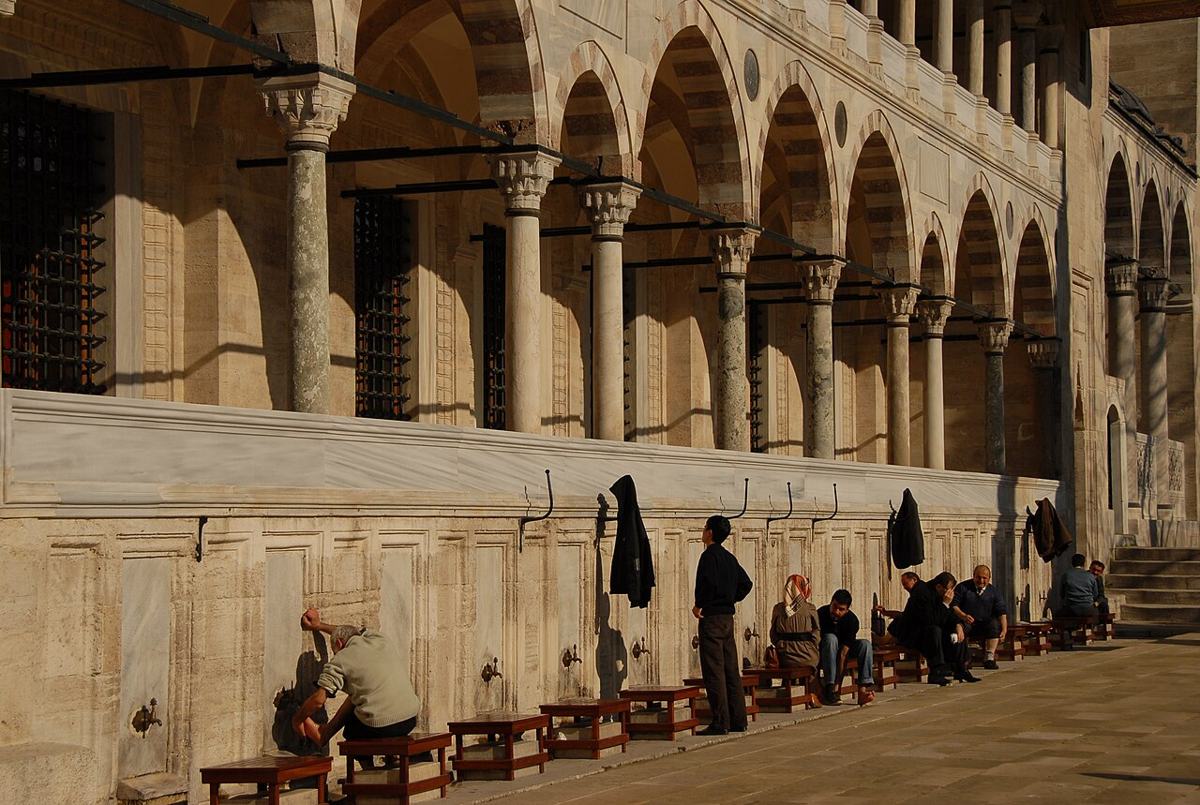
Wudu
Wudu is washing particular parts of the body with water, in a particular way, with the intention of wudu (Surah al-Ma'idah 5:6).
Meaning O you who believe, when you rise to pray (while in minor impurity), wash your faces and your hands up to and including the elbows, wipe part of your heads, and wash your feet up to and including the ankles.
Surah al-Ma'idah 5:6
The pillars of wudu
- Intention: at the moment you begin washing the face.
- Washing the face, to its limits.
- Washing both hands up to the elbows.
- Wiping the head with water, at least three hairs within the area of the head.
- Washing both feet up to the ankles.
- Order (tertib).
Where and how
You will need to make wudu in Masjid al-Haram and Masjid Nabawi, on the road and in vehicles, and at Arafah, Muzdalifah and Mina. You may use a water spray or a water bottle, on condition that the water flows, at least three drops running over each part.
The sunnahs of wudu
- Using the tooth-stick (bersugi / siwak).
- Facing the qiblah.
- Saying Bismillah.
- Washing both palms up to the wrists.
- Rinsing the mouth.
- Sniffing water into the nose.
- Wiping water over the whole head.
- Wiping water over the whole of the ears, outside and inside.
- Running the fingers through a thick beard.
- Running water between the fingers and toes.
- Washing the right side before the left.
- Washing and wiping three times each.
- Doing it continuously (muwalat).
- Reciting the du'a after wudu.
أَشْهَدُ أَنْ لَا إِلٰهَ إِلَّا اللّٰهُ وَحْدَهُ لَا شَرِيكَ لَهُ، وَأَشْهَدُ أَنَّ مُحَمَّدًا عَبْدُهُ وَرَسُولُهُ، اللّٰهُمَّ اجْعَلْنِي مِنَ التَّوَّابِينَ وَاجْعَلْنِي مِنَ الْمُتَطَهِّرِينَ
Reading Ash-hadu an lā ilāha illallāhu waḥdahū lā sharīka lah, wa ash-hadu anna Muḥammadan ʿabduhū wa rasūluh. Allāhummajʿalnī minat-tawwābīna wajʿalnī minal-mutaṭahhirīn.
Meaning I bear witness that there is no god but Allah alone, without partner, and I bear witness that Muhammad is His servant and Messenger. O Allah, make me among those who repent and among those who purify themselves.
What breaks wudu
- Anything coming out of the two passages, front or back, solid, liquid, wind or anything else.
- Losing consciousness: through insanity, fainting, intoxication, blacking out, or sleep in which the seat is not firmly settled.
- Skin contact between a man and a woman who are not mahram to each other, without a barrier.
- Touching the private parts (front or back) with the palm or the inside of the fingers, your own or someone else's.
- Apostasy.
Wudu in the Holy Land: the concession for crowds
- The original ruling: skin contact without a barrier between a man and a woman who could marry breaks wudu.
- But there is rukhsah, a concession Allah grants Muslims in carrying out His commands at times of necessity (darurah), hardship (masyaqqah) or need (hajah).
- 'Azimah means an obligation that must be carried out in every situation, for example, being in wudu for tawaf and prayer.
- Therefore a pilgrim may move from the well-known (masyhur) Shafi'i opinion to the weaker (marjuh) Shafi'i opinion: wudu is not broken by contact between a man and a woman without desire, in hardship and difficulty such as the crowding in the place of tawaf.
Decision of the National Hajj Council (Muzakarah Haji Peringkat Kebangsaan), 21st session (5–7 June 2005, Shah Alam) and 22nd session.
This opinion applies:
- from the moment you leave your building until you are inside Masjid al-Haram or Masjid Nabawi; and
- in hardship such as on planes or buses, during the period of Hajj or Umrah only.
It is valid for tawaf and so on as long as the wudu has not been broken in another way according to the Shafi'i school, for example by passing wind from the front or back passage.
Tayammum
Tayammum is wiping clean dust onto the face and both hands up to the elbows, using pure dust, on certain conditions, in place of wudu or the obligatory bath.
Excuses that permit tayammum
- No water.
- There is water, but it cannot be used, because it is hard to get, it is needed for eating and drinking, or it is very expensive.
- Illness that water would harm.
Conditions of tayammum
- The time of the obligatory prayer has begun.
- No water was found after trying to find it.
- With pure dust.
- Water cannot be used because of illness.
- Free of najis.
Pillars of tayammum
- Intention, in the words: "Sahaja aku bertayammum untuk membolehkanku mengerjakan solat kerana Allah Ta'ala", "I perform tayammum to make prayer permissible for me, for the sake of Allah."
- Wiping the face and both hands up to the elbows, once, with pure dust.
- Spreading the dust over all the parts of tayammum, the face and both hands.
- Order.
How to perform tayammum
- Place both hands on the dust and shake it off so it is thin.
- Wipe the dust over your face.
- Wipe both hands up to the elbows with the dust.
- In that order.
The parts of tayammum are only the face and the two hands (up to the elbows); the feet are not included.
Wiping over a dressing (jabirah)
- Jabirah means wiping water over a dressing, a cast or something similar on a part of the body that is washed in wudu.
- It is by analogy with wiping over khuf (leather socks worn in cold places) and the turban.
- The same applies to a broken limb in a cast, a head bandage or a dressing where blood comes out, a dressing over a sore, a dressing over a surgical wound, and so on.
How:
- Wash the healthy parts of the limbs of wudu, and wipe over the jabirah.
- It is recommended to repeat (i'adah) prayers performed with the wudu of someone with a jabirah.
Muzakarah Haji, 20th session (Melaka).
The prayer
Prayer is an act of worship that connects the servant with his Lord, made up of words and actions that begin with the takbir and end with the salam.
Meaning "The first deed for which a servant will be called to account on the Day of Judgement is the prayer. If his prayer is good, all his deeds are good, and if not, the opposite."
Hadith reported by al-Tabarani
Conditions of a valid prayer
- Islam.
- Being of sound mind.
- Purity from minor and major impurity.
- Purity from najis on the body, clothing and place.
- Certainty that the time has begun.
- Facing the qiblah.
- Covering the 'awrah.
- Knowing what is obligatory and what is sunnah.
- Not doing anything that breaks the prayer.
The thirteen pillars of prayer
- Intention.
- Takbiratul ihram.
- Standing, for those able.
- Reciting al-Fatihah.
- Bowing (ruku') with tama'ninah, calm and orderly, not rushed.
- Rising (i'tidal) with tama'ninah.
- Two prostrations, with tama'ninah.
- Sitting between the two prostrations, with tama'ninah.
- Reciting the final tashahhud.
- Sitting for the final tashahhud.
- Sending blessings on the Prophet ﷺ in the final tashahhud.
- The salam.
- Order (tertib).
Sunat ab'ad
Emphasised sunnahs: if one is missed, the prostration of forgetfulness (sujud sahwi) is recommended in its place.
- Reciting the first tashahhud.
- Sending blessings on the Prophet ﷺ in the first tashahhud.
- Sending blessings on the family of the Prophet ﷺ in the final tashahhud.
- The qunut in Subh, and in Witr from the night of the 16th of Ramadan to the end of the month.
Sunat hai'at
- Raising both hands, thumbs level with the ears, at takbiratul ihram, when going into ruku', at i'tidal, and when rising after the first tashahhud.
- Placing both hands below the chest while standing.
- The opening du'a (iftitah).
- Ta'awwudh before al-Fatihah.
- Saying "Amin" after al-Fatihah.
- Reciting a surah or verses after al-Fatihah in the first and second rak'ahs.
- Reciting aloud in the first two rak'ahs of Maghrib, Isha and Subh, except for those following an imam.
- Saying the takbir at every move from one physical pillar to another.
- Praising Allah when rising from ruku' and while standing.
- Placing the palms on the knees in ruku'.
- Tasbih in ruku' and prostration.
- In the tashahhud: right hand on the right thigh and left hand on the left; the left fingers straight; the right hand closed except the index finger, raised slightly at "illallah".
- Sitting iftirash in every sitting except the final tashahhud, sitting on the left foot with the right foot upright, its toes towards the qiblah.
- Sitting tawarruk in the final tashahhud, the left foot under the right, sitting on the floor, the right foot upright with its toes towards the qiblah.
- The second salam.
- Turning the face to the right for the first salam and to the left for the second.
Things that are disliked (makruh) in prayer
- Praying when food you want has been served.
- Reciting aloud what should be recited quietly.
- Standing on one foot, or with the feet pressed together.
- Turning the head right or left (without a reason).
- Holding back the need to open the bowels or urinate.
- Raising or lowering the head too much in ruku'.
- Men keeping the elbows against the sides, and the stomach against the thighs, in prostration.
- Leaving out the surah in the first and second rak'ahs.
- Leaving out the takbirs of moving between pillars.
Things that break the prayer
- Speaking deliberately.
- Moving three times in succession.
- Minor or major impurity occurring.
- Being touched by najis.
- The 'awrah becoming uncovered.
- Changing the intention.
- Turning the body (the chest) away from the qiblah.
- Eating or drinking, even a little.
- Laughing out loud.
- Crying until the voice is heard.
- Prolonging a short pillar.
- Apostasy.
- Going ahead of the imam, or falling behind him, by more than three movements.
Times when an unprompted voluntary prayer is forbidden
- From sunrise until the sun has risen about the height of a spear.
- When the sun is at its zenith, until it passes it.
- When the sun is about to set.
- After Asr prayer until Maghrib.
- After Subh prayer until sunrise.
Prayers that have a reason are not forbidden at these times, such as: make-up prayers, the funeral prayer, the prayer greeting the mosque, the sunnah prayer after wudu, and so on. In the Haram of Makkah there is no forbidden time for voluntary prayer (Chapter 4).
The funeral prayer (solat jenazah)
- Ruling: a communal obligation (fardu kifayah).
- Women may also join the funeral prayer in congregation with the men.
- It is usually held straight after the obligatory prayers, in Masjid al-Haram and Masjid Nabawi, almost every day.
Pillars of the funeral prayer
- Intention.
- Standing, for those able.
- Four takbirs.
- Reciting al-Fatihah.
- Sending blessings on the Prophet ﷺ (after the second takbir).
- Du'a for the deceased (after the third takbir).
- Salam.
Intention: "Sahaja aku sembahyang atas mayat ini, 4 takbir fardu kifayah, kerana Allah Ta'ala", "I pray over this deceased, four takbirs, as a communal obligation, for the sake of Allah."
- Recite al-Fatihah after the first takbir.
- Send blessings on the Prophet ﷺ after the second takbir, at least:
- Make du'a for the deceased after the third takbir, at least:
- Give the salam after the fourth takbir.
اللّٰهُمَّ صَلِّ عَلَى مُحَمَّدٍ
Reading Allāhumma ṣalli ʿalā Muḥammad.
Meaning O Allah, send blessings on Muhammad.
اللّٰهُمَّ اغْفِرْ لَهُ وَارْحَمْهُ
Reading Allāhummaghfir lahū warḥamh.
Meaning O Allah, forgive him and have mercy on him. For a woman: Allāhummaghfir lahā warḥamhā. For several deceased: Allāhummaghfir lahum warḥamhum.
Friday prayer and women
Meaning "Friday prayer is a duty owed by every Muslim, in congregation, except four: a slave who is owned, a woman, a child and a sick person."
Hadith reported by Abu Dawud and al-Hakim
- Friday prayer is not obligatory on women.
- If they do attend, they should sit in the area set aside for women.
- A woman who has prayed Jumu'ah does not need to pray Zuhr.
- It is better for her to pray Zuhr at her lodging.
Praying "to honour the time" (solat hormat waktu)
This is an obligatory prayer performed by someone who has no means or ability to purify themselves, or who is prevented from using water (faqid al-tahurain), for example on a plane, on a bus, and so on.
- They must repeat the prayer once they are able to purify themselves, if the time of that prayer still remains;
- and make it up (qada') if its time has passed.
Masbuq and muwafiq
- Muwafiq is a follower who has time, while the imam is standing, to recite al-Fatihah at a moderate pace. He must complete his al-Fatihah.
- Masbuq is a follower who does not have time to recite al-Fatihah while the imam is standing. He does not have to complete al-Fatihah: he recites what he can, and must bow together with the imam.
Prayer when ill
Family members, or anyone, may help a sick or frail person take wudu. Then make sure they face the qiblah as far as they are able, and pray in whichever of these ways they can:
- Sitting iftirash (as between the two prostrations).
- Lying on the side, facing the qiblah.
- Lying on the back, with the feet and head towards the qiblah.
- With movements of the head and eyes.
- It is enough to perform the prayer in the heart.
In the Holy Mosques
- Make the intention of i'tikaf when you enter the mosque.
- Pray the prayer greeting the mosque.
- Pray many voluntary prayers.
- Read the Qur'an.
- Remember Allah.
- Give charity.
- Keep away from what is forbidden, disliked and pointless (lagha).
- Face the qiblah when you make du'a.
- Stay in a state of wudu.
Shortening (qasar) and combining (jamak)
Shortening
Qasar is praying two rak'ahs only for Zuhr, Asr and Isha, never for Maghrib or Subh. Its conditions:
- The journey is permitted by the shariah.
- The distance is not less than two marhalah (91 km).
- You intend to shorten at takbiratul ihram.
- You do not follow an imam who is praying in full.
- Only the four-rak'ah prayers are shortened.
Combining
Jamak is joining Zuhr with Asr, and Maghrib with Isha.
| Jamak taqdim (early) | Jamak ta'khir (late) |
|---|---|
| Zuhr and Asr in the time of Zuhr, or Maghrib and Isha in the time of Maghrib | Zuhr and Asr in the time of Asr, or Maghrib and Isha in the time of Isha |
Conditions of jamak taqdim:
- Pray Zuhr before Asr, and Maghrib before Isha.
- Intend to combine during the first prayer, before its salam (best at its takbiratul ihram).
- Pray the two one straight after the other.
- Still be travelling until the takbiratul ihram of the second prayer.
- Be certain that the time of the first prayer lasts until the second has been begun.
Conditions of jamak ta'khir:
- Intend to combine during the time of the first prayer.
- Still be travelling until the salam of the second prayer.
Notes:
- In jamak ta'khir it is allowed to pray Asr before Zuhr, or Isha before Maghrib. It is sunnah to pray Zuhr first, then Asr (and Maghrib, then Isha), unless the time is too short for both, in which case the prayer whose time it is (sahib al-waqt) must be prayed first.
- Combined prayers are performed with two adhans and two iqamahs.
- In congregation, the follower intends to follow, and the imam intends to lead.
Combining at Arafah and Mina
- Combining obligatory prayers at Arafah and Mina is permitted.
- The prayers are combined in full (tamam), they are not shortened.
- The reasons combining is permitted are:
- because of the rites (nusuk);
- because of hardship (masyaqqah).
Hajj Worship Committee meeting 1427H / 2006, referring to al-Majmu' Sharh al-Muhadhdhab by Imam al-Nawawi, vol. 4, p. 384.
When you are and are not a traveller
- On arriving in Madinah, pilgrims may not combine or shorten their prayers: they are no longer travellers, because they know they will be in Madinah for eight days.
- Before leaving Madinah for Makkah, pilgrims may not combine or shorten at their hotel, because they have not yet begun their journey. Combining and shortening may only be done once the bus has set off, for example when it stops at a mosque or highway rest-area surau on the way to Makkah.
- In the same way, pilgrims about to leave for Arafah may not combine or shorten at their building in Makkah, because the distance is not enough to meet the condition for shortening and combining.
Warnings about prayer
1. Leaving the prayer. This is described as disbelief (kufur) on the basis of the Qur'an, the Sunnah and the consensus of the scholars.
Meaning "What led you into Saqar (Hell)?" They will say: "We were not of those who prayed."
Surah al-Muddaththir 74:42–43
Meaning "The covenant between us and them is the prayer; whoever abandons it has disbelieved."
Hadith reported by Ahmad and others
2. Delaying the prayer. "Indeed, prayer is prescribed for the believers at fixed times" (an-Nisa' 4:103). Delaying prayer without an excuse accepted by the shariah is a major sin. The Prophet ﷺ described the one who waits until the sun is between the horns of Shaytan and then pecks four rak'ahs, remembering Allah only a little, as praying "the prayer of a hypocrite" (reported by Muslim).
3. Not praying in congregation in Masjid al-Haram and Masjid Nabawi. "Whoever hears the call and does not answer it, there is no prayer for him, except with an excuse" (reported by Ibn Majah).
4. Praying without tama'ninah. Tama'ninah is a pillar of prayer; the prayer is not valid without it. It means being still in ruku', i'tidal, prostration and the sitting between the prostrations, until the bones settle back into place, and not rushing from one pillar to the next.
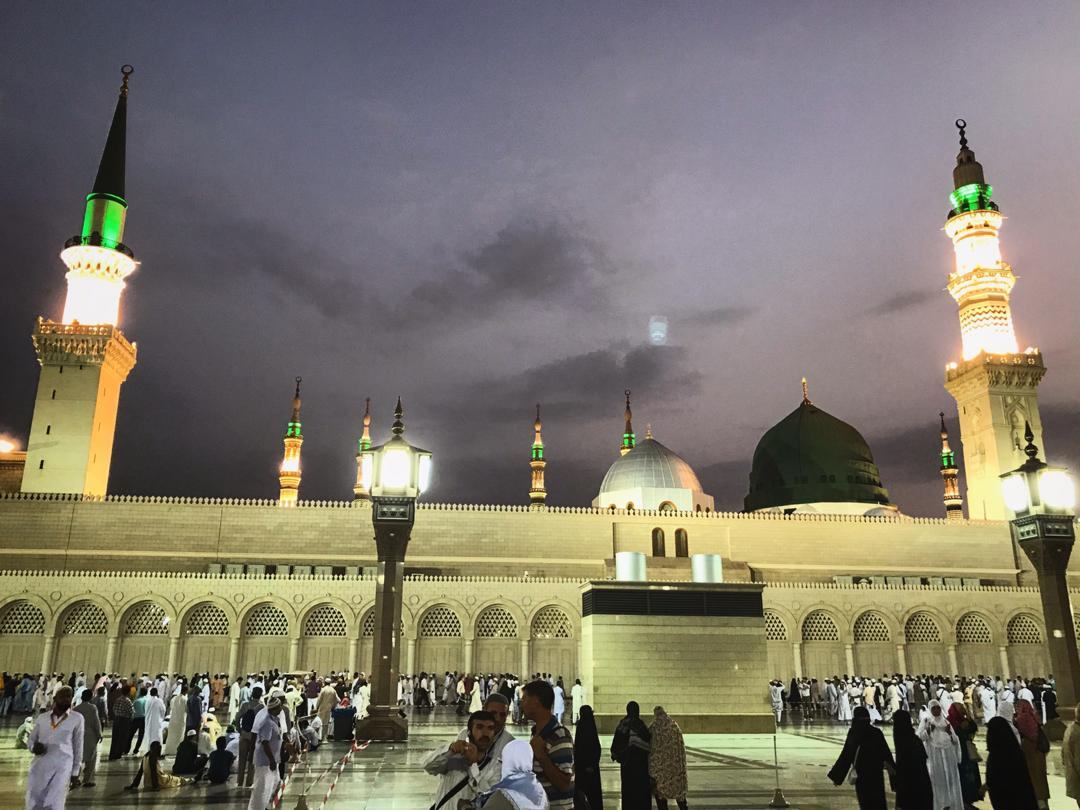
Chapter 17
Health and Safety
The basic Hajj course gives a whole session to health, taught by medical officers. This chapter gathers the practical points pilgrims are given, before you go, in the heat and the crowds, and in the masha'ir, so that illness does not stop you completing your worship.
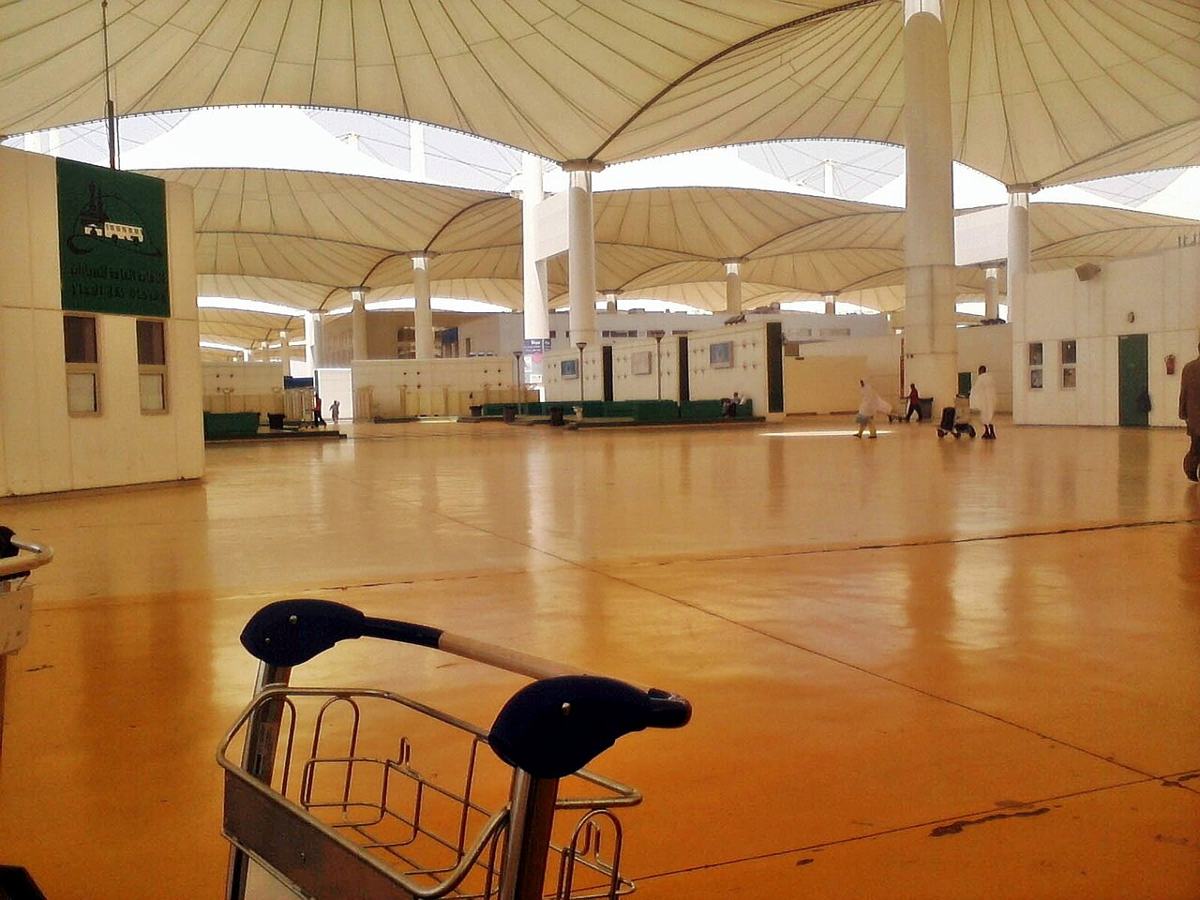
Before you go
- Complete your health screening early, and be honest about every condition you have.
- Treat problems before you travel. The course stresses that conditions such as prolapse, incontinence and menstrual problems should be raised at screening and treated at least three months before departure (Chapter 15).
- Vaccinations: take every vaccination required for your season (the meningococcal vaccine has long been a requirement for Hajj visas) and any others your health authority recommends. Requirements change, so follow your official instructions.
- Get fit. Hajj involves many kilometres of walking every day, in Mina, to the Jamarat, around the Ka'bah and between Safa and Marwah. Start walking daily, in the sandals you will wear, weeks before you leave.
- Medicines: bring enough for your whole stay plus extra, in their original packaging, with a doctor's letter listing them. Keep a few days' supply in your hand luggage.
Keep taking your medicines
The course is clear: Zamzam is a means of healing, but pilgrims who are already ill must keep taking their medicines on schedule and follow the advice of the medical officers. This is part of tawakkal, trusting Allah while using the means He has provided, not a lack of it (Chapter 4).
- Set alarms for your doses: the days of Hajj change every routine.
- If you are diabetic, carry sweets and your glucose meter; meals can be late.
- If you use insulin or other medicines that must be kept cool, ask your group how they will be stored in the masha'ir.
Heat
Hajj and Umrah are often performed in great heat, and heat exhaustion and heat stroke are among the most common reasons pilgrims need treatment.
- Drink water little and often: do not wait to feel thirsty.
- Use an umbrella in the sun. (Holding an umbrella is permitted in ihram; strapping it to the head is not, Chapter 7.)
- Stay in the shade at Arafah in the afternoon; your tent is a valid place for wuquf.
- Walk at cooler times when you can, late at night or early in the morning.
- Know the warning signs: headache, dizziness, nausea, confusion, very hot skin, or stopping sweating. Move into shade, cool the body with water and get medical help at once.
Crowds
- Go to tawaf, sa'i and the Jamarat at the times your group sets, and use the assigned routes.
- Never push. Patience in a crowd is part of your worship, and the safest thing you can do.
- Keep your bag in front of you. Do not stop suddenly in a narrow passage.
- If you feel faint in a crowd, signal to those around you and move sideways to the edge, not against the flow.
Feet and walking
- Use sandals you have already broken in. For men in ihram they must leave the toes and heel uncovered.
- Check your feet every day for blisters and cuts, especially if you are diabetic.
- Carry plasters and a small tube of unscented cream.
Infections
- Coughs, colds and flu spread easily in crowded tents, buses and rooms. Wash your hands often and consider wearing a mask in crowds.
- Do not share razors or blades when the hair is cut or shaved: use your own clean, disposable blade (Chapter 10).
- Eat freshly cooked food, and be careful with food that has been left out in the heat.
Wudu, prayer and illness
- If water would harm you, tayammum is permitted; and a person with a dressing or cast wipes over it (jabirah), see Chapter 16.
- A sick person prays in whatever way they are able: sitting, lying on the side, lying on the back, with movements of the head and eyes, or in the heart.
- If you cannot stone because of illness, a proxy may stone for you, after you have consulted the medical officer and your religious guide (Chapter 13).
- Illness is one of the recognised excuses for missing the nights at Muzdalifah and Mina (Chapter 12).
Getting help
- Know where your group's clinic and medical officers are, in Makkah, Madinah and the masha'ir.
- Carry your ID card, wristband and tent or room card at all times, and a note of your medical conditions and medicines.
- If you are separated from your group, go to the nearest guide post, security officer or your country's mission office.
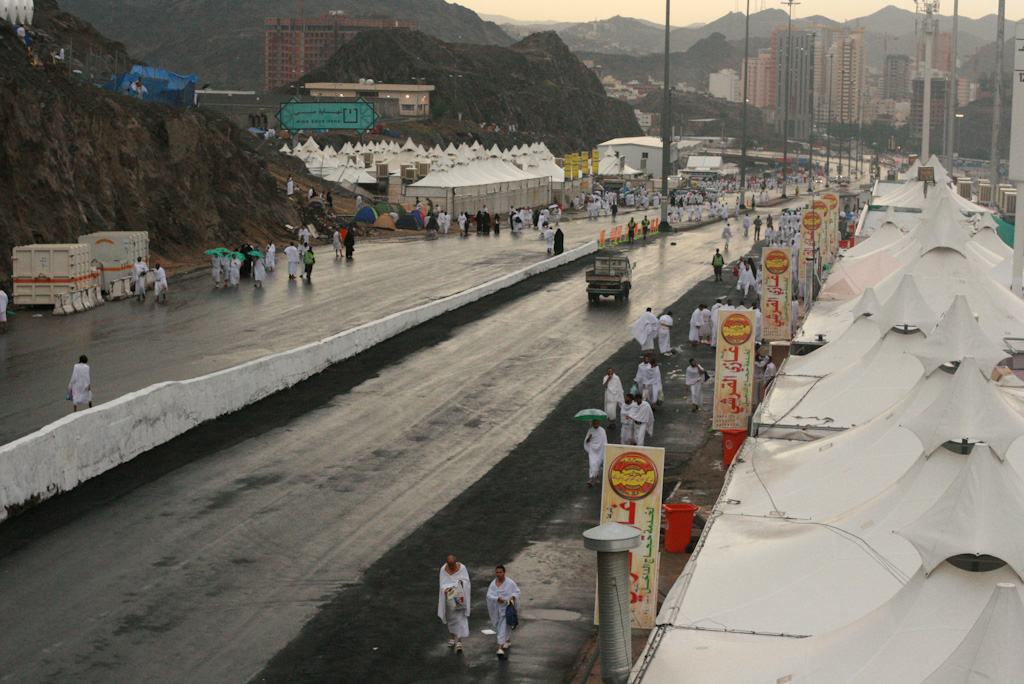
Chapter 18
Tawaf al-Wada' and Visiting Madinah
The farewell tawaf: who must perform it, who is excused, what happens if it is missed, how to prepare, and what you may and may not do afterwards. Then Madinah: the virtues of the city and the Prophet's Mosque, the visit (ziarah) to the Prophet ﷺ and his two Companions, al-Baqi', Quba', Qiblatain, Uhud and the other historic places.
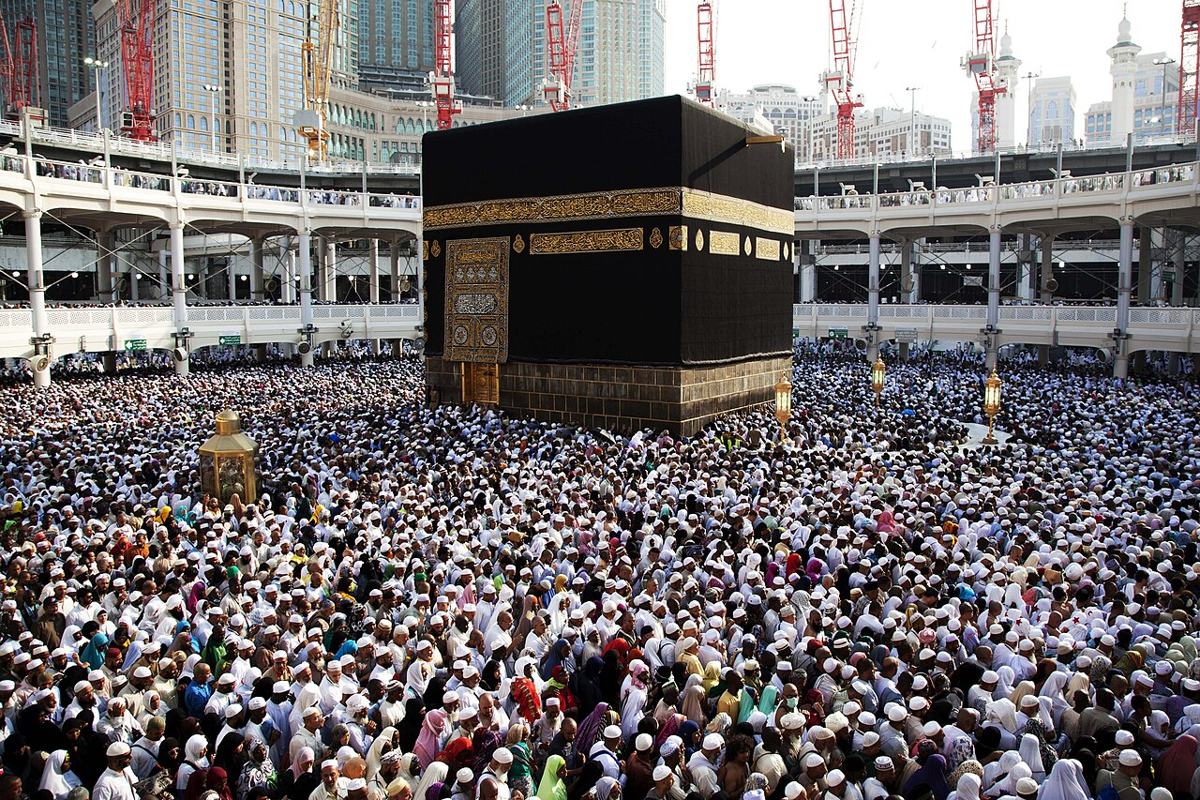
Tawaf al-Wada' and its ruling
Tawaf al-Wada' is the farewell tawaf, performed to honour and respect Baitullah (the Ka'bah), by anyone about to leave Makkah for a distance of two marhalah (91 km) or more.
It is obligatory for:
- Anyone travelling away from Makkah for a distance that permits shortening the prayer, two marhalah.
- Anyone leaving Makkah to stay outside the Haram for four days or more, even if the distance is less than two marhalah, whether a resident of Makkah or not.
Anyone who leaves Tawaf al-Wada' without an excuse accepted by the shariah must pay a dam (in order and fixed in amount, tertib dan taqdir, Chapter 7).
If it is not performed
| Situation | Dam | Sin |
|---|---|---|
| Excused (see below) | No | No |
| Left through ignorance or forgetfulness | Yes | No |
| Left deliberately, without a valid excuse | Yes | Yes |
| Left deliberately, knowing it was obligatory, then turned back before reaching two marhalah and performed it | No, turning back removes the dam | Yes, the sin remains |
| Someone who has not yet completed any of the pillars | Not required yet | No |
Excuses from Tawaf al-Wada'
The scholars agree that Tawaf al-Wada' is part of the shariah, and the National Hajj Council (Muzakarah Haji) holds to the view of the majority, including the Shafi'i school, that it is obligatory. Those excused, who owe no dam and commit no sin if they leave it, include:
- A woman with menstruation or post-natal bleeding, or with istihadah within the days of her period.
- A person with urinary incontinence (salasul baul) or similar.
- A person with wounds, pus or blood that could soil the mosque.
- A person who has no water or dust to purify themselves from major impurity.
- A person who fears for their life, honour or property.
- A person forced to leave without tawaf, an emergency or genuine urgency.
- A person who fears being wronged.
- A person who fears being left behind by their travelling companions, for example, pilgrims told only at the last moment that they are leaving Makkah, with no time for Tawaf al-Wada' before the bus departs. This only applies when it was not deliberate.
- A person fleeing a creditor whom they genuinely cannot pay.
- A person who must be led or carried because of illness or old age and cannot even sit in a pushed wheelchair.
- A patient under close, scheduled treatment in a medical centre, for example a pilgrim whose mind comes and goes and needs scheduled care by medical staff.
- Workers who go in and out of Makkah very often serving pilgrims or on Hajj business, such as postal staff taking luggage out of Makkah every day, drivers and so on: the opinion used is that Tawaf al-Wada' falls away for them.
Resolution of the Muzakarah Haji, 29th session, Hajj season 1434H / 2013.
Preparing for Tawaf al-Wada'
- Get your departure details from your group's office (Pejabat Maktab), whether you are flying home or going to Madinah.
- Get everything ready. If you want to buy anything, buy it before Tawaf al-Wada'.
- Bring your luggage down to the lobby to be loaded onto the bus by the operator, according to the schedule from your office.
- Take wudu and go to Tawaf al-Wada' about four or five hours before you leave Makkah, following your office's schedule and instructions.
- You do not wear ihram for it, and you do not go out to a miqat.
The intention is required:
Meaning "O Allah, I intend to circle Your Sacred House seven times as the farewell tawaf (Tawaf al-Wada'); make it easy for me and accept it from me, for the sake of Allah the Most High."
Performing it
- It can only be performed after the pillar tawaf (of Umrah or of Hajj) has been completed.
- Afterwards, leave Makkah promptly, except for things to do with prayer or the journey.
After Tawaf al-Wada'
You may
In Masjid al-Haram:
- pray the two rak'ahs of tawaf;
- kiss the Black Stone (if you can);
- touch the Ka'bah, the Hijr Ismail or Maqam Ibrahim;
- drink Zamzam;
- make du'a;
- pray, if the iqamah has already been called, for example if the crowd keeps you inside, or it is called just as you finish.
At your building:
- eat and drink in your room, only as much as you need;
- use the toilet in your building;
- do what has no direct connection with the journey but must be done out of need or a particular or general interest, such as searching for a lost husband, wife, family member, friend or belongings, or visiting someone who is ill (emergencies only);
- wait for the bus (by custom, within about four or five hours after Tawaf al-Wada');
- bathe and change your clothes;
- take photographs or give charity while waiting for the bus.
You may not
- rest, relax or sleep in your room;
- pay a debt that could be paid later;
- give charity in Masjid al-Haram or on the way back to your building, if you go looking for people to give to (giving in passing, without searching, does not cancel it);
- pray voluntary prayers such as the prayer of need (hajat) or repentance (taubat), pray them before Tawaf al-Wada';
- buy things not connected with the journey: prayer beads, perfume, rings, scarves, bird food and so on, even if they cost one riyal;
- linger in Masjid al-Haram so that other pilgrims are kept waiting for you;
- take photographs, or ask someone to take them, in Masjid al-Haram or on the way back to your building, take your photographs earlier, before Tawaf al-Wada' or the day before.
If someone else buys things for you
- If the purchase was made before you performed Tawaf al-Wada', your Tawaf al-Wada' is not cancelled.
- If the purchase was made after your Tawaf al-Wada' but after you had already left for your destination, it is not cancelled.
- If the purchase was made after your Tawaf al-Wada' while you were still at your building, your Tawaf al-Wada' is cancelled and must be repeated.
Madinah
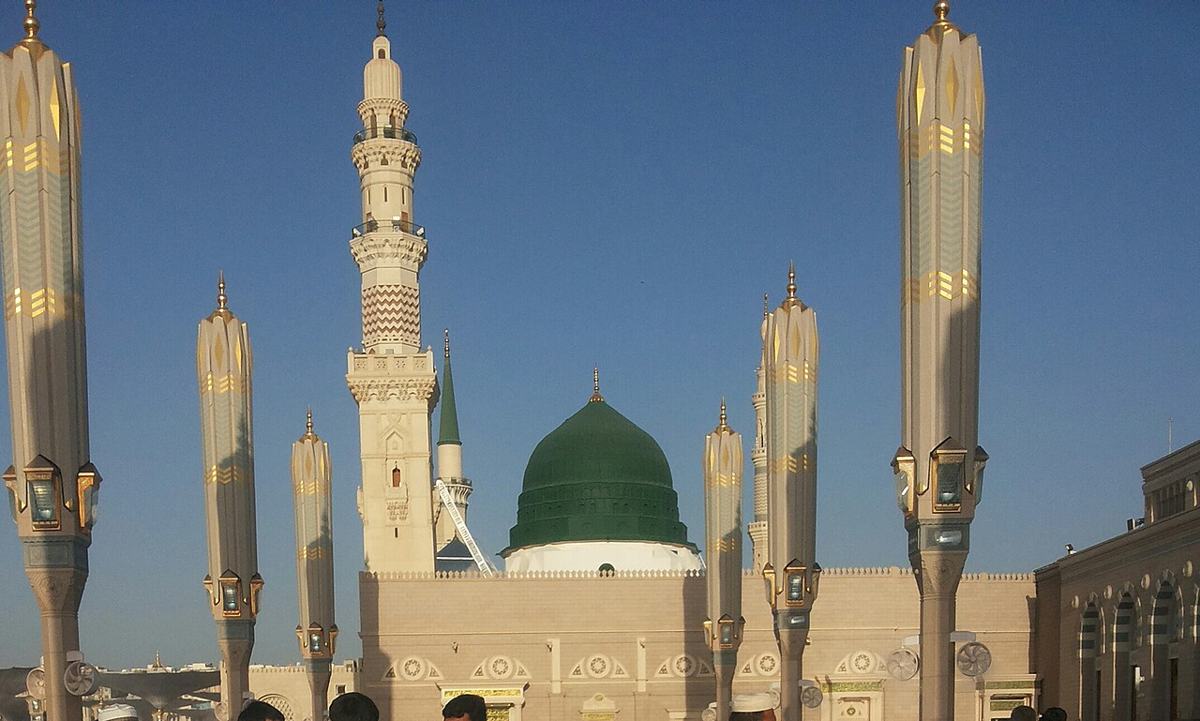
Why we visit Madinah
The course explains the purpose of the visit:
- to understand the importance of visiting Madinah, to bring the Prophet's ﷺ life and struggle and that of his Companions to life, and to build love for the Prophet ﷺ and his Companions;
- as a sign of deep gratitude for the hardship and sacrifice of the Prophet ﷺ and his Companions in spreading Islam from Madinah, so that we can enjoy the blessing of Islam and faith;
- to practise the shariah he brought, and to grow in taqwa and faith in Allah SWT.
The ruling of visiting Madinah is sunnah. It is not part of Hajj or Umrah.
The virtues of Madinah
صَلَاةٌ فِي مَسْجِدِي هٰذَا خَيْرٌ مِنْ أَلْفِ صَلَاةٍ فِيمَا سِوَاهُ إِلَّا الْمَسْجِدَ الْحَرَامَ
Reading Ṣalātun fī masjidī hādhā khairun min alfi ṣalātin fīmā siwāhu illal-masjidal-ḥarām.
Meaning A prayer in this mosque of mine is better than a thousand prayers in any other mosque, except Masjid al-Haram.
Reported by al-Bukhari and Muslim
The majority of scholars hold that all the buildings added after the Prophet's ﷺ time are included in "my mosque", so a prayer anywhere inside them earns the thousand-fold reward. This does not include the courtyard: there is no prayer greeting the mosque and no intention of i'tikaf in the courtyard of Masjid Nabawi.
A warning against wrongdoing in Madinah: "Madinah is a sanctuary, between the mountains of 'Eir and Thawr. Whoever commits wrongdoing in it, or shelters a wrongdoer, upon him is the curse of Allah, the angels and all people, and none of his good deeds, obligatory or voluntary, will be accepted from him on the Day of Resurrection."
Dying in Madinah: "Whoever is able to die in Madinah, let him do so, for I will intercede for those who die in Madinah."
Patience in Madinah: "Whoever of my nation is patient with the hardships and difficulties of Madinah, I will be an intercessor or a witness for him on the Day of Resurrection."
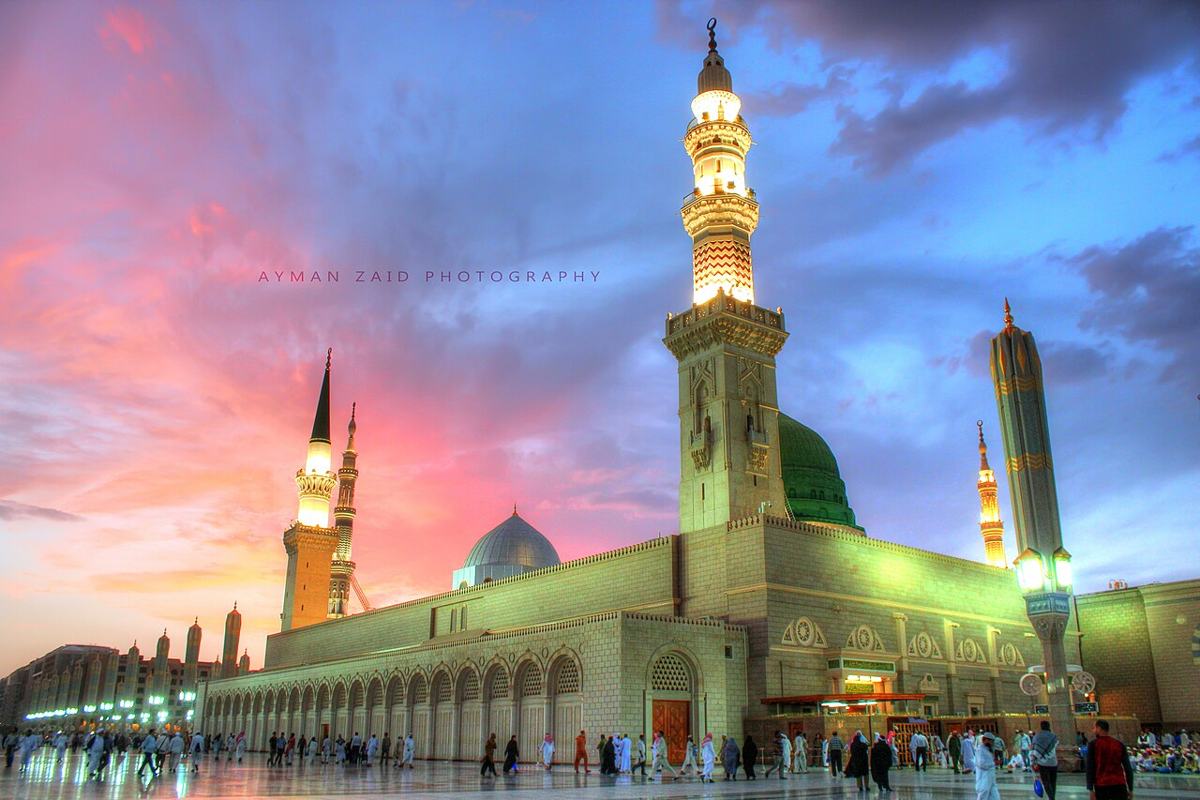
Arriving in Madinah: your prayers
Pilgrims staying eight days in Madinah are not travellers there. On arrival, do not combine or shorten your prayers; and before you leave for Makkah, do not combine or shorten at your hotel, only once the bus has set off (Chapter 16).
Visiting Masjid Nabawi
The visit to Masjid Nabawi includes the Raudhah, and greeting the Prophet ﷺ and his two Companions at their graves. Guides for visitors (muzawwir) will lead pilgrims in their visit.
مَا بَيْنَ بَيْتِي وَمِنْبَرِي رَوْضَةٌ مِنْ رِيَاضِ الْجَنَّةِ
Reading Mā baina baitī wa minbarī rauḍatun min riyāḍil-jannah.
Meaning What is between my house and my pulpit is a garden from the gardens of Paradise.
Reported by al-Bukhari and Muslim
- Men usually enter through Bab al-Salam, pray in the Raudhah if they can, and then pass the graves, giving salam to the Prophet ﷺ, then to Abu Bakr and then to 'Umar, before leaving through Bab al-Baqi'.
- Women have their own entrance and route, and visit at set times. The course showed the women's visiting times of its day; today entry to the Raudhah is by booked permit (through the official Nusuk app), for men and women alike. Follow the current arrangements and your group's guidance.
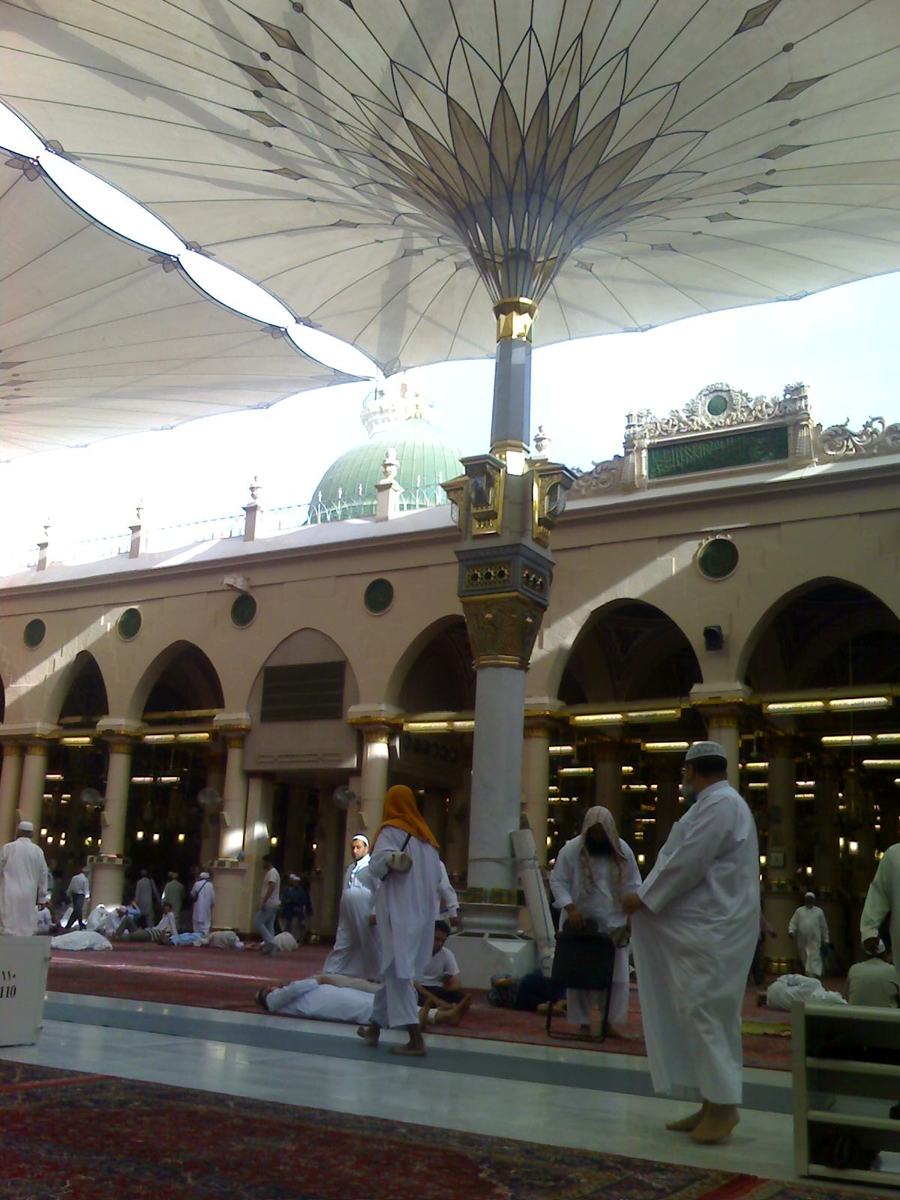
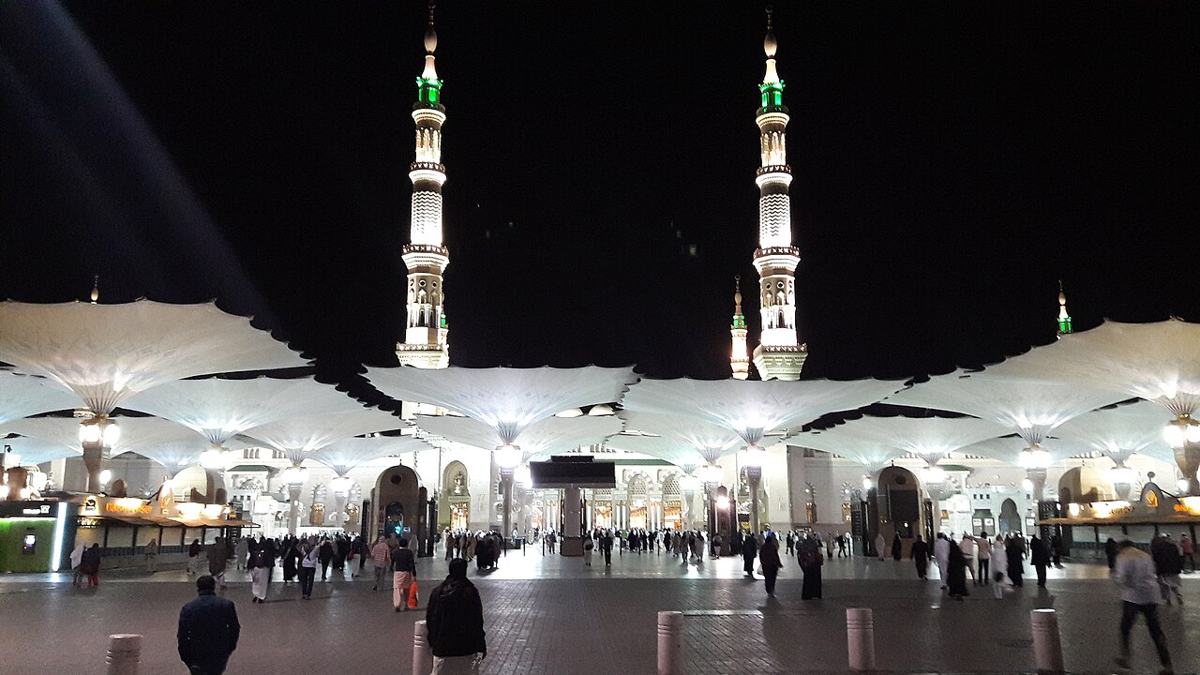
السَّلَامُ عَلَيْكَ يَا رَسُولَ اللّٰهِ
Reading As-salāmu ʿalaika yā Rasūlallāh.
Meaning Peace be upon you, O Messenger of Allah.
السَّلَامُ عَلَيْكَ يَا أَبَا بَكْرٍ، السَّلَامُ عَلَيْكَ يَا عُمَرُ
Reading As-salāmu ʿalaika yā Abā Bakr. As-salāmu ʿalaika yā ʿUmar.
Meaning Peace be upon you, O Abu Bakr. Peace be upon you, O 'Umar.
Historic places in Madinah
The course lists these visits: Masjid Nabawi, the grave of the Prophet ﷺ, the Raudhah, al-Baqi', Masjid Quba', Masjid Qiblatain, the graves of the martyrs of Uhud, the Seven Mosques and other mosques, as well as Jabal al-Rumah and the date market.
Al-Baqi'
The cemetery beside Masjid Nabawi where many of the Prophet's ﷺ family and Companions are buried.
السَّلَامُ عَلَيْكُمْ أَهْلَ الدِّيَارِ مِنَ الْمُؤْمِنِينَ وَالْمُسْلِمِينَ، وَإِنَّا إِنْ شَاءَ اللّٰهُ بِكُمْ لَلَاحِقُونَ، نَسْأَلُ اللّٰهَ لَنَا وَلَكُمُ الْعَافِيَةَ
Reading As-salāmu ʿalaikum ahlad-diyāri minal-mu'minīna wal-muslimīn, wa innā in shā'allāhu bikum la-lāḥiqūn, nas'alullāha lanā wa lakumul-ʿāfiyah.
Meaning Peace be upon you, people of these dwellings, believers and Muslims. We will, if Allah wills, join you. We ask Allah for well-being for us and for you.
Reported by Muslim
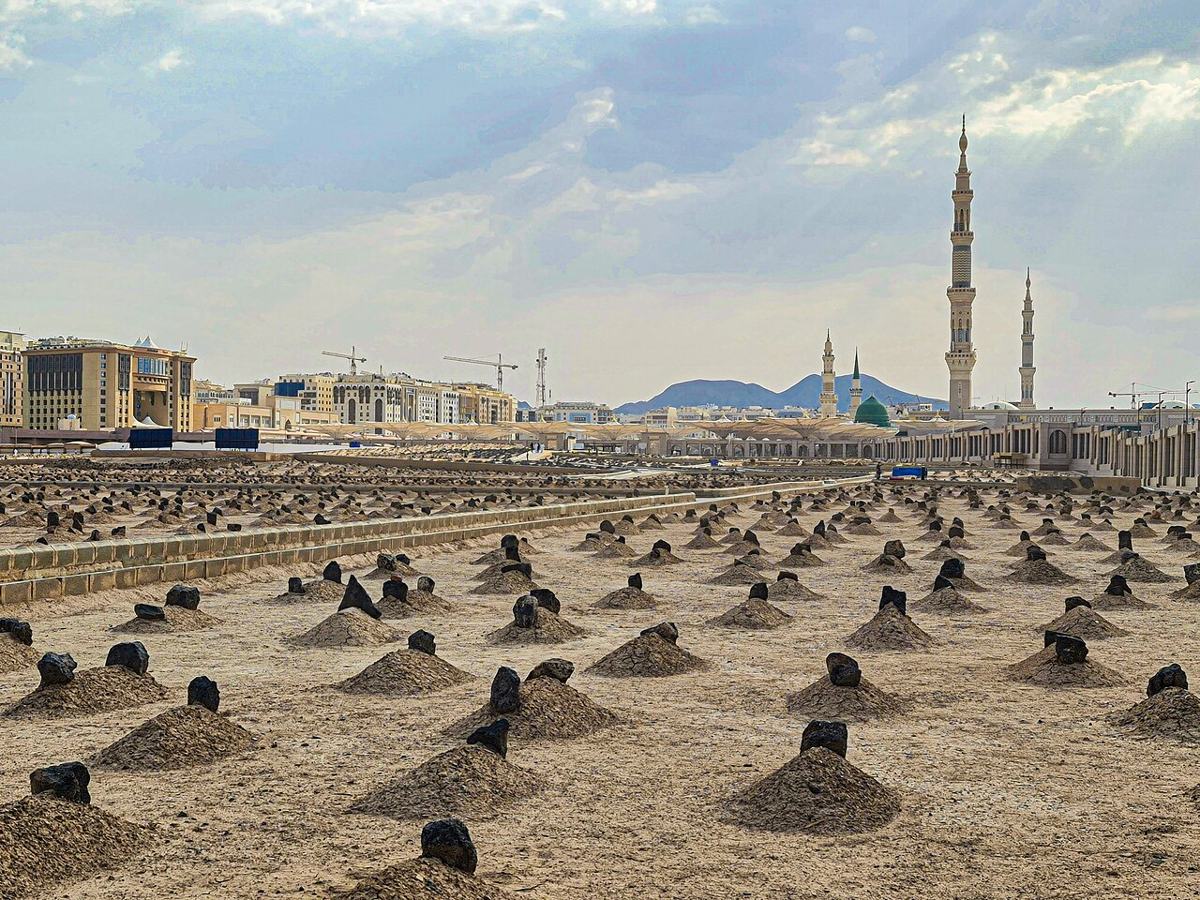
Masjid Quba'
- In the village of Quba', about 3 km south of Madinah; it now covers about 5,035 m².
- The first mosque built in the history of Islam, as Allah says: "A mosque founded on taqwa from the first day is more worthy for you to stand in" (Surah al-Tawbah 9:108).
- Imam al-Bukhari reports from Ibn 'Umar that the Prophet ﷺ used to go to Quba' every Saturday, riding or walking, and sometimes on Mondays and Thursdays.
- The Prophet ﷺ said: "Whoever purifies himself in his house and then comes to Masjid Quba' and prays in it will have a reward like that of an Umrah" (reported by Ibn Majah).
Its history: on Monday, 8 Rabi' al-Awwal (23 September 622 CE), the Prophet ﷺ reached Quba' on his Hijrah from Makkah, and stayed four days with Banu 'Amr ibn 'Awf in the house of Kulthum ibn al-Hidm. On the first day he began building the mosque, the first mosque of this Ummah, and carried bricks and sand with the Companions. Al-Shamus bint al-Nu'man described seeing him carrying bricks on his back until he was bent, covered in dust; when a Companion asked to take his load, he refused and told him to carry another like it (reported by al-Tabarani). He then led the Companions in congregational prayer there, facing Masjid al-Aqsa, the qiblah at that time.
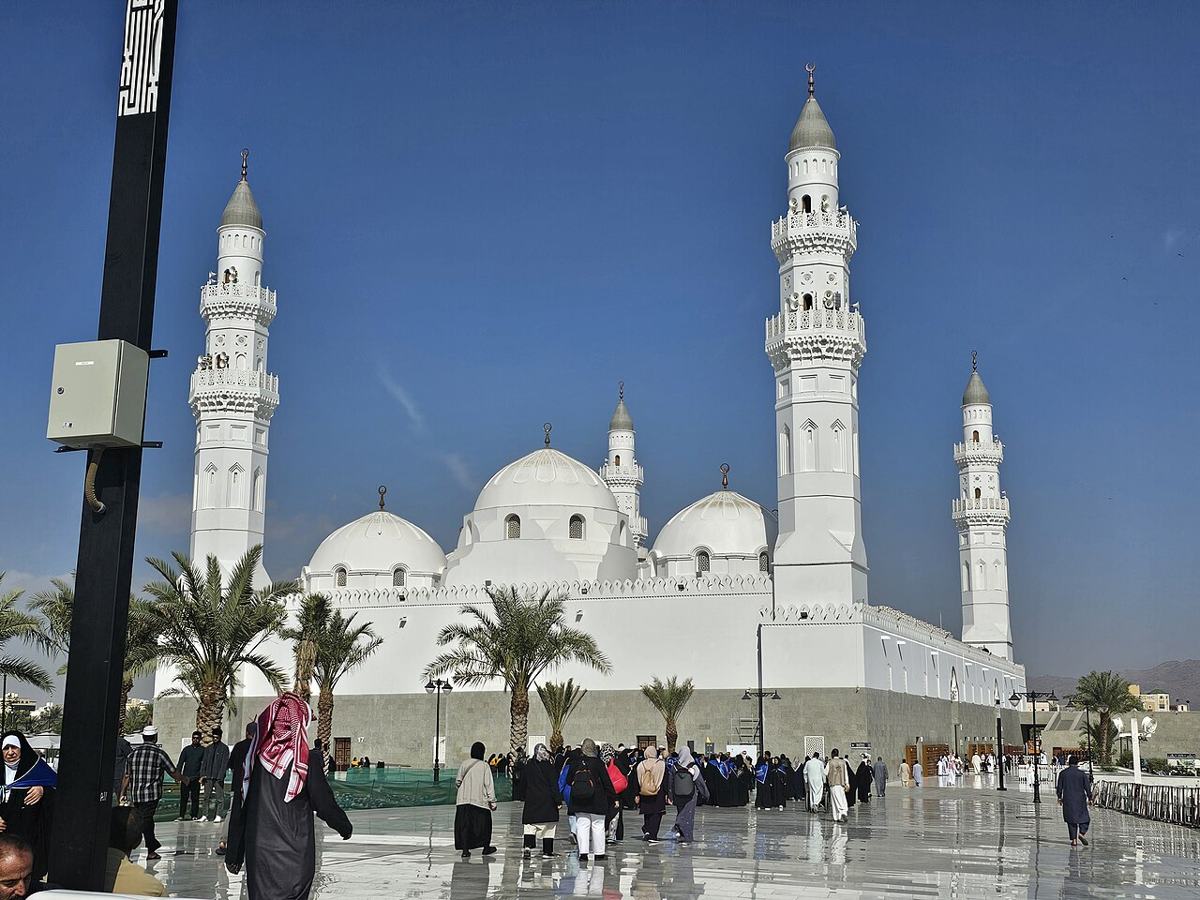
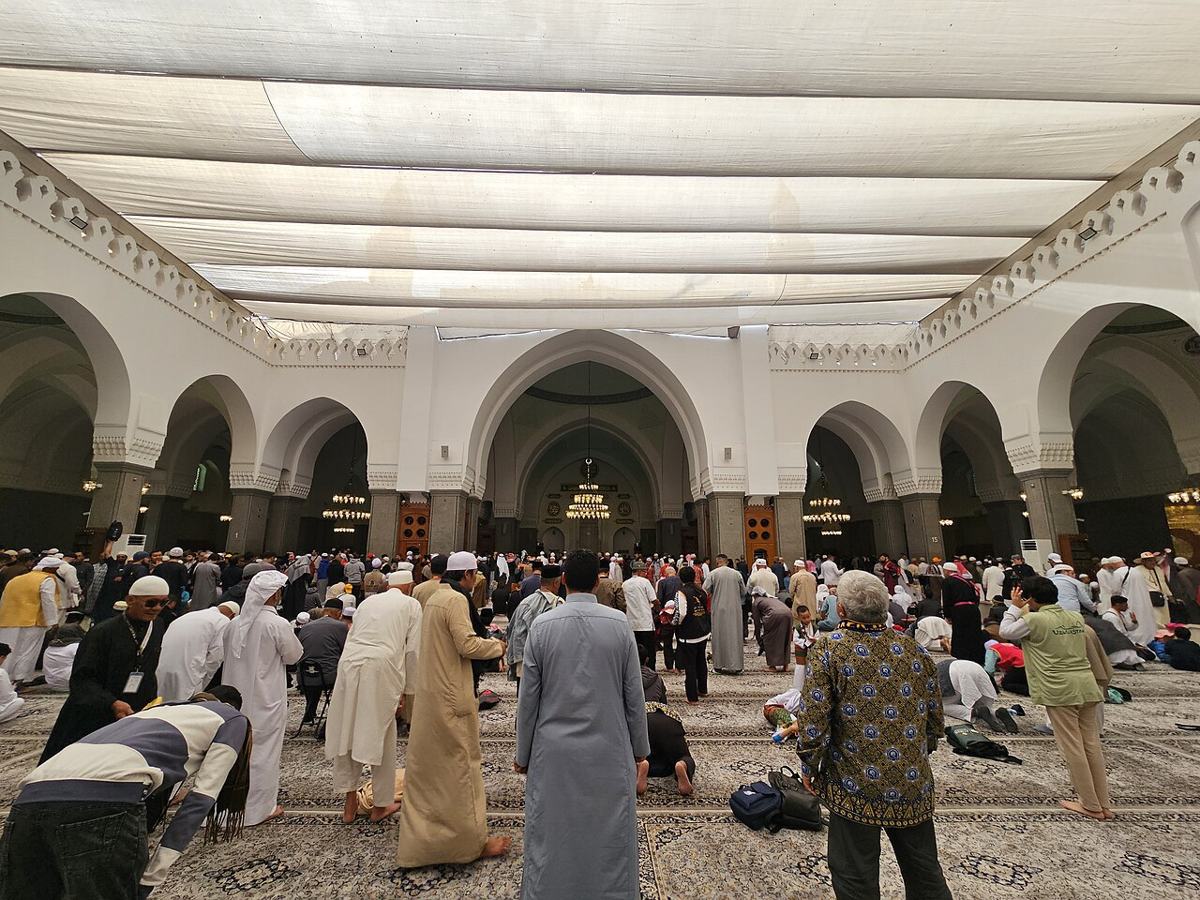
Masjid Qiblatain
The "Mosque of the Two Qiblahs", where the command came to change the qiblah from Masjid al-Aqsa to the Ka'bah.
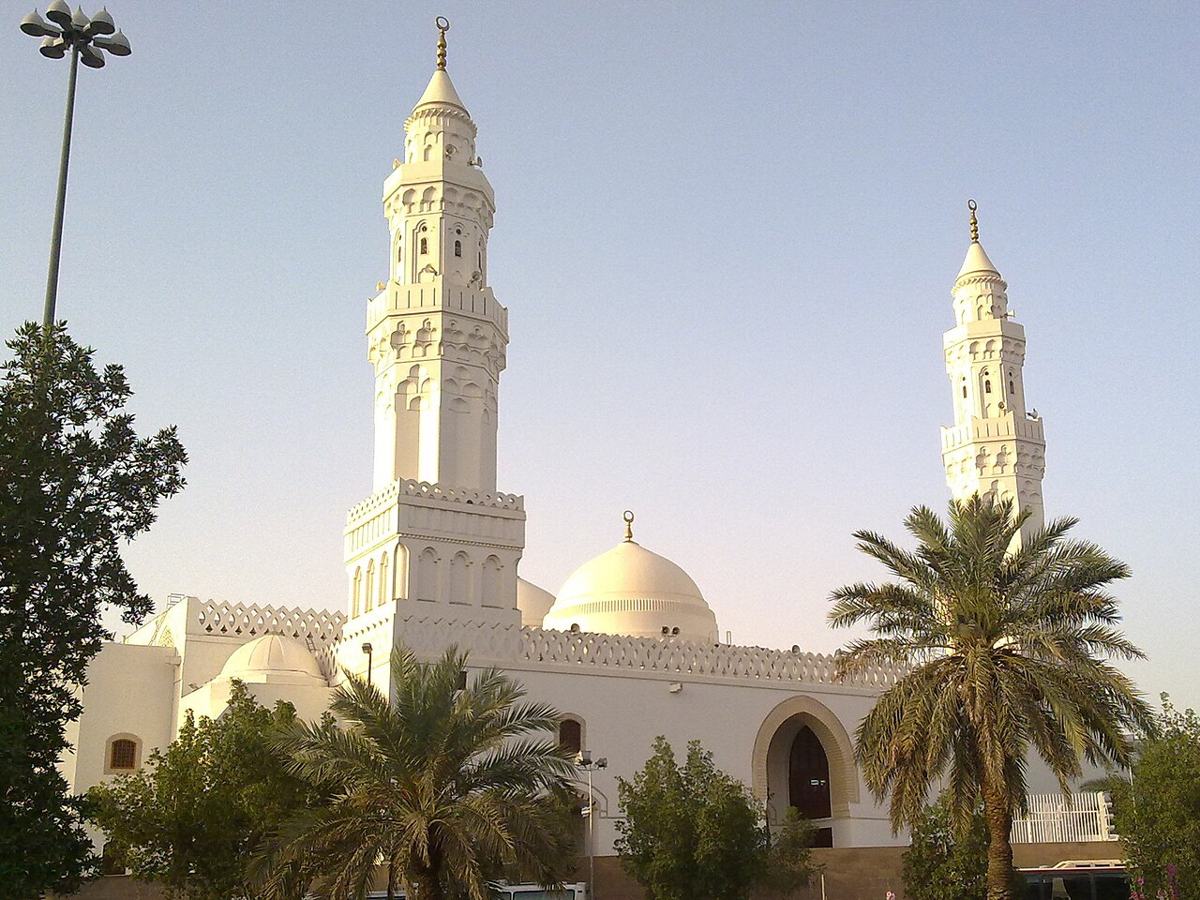
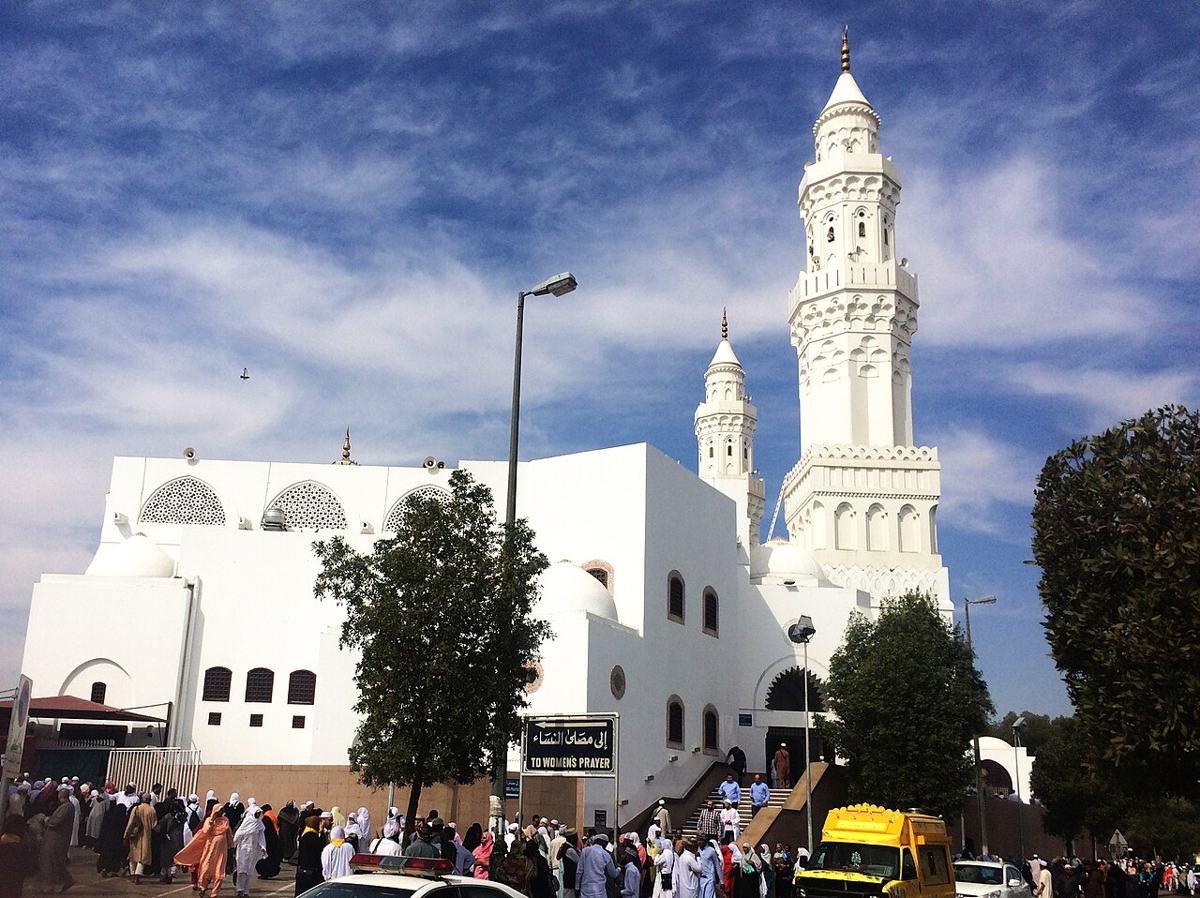
The Seven Mosques
A group of small mosques at the site of the Battle of the Trench (al-Khandaq).
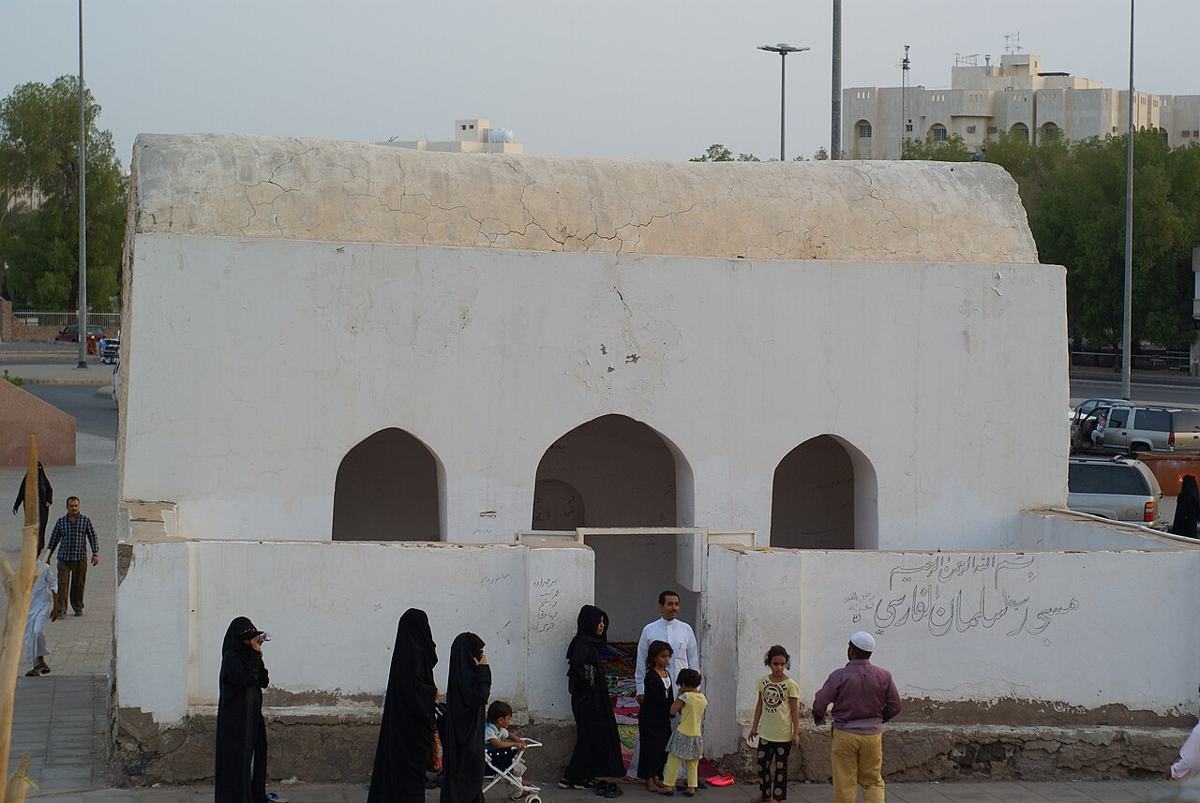
Uhud, the martyrs' cemetery and Jabal al-Rumah
Mount Uhud, north of Madinah, where the Battle of Uhud was fought, and the graves of the martyrs of Uhud, among them Hamzah ibn 'Abd al-Muttalib. Facing it is Jabal al-Rumah, the small hill of the archers.
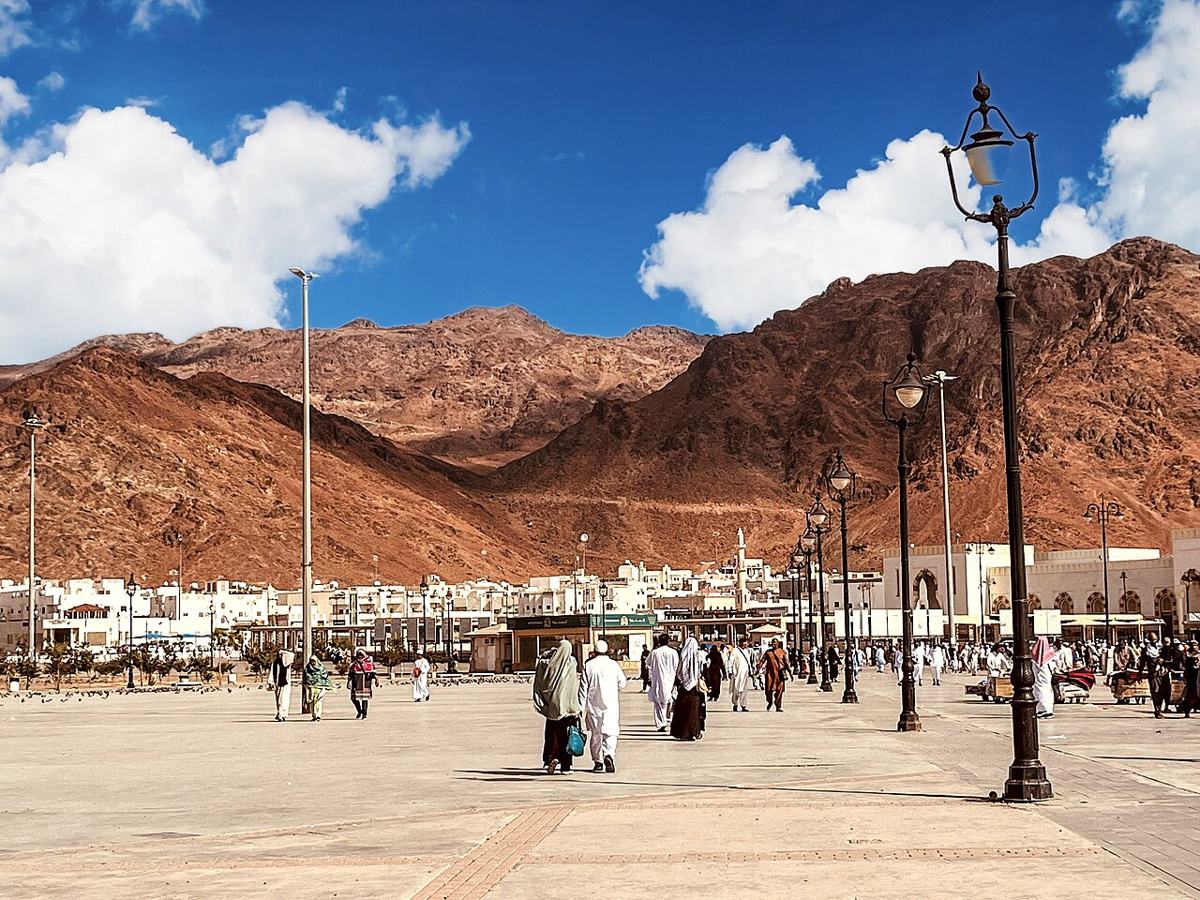
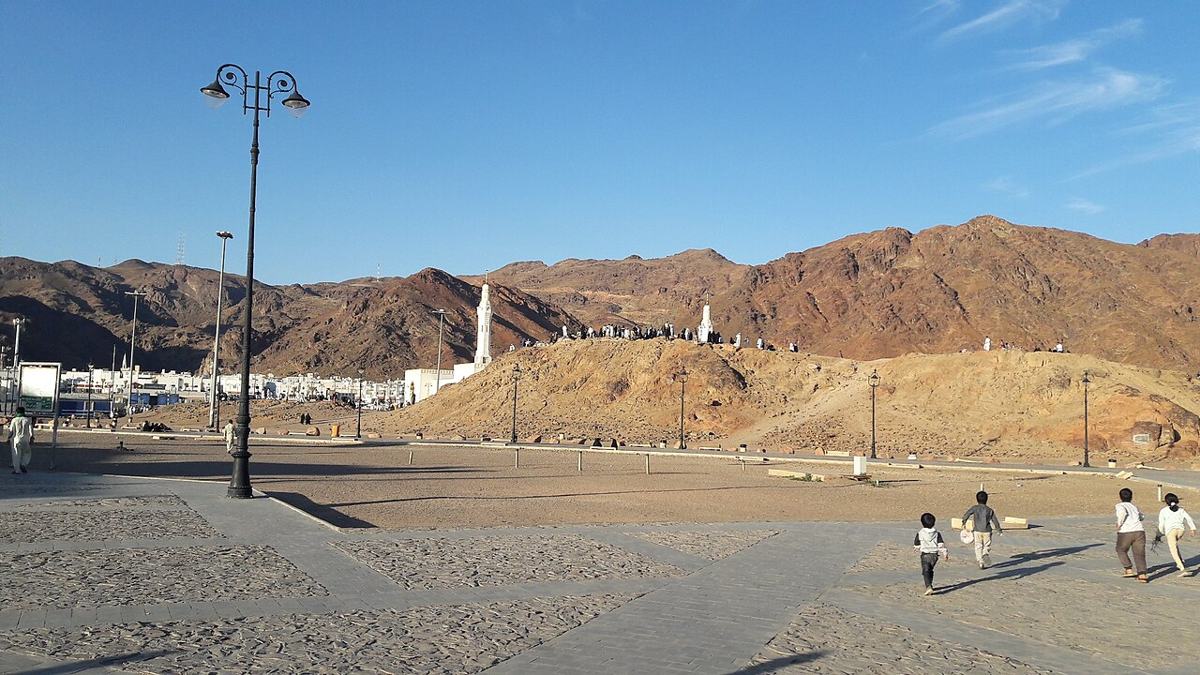
The date market
Madinah's dates are famous. The date market is a favourite last stop before going home.
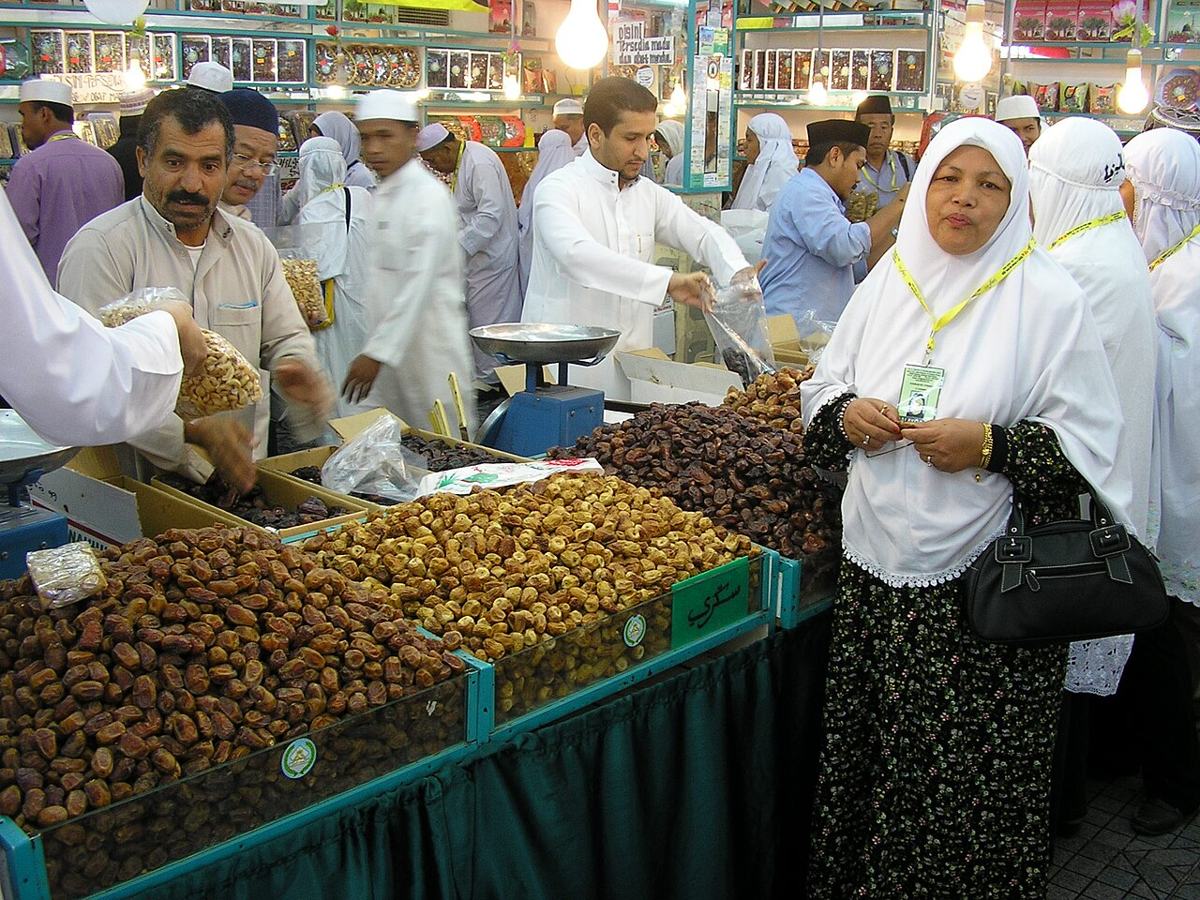
Chapter 19
Planning and Practicalities
The practical side of the journey: registration and management, what to pack, the course's practical session (amali) and its key reminders, vows (nazar) in Hajj, unfinished voluntary Umrah, and keeping your Hajj mabrur after you return.
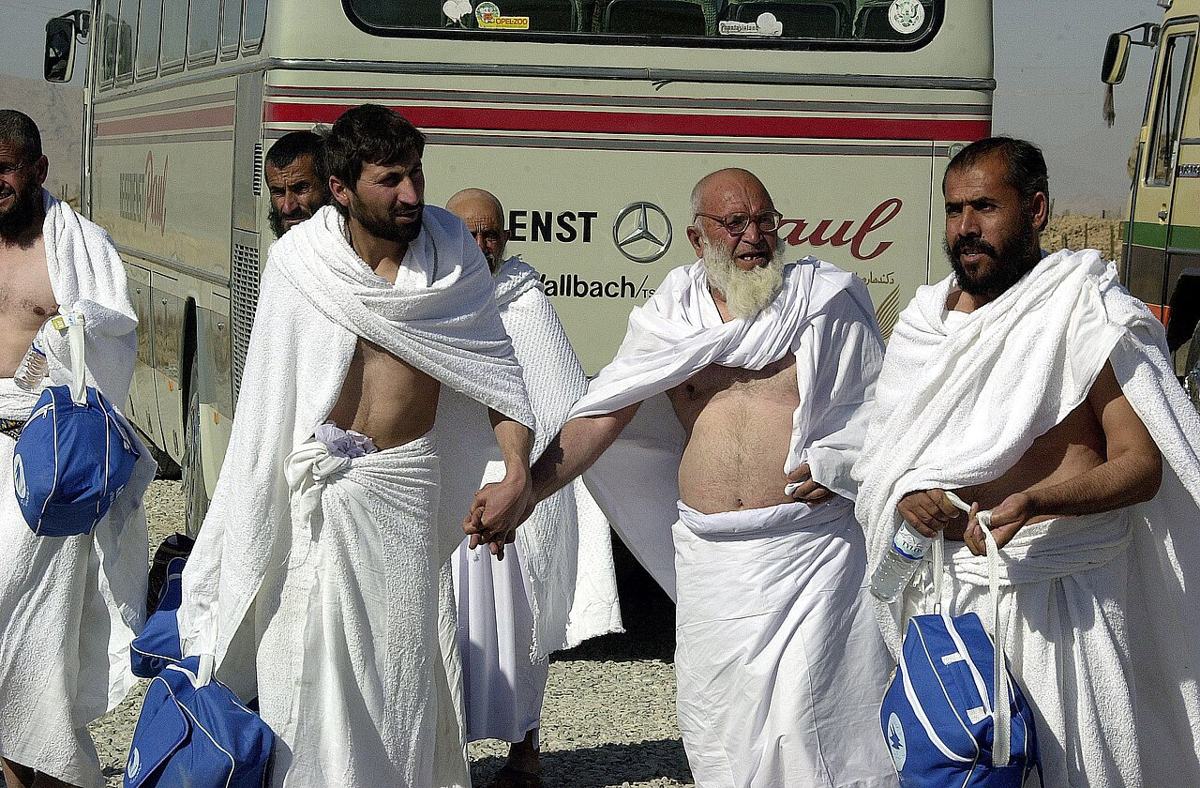
Management of Hajj
The basic Hajj course includes a session on Hajj management (Pengurusan Haji), given by your Hajj body's officers. For Malaysians this is Lembaga Tabung Haji; pilgrims from other countries go through their own national Hajj authority. In general the journey involves:
- Registering and waiting for your turn to be called for a season.
- Accepting the offer and paying the costs for your package or category.
- Health screening and the required vaccinations (Chapter 17).
- Attending the basic Hajj course at your mosque, and the practical session.
- Receiving your travel documents, visa, ID card, wristband and luggage tags, and your flight details.
- Departure from the Hajj complex on the given date, in ihram if you are flying straight to Jeddah (Chapter 6).
What to pack
Worship
- Two or three sets of ihram (men) or several sets of suitable clothing, socks and telekung (women).
- An ihram belt or pouch; sandals that leave the toes and heel uncovered.
- A small prayer mat, a pocket Qur'an, and a du'a booklet you understand.
- A spray bottle or small water bottle for wudu (Chapter 16).
- A small pouch for pebbles.
- Clean scissors or a disposable razor for cutting the hair.
Health
- All your medicines, with extra, and a doctor's letter.
- Unscented soap, shampoo, toothpaste, deodorant and wet wipes for the days in ihram.
- Plasters, unscented cream, a face mask, a small towel.
Practical
- An umbrella, a small torch, a power bank and charger, a small fan or spray.
- A copy of your passport and documents, and a list of emergency contacts.
- A small bag for the days in the masha'ir (Chapter 11).
The practical session (amali)
The last week of the course is a practical rehearsal of the rites. Its summary slide sets the pillars and obligations of Hajj and Umrah side by side:
| Hajj | Umrah | |
|---|---|---|
| Pillars | 1. Intention of ihram for Hajj · 2. Wuquf · 3. Tawaf · 4. Sa'i · 5. Shaving or cutting · 6. Order in most pillars | 1. Intention of ihram for Umrah · 2. Tawaf · 3. Sa'i · 4. Shaving or cutting · 5. Order in all pillars |
| Obligations | 1. Intention of ihram at the miqat · 2. Avoiding the prohibitions of ihram · 3. Mabit at Muzdalifah · 4. Stoning Jamrah al-Kubra on 10 Dhul Hijjah · 5. Mabit in Mina on the Days of Tashriq (11, 12, 13) · 6. Stoning all three Jamarat on the Days of Tashriq | 1. Intention of ihram at the miqat · 2. Avoiding the prohibitions of ihram |
The difference: the obligations of Umrah do not include numbers 3, 4, 5 and 6 of the obligations of Hajj.
Key reminders from the practical session
- Menstruation with interrupted bleeding (fatrah al-naqa'): for prayer, pray as soon as you are dry; for tawaf in Hajj, wait until you have been dry for 24 hours, then bathe and perform tawaf (Chapter 15).
- A voluntary Umrah must be finished. If you have begun a voluntary Umrah, you are still bound by the prohibitions of ihram until its tawaf and sa'i are done. If you must go home before then, perform the tahallul of ihsar, slaughter a goat and cut the hair, to release yourself. You do not need to come back to Makkah to complete a voluntary Umrah (or a voluntary Hajj); the tahallul of ihsar is enough.
- But an obligatory Umrah or Hajj (the first one) must be completed: after the tahallul of ihsar you must come back to Makkah to complete the pillars and acts that remain (Chapter 7).
- A voluntary tawaf is different: if you do not finish it, you are not bound by any prohibition of ihram and may stop without consequence; there is no tahallul of ihsar.
Vows (nazar) in Hajj
The course gives these points:
- A vow to perform the obligatory Hajj or obligatory Umrah is not valid (they are already obligatory).
- Someone who vowed to perform Hajj in a particular year but was prevented by the authorities does not have to perform it, nor make it up.
- A passing thought to do something is not a vow unless it is spoken and meets the conditions of a vow.
- Vowing is not encouraged: the Prophet ﷺ himself never made a vow.
- A vow may not be used to pressure the authorities into approving an application for Hajj; that would deny the rights of those who should be given priority.
- A vow may not be used by interested parties to promise pilgrims a place for Hajj.
Keeping your Hajj mabrur
The course's guidance for after Hajj (Chapter 1):
- Keep away from sin and wrongdoing.
- Increase your good deeds, to raise your faith and taqwa.
- Keep improving your character and conduct, continuously.
اللّٰهُمَّ اجْعَلْهُ حَجًّا مَبْرُورًا، وَسَعْيًا مَشْكُورًا، وَذَنْبًا مَغْفُورًا، وَعَمَلًا صَالِحًا مَقْبُولًا، وَتِجَارَةً لَنْ تَبُورَ
Reading Allāhummajʿalhu ḥajjan mabrūrā, wa saʿyan mashkūrā, wa dhanban maghfūrā, wa ʿamalan ṣāliḥan maqbūlā, wa tijāratan lan tabūr.
Meaning O Allah, make it an accepted Hajj, an effort that is appreciated, sins that are forgiven, righteous deeds that are accepted, and a trade that never fails.