Chapter 16 / 19
Purification and Prayer on the Journey
Wudu, including with a spray bottle, what breaks it, and the concession for crowds; tayammum and wiping over a dressing (jabirah); then the prayer, its conditions, pillars, sunnahs and what breaks it, the funeral prayer, Friday prayer for women, praying "to honour the time", masbuq and muwafiq, prayer when ill, shortening and combining, and the ruling on combining at Arafah and Mina.
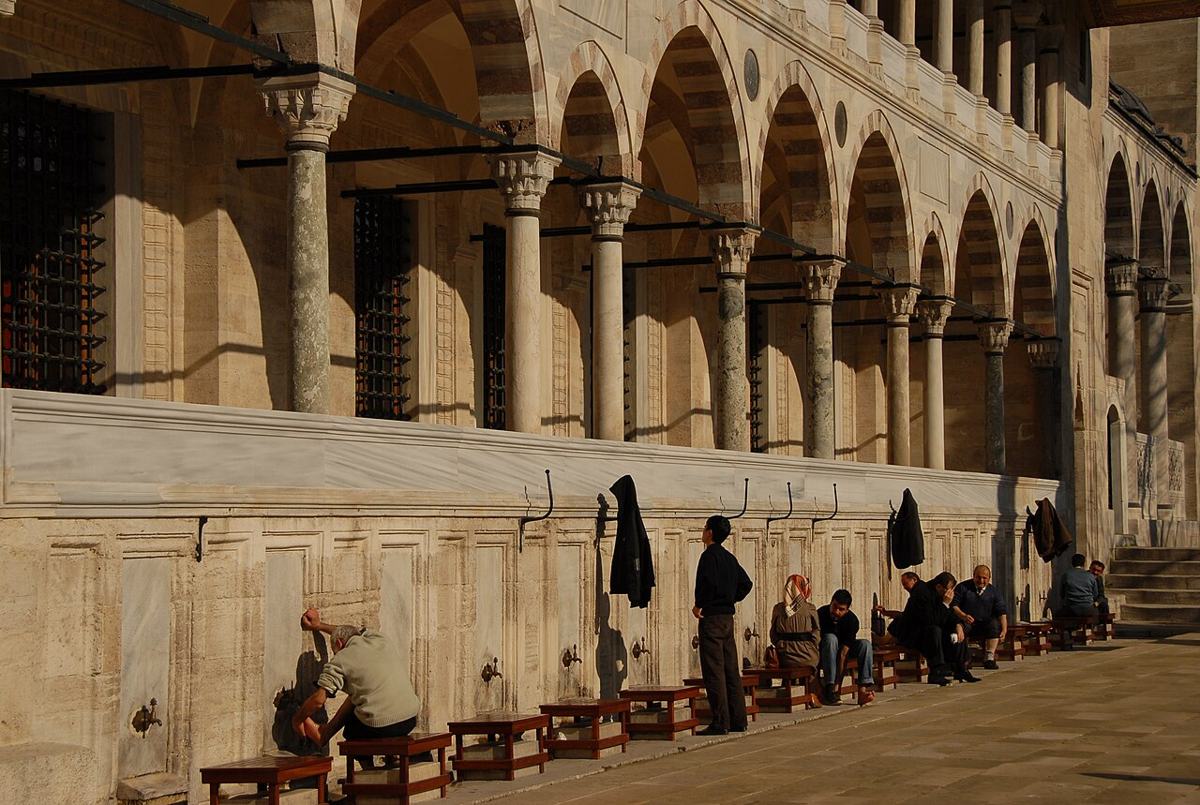
Wudu
Wudu is washing particular parts of the body with water, in a particular way, with the intention of wudu (Surah al-Ma'idah 5:6).
Meaning O you who believe, when you rise to pray (while in minor impurity), wash your faces and your hands up to and including the elbows, wipe part of your heads, and wash your feet up to and including the ankles.
Surah al-Ma'idah 5:6
The pillars of wudu
- Intention: at the moment you begin washing the face.
- Washing the face, to its limits.
- Washing both hands up to the elbows.
- Wiping the head with water, at least three hairs within the area of the head.
- Washing both feet up to the ankles.
- Order (tertib).
Where and how
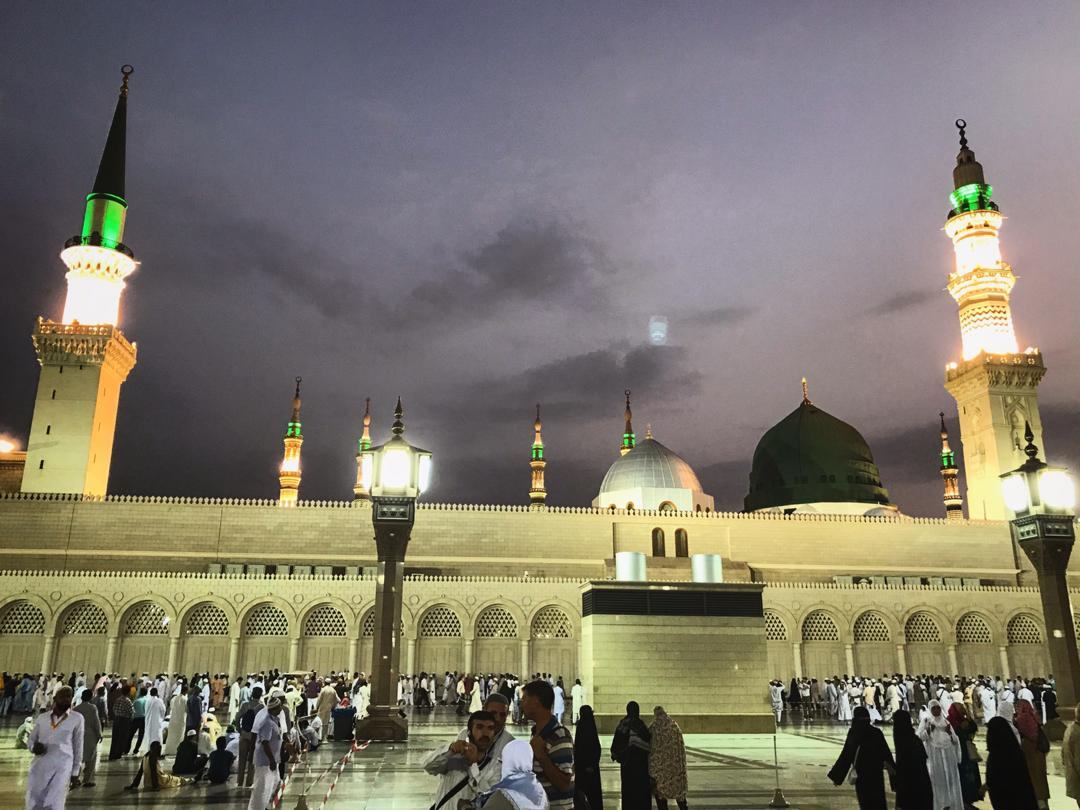
You will need to make wudu in Masjid al-Haram and Masjid Nabawi, on the road and in vehicles, and at Arafah, Muzdalifah and Mina. You may use a water spray or a water bottle, on condition that the water flows, at least three drops running over each part.
The sunnahs of wudu
- Using the tooth-stick (bersugi / siwak).
- Facing the qiblah.
- Saying Bismillah.
- Washing both palms up to the wrists.
- Rinsing the mouth.
- Sniffing water into the nose.
- Wiping water over the whole head.
- Wiping water over the whole of the ears, outside and inside.
- Running the fingers through a thick beard.
- Running water between the fingers and toes.
- Washing the right side before the left.
- Washing and wiping three times each.
- Doing it continuously (muwalat).
- Reciting the du'a after wudu.
أَشْهَدُ أَنْ لَا إِلٰهَ إِلَّا اللّٰهُ وَحْدَهُ لَا شَرِيكَ لَهُ، وَأَشْهَدُ أَنَّ مُحَمَّدًا عَبْدُهُ وَرَسُولُهُ، اللّٰهُمَّ اجْعَلْنِي مِنَ التَّوَّابِينَ وَاجْعَلْنِي مِنَ الْمُتَطَهِّرِينَ
Reading Ash-hadu an lā ilāha illallāhu waḥdahū lā sharīka lah, wa ash-hadu anna Muḥammadan ʿabduhū wa rasūluh. Allāhummajʿalnī minat-tawwābīna wajʿalnī minal-mutaṭahhirīn.
Meaning I bear witness that there is no god but Allah alone, without partner, and I bear witness that Muhammad is His servant and Messenger. O Allah, make me among those who repent and among those who purify themselves.
What breaks wudu
- Anything coming out of the two passages, front or back, solid, liquid, wind or anything else.
- Losing consciousness: through insanity, fainting, intoxication, blacking out, or sleep in which the seat is not firmly settled.
- Skin contact between a man and a woman who are not mahram to each other, without a barrier.
- Touching the private parts (front or back) with the palm or the inside of the fingers, your own or someone else's.
- Apostasy.
Wudu in the Holy Land: the concession for crowds
- The original ruling: skin contact without a barrier between a man and a woman who could marry breaks wudu.
- But there is rukhsah, a concession Allah grants Muslims in carrying out His commands at times of necessity (darurah), hardship (masyaqqah) or need (hajah).
- 'Azimah means an obligation that must be carried out in every situation, for example, being in wudu for tawaf and prayer.
- Therefore a pilgrim may move from the well-known (masyhur) Shafi'i opinion to the weaker (marjuh) Shafi'i opinion: wudu is not broken by contact between a man and a woman without desire, in hardship and difficulty such as the crowding in the place of tawaf.
Decision of the National Hajj Council (Muzakarah Haji Peringkat Kebangsaan), 21st session (5–7 June 2005, Shah Alam) and 22nd session.
This opinion applies:
- from the moment you leave your building until you are inside Masjid al-Haram or Masjid Nabawi; and
- in hardship such as on planes or buses, during the period of Hajj or Umrah only.
It is valid for tawaf and so on as long as the wudu has not been broken in another way according to the Shafi'i school, for example by passing wind from the front or back passage.
Tayammum
Tayammum is wiping clean dust onto the face and both hands up to the elbows, using pure dust, on certain conditions, in place of wudu or the obligatory bath.
Excuses that permit tayammum
- No water.
- There is water, but it cannot be used, because it is hard to get, it is needed for eating and drinking, or it is very expensive.
- Illness that water would harm.
Conditions of tayammum
- The time of the obligatory prayer has begun.
- No water was found after trying to find it.
- With pure dust.
- Water cannot be used because of illness.
- Free of najis.
Pillars of tayammum
- Intention, in the words: "Sahaja aku bertayammum untuk membolehkanku mengerjakan solat kerana Allah Ta'ala", "I perform tayammum to make prayer permissible for me, for the sake of Allah."
- Wiping the face and both hands up to the elbows, once, with pure dust.
- Spreading the dust over all the parts of tayammum, the face and both hands.
- Order.
How to perform tayammum
- Place both hands on the dust and shake it off so it is thin.
- Wipe the dust over your face.
- Wipe both hands up to the elbows with the dust.
- In that order.
The parts of tayammum are only the face and the two hands (up to the elbows); the feet are not included.
Wiping over a dressing (jabirah)
- Jabirah means wiping water over a dressing, a cast or something similar on a part of the body that is washed in wudu.
- It is by analogy with wiping over khuf (leather socks worn in cold places) and the turban.
- The same applies to a broken limb in a cast, a head bandage or a dressing where blood comes out, a dressing over a sore, a dressing over a surgical wound, and so on.
How:
- Wash the healthy parts of the limbs of wudu, and wipe over the jabirah.
- It is recommended to repeat (i'adah) prayers performed with the wudu of someone with a jabirah.
Muzakarah Haji, 20th session (Melaka).
The prayer
Prayer is an act of worship that connects the servant with his Lord, made up of words and actions that begin with the takbir and end with the salam.
Meaning "The first deed for which a servant will be called to account on the Day of Judgement is the prayer. If his prayer is good, all his deeds are good, and if not, the opposite."
Hadith reported by al-Tabarani
Conditions of a valid prayer
- Islam.
- Being of sound mind.
- Purity from minor and major impurity.
- Purity from najis on the body, clothing and place.
- Certainty that the time has begun.
- Facing the qiblah.
- Covering the 'awrah.
- Knowing what is obligatory and what is sunnah.
- Not doing anything that breaks the prayer.
The thirteen pillars of prayer
- Intention.
- Takbiratul ihram.
- Standing, for those able.
- Reciting al-Fatihah.
- Bowing (ruku') with tama'ninah, calm and orderly, not rushed.
- Rising (i'tidal) with tama'ninah.
- Two prostrations, with tama'ninah.
- Sitting between the two prostrations, with tama'ninah.
- Reciting the final tashahhud.
- Sitting for the final tashahhud.
- Sending blessings on the Prophet ﷺ in the final tashahhud.
- The salam.
- Order (tertib).
Sunat ab'ad
Emphasised sunnahs: if one is missed, the prostration of forgetfulness (sujud sahwi) is recommended in its place.
- Reciting the first tashahhud.
- Sending blessings on the Prophet ﷺ in the first tashahhud.
- Sending blessings on the family of the Prophet ﷺ in the final tashahhud.
- The qunut in Subh, and in Witr from the night of the 16th of Ramadan to the end of the month.
Sunat hai'at
- Raising both hands, thumbs level with the ears, at takbiratul ihram, when going into ruku', at i'tidal, and when rising after the first tashahhud.
- Placing both hands below the chest while standing.
- The opening du'a (iftitah).
- Ta'awwudh before al-Fatihah.
- Saying "Amin" after al-Fatihah.
- Reciting a surah or verses after al-Fatihah in the first and second rak'ahs.
- Reciting aloud in the first two rak'ahs of Maghrib, Isha and Subh, except for those following an imam.
- Saying the takbir at every move from one physical pillar to another.
- Praising Allah when rising from ruku' and while standing.
- Placing the palms on the knees in ruku'.
- Tasbih in ruku' and prostration.
- In the tashahhud: right hand on the right thigh and left hand on the left; the left fingers straight; the right hand closed except the index finger, raised slightly at "illallah".
- Sitting iftirash in every sitting except the final tashahhud, sitting on the left foot with the right foot upright, its toes towards the qiblah.
- Sitting tawarruk in the final tashahhud, the left foot under the right, sitting on the floor, the right foot upright with its toes towards the qiblah.
- The second salam.
- Turning the face to the right for the first salam and to the left for the second.
Things that are disliked (makruh) in prayer
- Praying when food you want has been served.
- Reciting aloud what should be recited quietly.
- Standing on one foot, or with the feet pressed together.
- Turning the head right or left (without a reason).
- Holding back the need to open the bowels or urinate.
- Raising or lowering the head too much in ruku'.
- Men keeping the elbows against the sides, and the stomach against the thighs, in prostration.
- Leaving out the surah in the first and second rak'ahs.
- Leaving out the takbirs of moving between pillars.
Things that break the prayer
- Speaking deliberately.
- Moving three times in succession.
- Minor or major impurity occurring.
- Being touched by najis.
- The 'awrah becoming uncovered.
- Changing the intention.
- Turning the body (the chest) away from the qiblah.
- Eating or drinking, even a little.
- Laughing out loud.
- Crying until the voice is heard.
- Prolonging a short pillar.
- Apostasy.
- Going ahead of the imam, or falling behind him, by more than three movements.
Times when an unprompted voluntary prayer is forbidden
- From sunrise until the sun has risen about the height of a spear.
- When the sun is at its zenith, until it passes it.
- When the sun is about to set.
- After Asr prayer until Maghrib.
- After Subh prayer until sunrise.
Prayers that have a reason are not forbidden at these times, such as: make-up prayers, the funeral prayer, the prayer greeting the mosque, the sunnah prayer after wudu, and so on. In the Haram of Makkah there is no forbidden time for voluntary prayer (Chapter 4).
The funeral prayer (solat jenazah)
- Ruling: a communal obligation (fardu kifayah).
- Women may also join the funeral prayer in congregation with the men.
- It is usually held straight after the obligatory prayers, in Masjid al-Haram and Masjid Nabawi, almost every day.
Pillars of the funeral prayer
- Intention.
- Standing, for those able.
- Four takbirs.
- Reciting al-Fatihah.
- Sending blessings on the Prophet ﷺ (after the second takbir).
- Du'a for the deceased (after the third takbir).
- Salam.
Intention: "Sahaja aku sembahyang atas mayat ini, 4 takbir fardu kifayah, kerana Allah Ta'ala", "I pray over this deceased, four takbirs, as a communal obligation, for the sake of Allah."
- Recite al-Fatihah after the first takbir.
- Send blessings on the Prophet ﷺ after the second takbir, at least:
- Make du'a for the deceased after the third takbir, at least:
- Give the salam after the fourth takbir.
اللّٰهُمَّ صَلِّ عَلَى مُحَمَّدٍ
Reading Allāhumma ṣalli ʿalā Muḥammad.
Meaning O Allah, send blessings on Muhammad.
اللّٰهُمَّ اغْفِرْ لَهُ وَارْحَمْهُ
Reading Allāhummaghfir lahū warḥamh.
Meaning O Allah, forgive him and have mercy on him. For a woman: Allāhummaghfir lahā warḥamhā. For several deceased: Allāhummaghfir lahum warḥamhum.
Friday prayer and women
Meaning "Friday prayer is a duty owed by every Muslim, in congregation, except four: a slave who is owned, a woman, a child and a sick person."
Hadith reported by Abu Dawud and al-Hakim
- Friday prayer is not obligatory on women.
- If they do attend, they should sit in the area set aside for women.
- A woman who has prayed Jumu'ah does not need to pray Zuhr.
- It is better for her to pray Zuhr at her lodging.
Praying "to honour the time" (solat hormat waktu)
This is an obligatory prayer performed by someone who has no means or ability to purify themselves, or who is prevented from using water (faqid al-tahurain), for example on a plane, on a bus, and so on.
- They must repeat the prayer once they are able to purify themselves, if the time of that prayer still remains;
- and make it up (qada') if its time has passed.
Masbuq and muwafiq
- Muwafiq is a follower who has time, while the imam is standing, to recite al-Fatihah at a moderate pace. He must complete his al-Fatihah.
- Masbuq is a follower who does not have time to recite al-Fatihah while the imam is standing. He does not have to complete al-Fatihah: he recites what he can, and must bow together with the imam.
Prayer when ill
Family members, or anyone, may help a sick or frail person take wudu. Then make sure they face the qiblah as far as they are able, and pray in whichever of these ways they can:
- Sitting iftirash (as between the two prostrations).
- Lying on the side, facing the qiblah.
- Lying on the back, with the feet and head towards the qiblah.
- With movements of the head and eyes.
- It is enough to perform the prayer in the heart.
In the Holy Mosques
- Make the intention of i'tikaf when you enter the mosque.
- Pray the prayer greeting the mosque.
- Pray many voluntary prayers.
- Read the Qur'an.
- Remember Allah.
- Give charity.
- Keep away from what is forbidden, disliked and pointless (lagha).
- Face the qiblah when you make du'a.
- Stay in a state of wudu.
Shortening (qasar) and combining (jamak)
Shortening
Qasar is praying two rak'ahs only for Zuhr, Asr and Isha, never for Maghrib or Subh. Its conditions:
- The journey is permitted by the shariah.
- The distance is not less than two marhalah (91 km).
- You intend to shorten at takbiratul ihram.
- You do not follow an imam who is praying in full.
- Only the four-rak'ah prayers are shortened.
Combining
Jamak is joining Zuhr with Asr, and Maghrib with Isha.
| Jamak taqdim (early) | Jamak ta'khir (late) |
|---|---|
| Zuhr and Asr in the time of Zuhr, or Maghrib and Isha in the time of Maghrib | Zuhr and Asr in the time of Asr, or Maghrib and Isha in the time of Isha |
Conditions of jamak taqdim:
- Pray Zuhr before Asr, and Maghrib before Isha.
- Intend to combine during the first prayer, before its salam (best at its takbiratul ihram).
- Pray the two one straight after the other.
- Still be travelling until the takbiratul ihram of the second prayer.
- Be certain that the time of the first prayer lasts until the second has been begun.
Conditions of jamak ta'khir:
- Intend to combine during the time of the first prayer.
- Still be travelling until the salam of the second prayer.
Notes:
- In jamak ta'khir it is allowed to pray Asr before Zuhr, or Isha before Maghrib. It is sunnah to pray Zuhr first, then Asr (and Maghrib, then Isha), unless the time is too short for both, in which case the prayer whose time it is (sahib al-waqt) must be prayed first.
- Combined prayers are performed with two adhans and two iqamahs.
- In congregation, the follower intends to follow, and the imam intends to lead.
Combining at Arafah and Mina
- Combining obligatory prayers at Arafah and Mina is permitted.
- The prayers are combined in full (tamam), they are not shortened.
- The reasons combining is permitted are:
- because of the rites (nusuk);
- because of hardship (masyaqqah).
Hajj Worship Committee meeting 1427H / 2006, referring to al-Majmu' Sharh al-Muhadhdhab by Imam al-Nawawi, vol. 4, p. 384.
When you are and are not a traveller
- On arriving in Madinah, pilgrims may not combine or shorten their prayers: they are no longer travellers, because they know they will be in Madinah for eight days.
- Before leaving Madinah for Makkah, pilgrims may not combine or shorten at their hotel, because they have not yet begun their journey. Combining and shortening may only be done once the bus has set off, for example when it stops at a mosque or highway rest-area surau on the way to Makkah.
- In the same way, pilgrims about to leave for Arafah may not combine or shorten at their building in Makkah, because the distance is not enough to meet the condition for shortening and combining.
Warnings about prayer
1. Leaving the prayer. This is described as disbelief (kufur) on the basis of the Qur'an, the Sunnah and the consensus of the scholars.
Meaning "What led you into Saqar (Hell)?" They will say: "We were not of those who prayed."
Surah al-Muddaththir 74:42–43
Meaning "The covenant between us and them is the prayer; whoever abandons it has disbelieved."
Hadith reported by Ahmad and others
2. Delaying the prayer. "Indeed, prayer is prescribed for the believers at fixed times" (an-Nisa' 4:103). Delaying prayer without an excuse accepted by the shariah is a major sin. The Prophet ﷺ described the one who waits until the sun is between the horns of Shaytan and then pecks four rak'ahs, remembering Allah only a little, as praying "the prayer of a hypocrite" (reported by Muslim).
3. Not praying in congregation in Masjid al-Haram and Masjid Nabawi. "Whoever hears the call and does not answer it, there is no prayer for him, except with an excuse" (reported by Ibn Majah).
4. Praying without tama'ninah. Tama'ninah is a pillar of prayer; the prayer is not valid without it. It means being still in ruku', i'tidal, prostration and the sitting between the prostrations, until the bones settle back into place, and not rushing from one pillar to the next.