Chapter 10 / 19
Shaving or Cutting the Hair, Tahallul and the Order of the Pillars
Removing the hair is a pillar of both Hajj and Umrah, and it is how you come out of ihram. This chapter explains how much hair, when, by whom, and how the first and second tahallul of Hajj are reached.
What it is
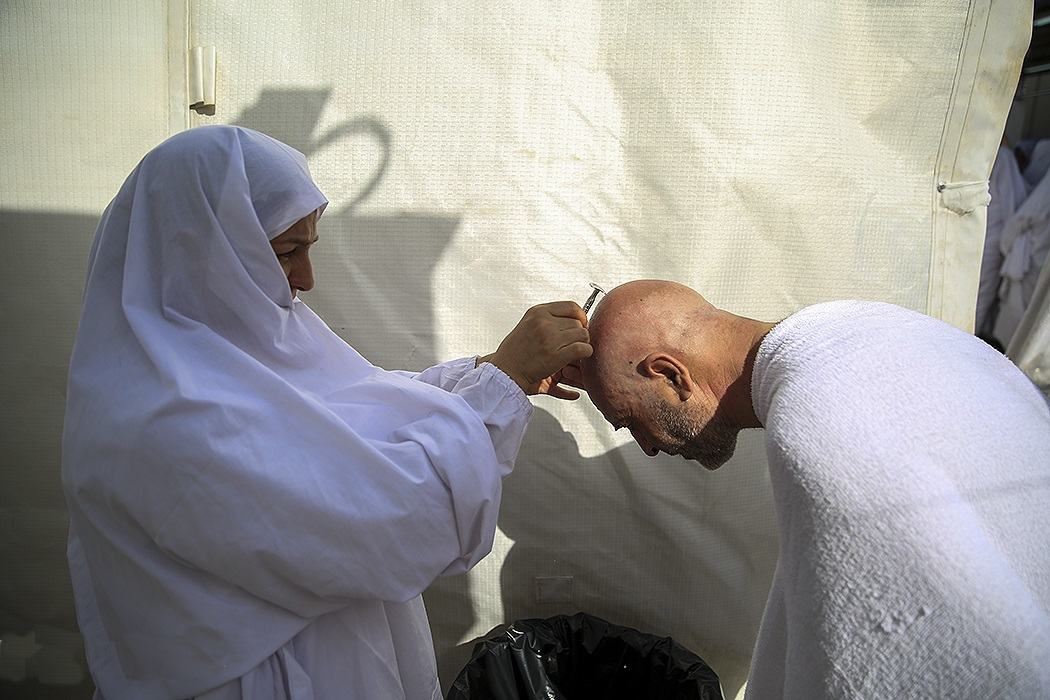
Shaving or cutting the hair (bercukur or bergunting, halq or taqsir) means removing at least three hairs from the head, on these conditions:
- Its time has begun.
- The hair is from the head, not the beard or elsewhere.
- No fewer than three hairs.
Shaving the whole head is best for men; cutting is enough. For women, shaving is not permitted: it is enough for a woman to cut the ends of her hair, the length of one finger joint.
Meaning The Prophet ﷺ prayed three times, "O Allah, have mercy on those who shave their heads," and when the Companions asked, "And those who cut, O Messenger of Allah?", he included them on the fourth. (Reported by al-Bukhari and Muslim.)
When
- Umrah: after tawaf and sa'i have been completed.
- Hajj: from after midnight on the night of the 10th of Dhul Hijjah, once wuquf is behind you. The best time is on the 10th, after stoning Jamrah al-'Aqabah.
Useful details from the course
- Once the time has begun, you may cut your own hair or someone else's, even if they are also in ihram, because removing hair is now part of your worship, not a violation.
- It is better to have your own hair cut first, before cutting anyone else's.
- Women must keep their 'awrah covered while their hair is cut, do it in your room or among women.
- Cutting just the ends of the hair is valid.
- You can do it at your building, it does not have to be at Marwah or Mina.
- A completely bald man should pass a razor over his scalp; this is sunnah.
What tahallul means
Tahallul means releasing yourself from the prohibitions of ihram.
Tahallul of Umrah
Umrah has a single tahallul. Once you have completed tawaf, sa'i and the shaving or cutting, in that order, every prohibition is lifted.
Tahallul of Hajj: the first and the second
Hajj has two stages, built on three acts:
- Ⓐ Stoning Jamrah al-'Aqabah (the large Jamrah) on the 10th.
- Ⓑ Shaving or cutting the hair.
- Ⓒ Tawaf al-Ifadah, together with sa'i, if the sa'i of Hajj has not yet been done.
First tahallul (tahallul awwal): reached after completing any two of the three. Everything forbidden in ihram becomes permitted except three things:
- marriage and anything to do with a marriage contract;
- foreplay;
- sexual intercourse.
So after the first tahallul, men may put on normal clothes and cover their heads, and everyone may use perfume and cut their nails.
Second tahallul (tahallul thani): reached after completing all three. Every prohibition of ihram is lifted.
Where the first tahallul usually happens
| Order you follow | First tahallul is reached… |
|---|---|
| Stone 'Aqabah in Mina → cut the hair (in Mina or anywhere) | in Mina, after the hair |
| Stone 'Aqabah in Mina → Tawaf al-Ifadah and sa'i in Makkah | in Makkah, after sa'i |
| Tawaf al-Ifadah and sa'i in Makkah → cut the hair | in Makkah, after the hair |
Order (tertib) in the pillars
Umrah: order is required in all its pillars, intention, then tawaf, then sa'i, then hair. Cutting the hair before finishing sa'i is a violation of ihram (and incurs dam), not the end of your Umrah.
Hajj: order is required in most of its pillars:
- the intention comes before all the other pillars;
- wuquf comes before Tawaf al-Ifadah (and before the hair);
- tawaf comes before sa'i.
But some pillars may change place:
- Sa'i of Hajj may be performed before wuquf by Ifrad and Qiran pilgrims, after their Tawaf al-Qudum.
- The hair may be cut after wuquf, once its time has begun, before Tawaf al-Ifadah.